Bài viết bên dưới được đăng bằng tiếng Anh. Mọi con số trong đó là con số do chính nhà cung cấp công bố, kèm ngày chúng tôi đọc được.
ChatGPT is the assistant every team already has an opinion on, which makes its pricing the second question more often than the first. What OpenAI prints about that pricing has changed this year: the four tier cards are on the pricing page now, each with a monthly price in the local currency of the reader.
The prices are printed, and the number depends on the country
The ChatGPT pricing page now renders the consumer lineup itself. Free sits at zero and Go, Plus and Pro sit above it, every card reading per month. That sounds like progress, and it is, because until recently the entry price lived on a launch post instead. Then the second sentence answers what the first raised: the page we read this review from printed Go at 132,000 Vietnamese dong a month and Plus at 522,500, because the page chooses the currency by country rather than showing one flat dollar amount.
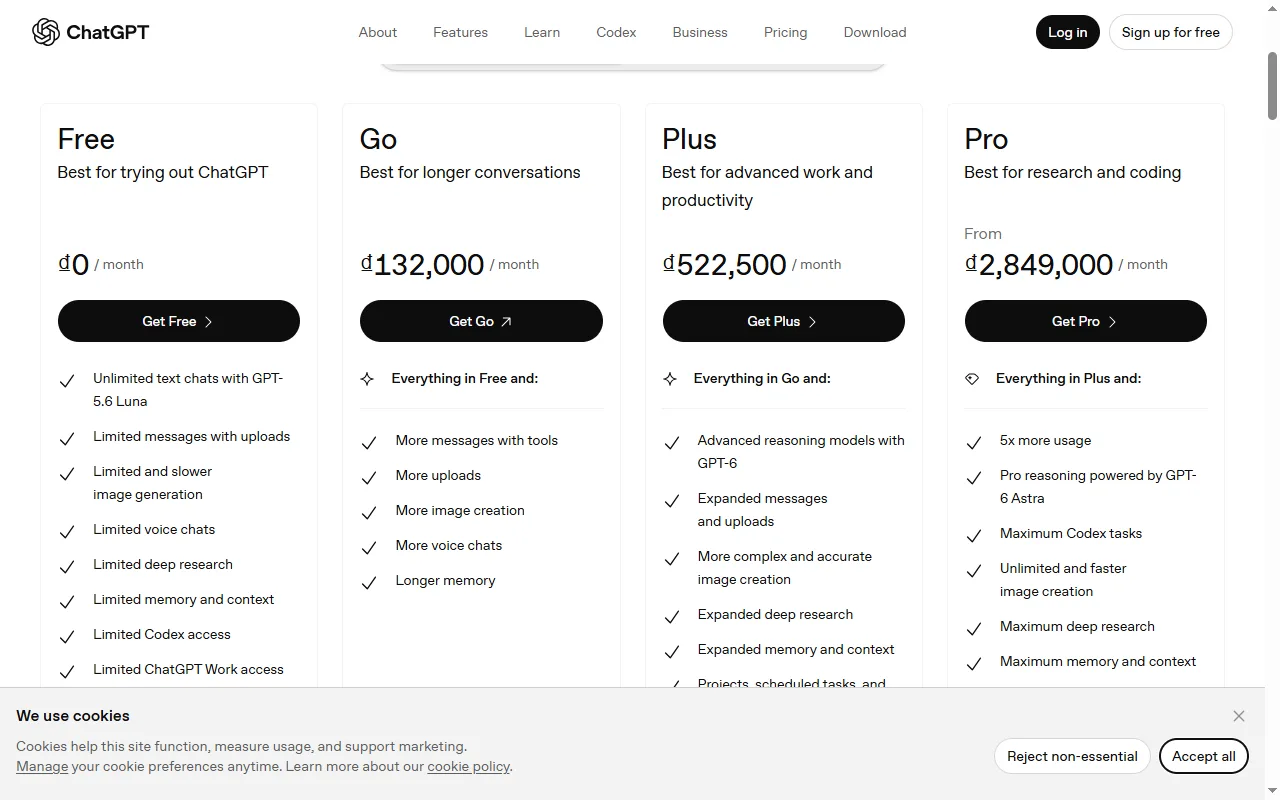
The US figures are stated separately on OpenAI's own documents. The Go launch post names Go at $8 a month, plus an asterisk saying the price displayed is the US one and that Go pricing is localized in some markets. Plus is $20 on the same page, and the Pro tiers article names Pro $100 and Pro $200 by their price. So a buyer in the United States sees Go at $8, Plus at $20, Pro from $100, and a buyer elsewhere sees a different number for the same plan, set by OpenAI in the local currency.
That localization is the reason the entry price at the top of this page carries the country with it. Compare it against Claude's $20 or Gemini's $4.99 and you are comparing a figure OpenAI scopes to one market with figures those two pages do not narrow the same way. The numbers are all real and all dated; they are not all the same kind of claim.
Unlimited means text chats, and Pro is the only tier with message counts
The word unlimited appears throughout the pricing table, and OpenAI's own footnotes pin down exactly what it covers. The Free card says unlimited text chats with GPT-5.6 Luna, and both the pricing page and the Go help article add the guardrail in the same breath: usage remains subject to abuse-prevention safeguards. The feature table then labels everything else with relative words instead: uploads are Limited or Expanded, image generation is Limited or Unlimited, voice is Expanded, data analysis is Limited. None of those rows carries a count.
The single place OpenAI prints message counts is the top of the range. The GPT-5.6 and GPT-6 article names the GPT-6 Pro chat allowance as 50 messages a week on Pro $100 and 200 a week on Pro $200, and the same document says a Pro subscription does not include unlimited use of GPT-6 Pro. The only other numbers on the pricing table are context window figures, which are not the same as an allowance. So on the mid tiers you get access bands and gradient words, no message figure you can turn into a monthly equation.
Large claims need the reading that goes with them
Three statements on the current pricing page deserve the second clause before you act on them. New sign-ups and upgrades to Pro $200 are paused as of September 10, 2026, while existing $200 subscriptions and new or existing $100 subscriptions continue, per the Pro tiers article. Go may include ads, per the Go card and the Go help article. And OpenAI states it does not support annual billing, or paying for several months in advance, on Go, Plus or Pro, which is the whole sentence, not a complaint about it.
The data arrangement is covered by named, dated documents
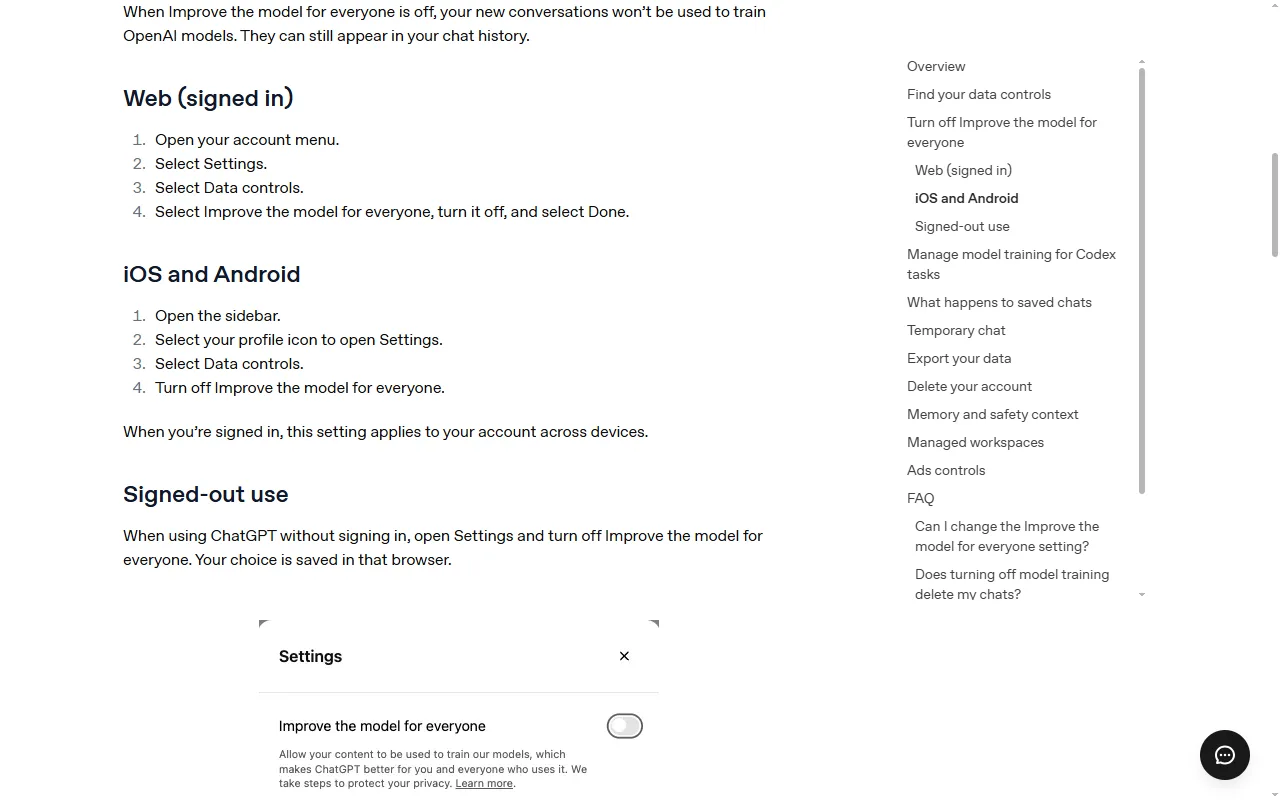
Data controls in ChatGPT is one of the better written privacy documents on this site. The off state is exactly one sentence: when Improve the model for everyone is off, your new conversations will not be used to train OpenAI models. The pricing table labels consumer training Opt-out available on every tier, and the feedback caveat is printed rather than hidden, with the conversation attached to a thumbs down counting as training even after opt-out.
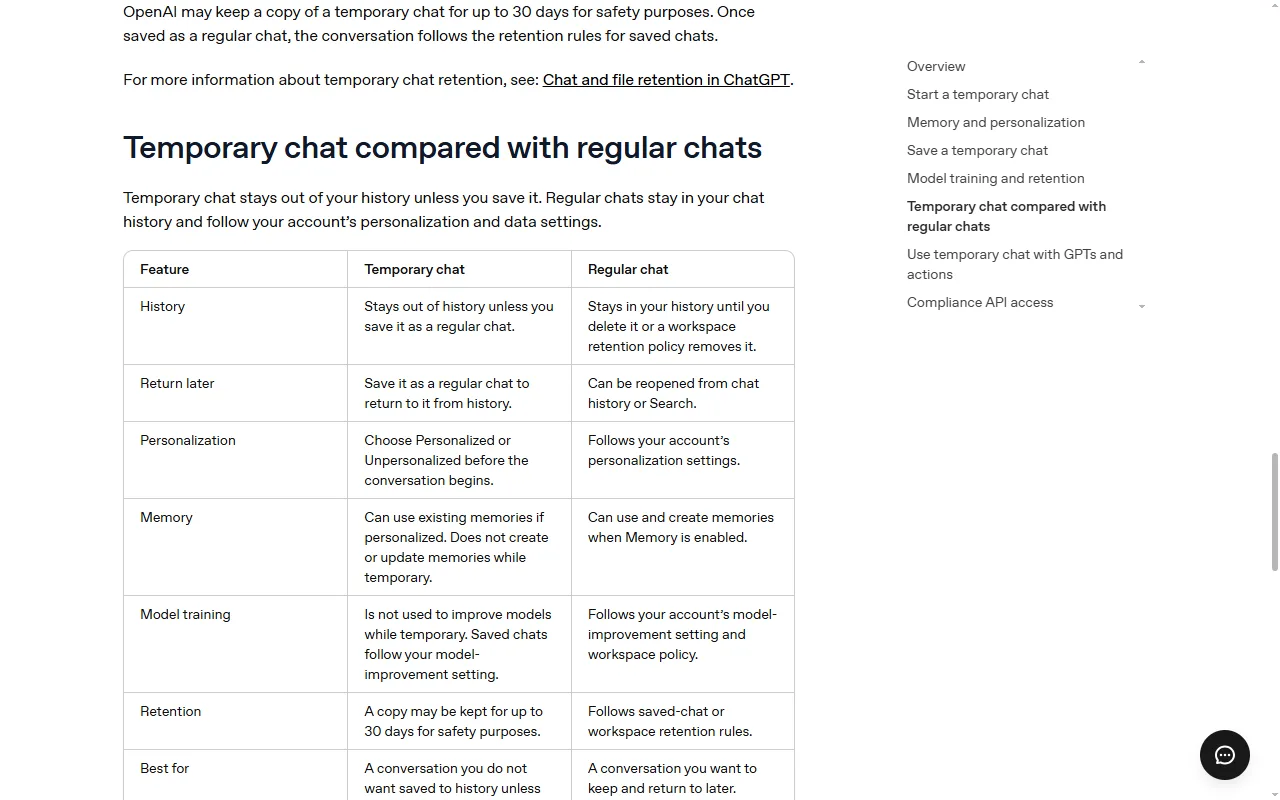
Temporary chats get their own page. They stay out of chat history, are not used to improve models while temporary, can choose personalization on or off up front, and a copy may be retained for up to 30 days for safety purposes. Saving one converts it into a regular chat that then follows the normal settings. Export, deletion and cancellation each have a page with specific numbers: exports on Free, Go, Plus and Pro arrive within up to 7 days and their link lives 24 hours, deleting a chat or an account removes it from OpenAI systems within 30 days, and cancellation runs through the platform you paid on rather than through OpenAI alone.
What the score rests on
The five components and their weights are published on our methodology page. This is what this review put under each of them rather than a number with nothing behind it.
Fit for the stated job, 30 percent. This category is the general assistant, and ChatGPT is nearly the whole of it in one subscription: a chat product, apps, memory, research, image and voice features, with a tier for almost every buyer. That is the broadest fit of the three assistants we compare.
Cost to get started, 25 percent. A stated free tier with the vendor's own literal phrase unlimited text chats, and an entry price of $8 that is the lowest paid plan of the three here. Held back by the structure of the number itself: it is a country-localized figure, it does not exist as an annual rate, and the card stops telling you what the next month costs the moment you leave text chats.
What the vendor commits to, 20 percent. The opt-out, the temporary chat behavior, the export and deletion timeframes and the cancellation rules are all written down, dated and specific, which is rare. The pause on Pro $200 sign-ups and the ads-in-Go clause are both stated conditions on the current offer rather than defects, but they are conditions.
Portability, 15 percent. Chat migration has a published shape: export within 7 days, deletion within 30, cancellation through the paying platform, one account across devices. The portability cost is that none of the mid tiers gives you a numeric allowance to compare before you switch, so moving between plans is an experiment.
Documentation quality, 10 percent. The help center answers the follow-up questions in writing, named and dated, from the Pro tiers FAQ to the temporary chat comparison table. The gap is that the two things a budget needs most, an annual rate and a mid-tier message count, are stated as absent while everything else is explained.
Weighted at those weights, the total comes to 8.0.
What we could not settle
There is no output quality score here, because we did not measure it and we have not found an independent benchmark of general assistant output we would be willing to rank on this review. There is also no public figure for the size of a Go or Plus message allowance, because OpenAI does not print one, and the only enumerated counts are the Pro-model allowances where the price has already tripled. Publishing a number to fill either gap would be worth less than the empty space.
Claude and Gemini are the other assistants in this category, and the three-assistant entry price ranking reads their cheapest paid plans side by side. The ChatGPT tool profile carries the same figures with the same dates.