L'article ci-dessous est publié en anglais. Chaque chiffre qu'il contient est le chiffre publié par l'éditeur lui-même, avec la date à laquelle nous l'avons lu.
Claude prices its consumer tiers in plain dollars and describes their usage allowance relative to one another rather than as a count. The number a buyer usually needs second, the size of the included usage, is the one Anthropic does not print.
The prices are the easy part
Anthropic's pricing page and help articles answer the price question in one sentence each. Pro is $20 a month in the United States (monthly pricing varies by region), with an annual option billed once yearly at a lower rate, shown as $17 a month with $200 billed up front. Free is $0 and the card says it is for everyone. Above Pro, Max starts at $100 a month for 5x and reaches $200 for 20x, and both Max tiers are monthly only.
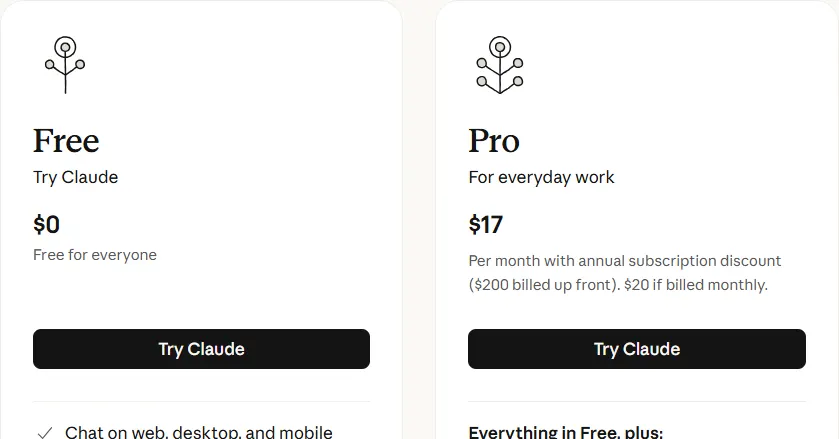
None of that needs reconstructing. Unlike the Cursor review, where the number on the card was the seat and the usage was pooled elsewhere, Claude prints the price and then turns to describing usage on a relative scale. The figure you commit to is unambiguous. The figure you cannot get is the allowance.
The usage is relative, and the window is five hours
The pricing FAQ states the usage model in one paragraph. Every plan has usage limits that reset on a rolling five-hour session window, and paid plans add weekly limits on top. Your activity across Claude on web, desktop, mobile and Claude Code draws from the same pool. And then the sentence that decides how budgetable this is: there is no fixed message count. Free covers everyday questions, Pro gives at least 5x more usage per five-hour session than Free, and Max gives 5x or 20x more than Pro.
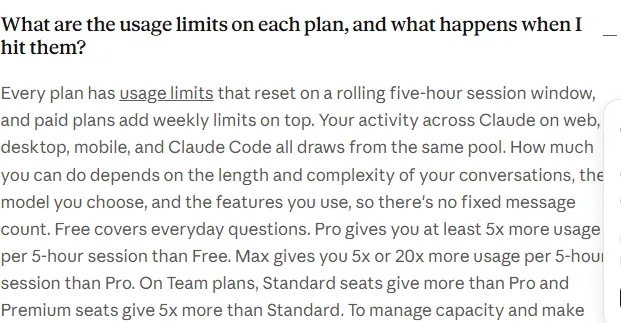
That is a scale, not a number. Knowing that Pro is five times Free does not tell you what Free starts from, because Free's own allowance is not published either. The help articles are explicit about the mechanism: message limits vary with message length, attached file length, conversation length and the model or feature used, and the vendor reserves the right to limit usage in other ways at its discretion. A weekly limit exists on paid plans and resets at a fixed time assigned to the account, which you can see in Settings under Usage. What you cannot see anywhere is the size of that weekly allowance in messages or sessions.
That is the honest summary of the whole page: predictable pricing, described usage. The trade-off is that the weekly limit is a real price of the plan that only becomes knowable after you live on it.
The escape hatch is usage credits
For the moment a session limit does arrive, Pro and Max have a written path past it. Usage credits switch you to pay-as-you-go pricing at standard API rates after the included usage runs out, with a monthly spend limit you set, prepaid funds or auto-reload. That is the same shape as the Cursor overage model: the overage rate is stated instead of hidden, and the default is that nothing extra happens until you enable it.
What the credits do not solve is the budgeting problem. The standard API rates are published on the pricing page, but the amount of usage a mode really consumes depends on the model, the effort level and the length of your work, so predicting a month of credits before spending is close to guessing. The credits make the transaction legible, not the consumption.
The data arrangement is written down, dated and optional
Anthropic's consumer privacy articles give a consumer a plain statement of when their chats may be used to improve models. On the pricing page's feature matrix, model training on Free, Pro and Max is labelled Opt-out, which means a consumer account is included unless the setting is turned off in the privacy controls. The privacy article lists the specific cases where chats and coding sessions are used regardless: when the improvement setting is left on, when a conversation is flagged for safety review, or when the user explicitly opts in through a program. Incognito chats are not used to improve Claude even with the setting on. Deleting a conversation removes it from your history immediately and from backend storage within 30 days, with the stated exceptions for legal hold and Usage Policy flags.
That is a stated arrangement rather than a rumor: the consumer state is opt-out, the exceptions are named in the same documents as the rule, and the Team and Enterprise tiers differ, with training labelled off by default there. We have not verified what happens inside a safety-review pipeline, because no vendor publishes that. What the pages commit to, and label, is what the review rests on.
What the score rests on
Fit for the stated job, 30 percent. This is the whole of the general-assistant category: a single subscription that powers a chat product, a coding agent, and the surface you already use. The fit is broad rather than narrow, which is what the category asks for.
Cost to get started, 25 percent. A real free tier at zero dollars, an entry price printed plainly, and an annual option stated in the same sentence. Held back by the absent allowance figure, which moves the real cost question to after you subscribe.
What the vendor commits to, 20 percent. The written model-improvement arrangement with its exceptions, the deletion path, and usage credits with published overage rates keep this component strong. Deducted for the reserve power to adjust usage limits at its discretion, which is a real and stated limitation.
Portability, 15 percent. Conversations can be deleted immediately from history and within 30 days from backend storage, and the assistant is accessible across web, mobile, desktop and Claude Code from one account. The portability cost is the absence of a published message budget, which makes moving between plans an experiment rather than an arithmetic choice.
Documentation quality, 10 percent. The help and privacy articles answer the follow-up questions in writing, dated, with the edge cases named. The gap is that the one number a budget needs is published nowhere.
Weighted, that comes to 8.1.
What we could not settle
There is no output quality score here, because we did not measure it and we did not find an independent benchmark of general assistant quality we would be willing to rank on this review. There is also no figure for the size of any plan's usage allowance, in messages or sessions, because Anthropic publishes the allowance as a multiple of another tier and not as a count. Publishing a number to fill either row would be worth less than the empty space.
ChatGPT and Gemini are the other assistants in this category, and the three-assistant ranking reads their entry prices side by side. The Claude tool profile carries the same figures with the same dates, and the comparison with Gemini is where the two subscriptions are set next to each other.