L'article ci-dessous est publié en anglais. Chaque chiffre qu'il contient est le chiffre publié par l'éditeur lui-même, avec la date à laquelle nous l'avons lu.
Gemini is Google's consumer assistant, sold as Google AI plans, and the cheapest paid entry among the three assistants this site ranks on its chatbot page. The price is the easy part to verify. The question that decides the purchase is what happens to the chats, and Google's answer depends on a setting and on which product you are using.
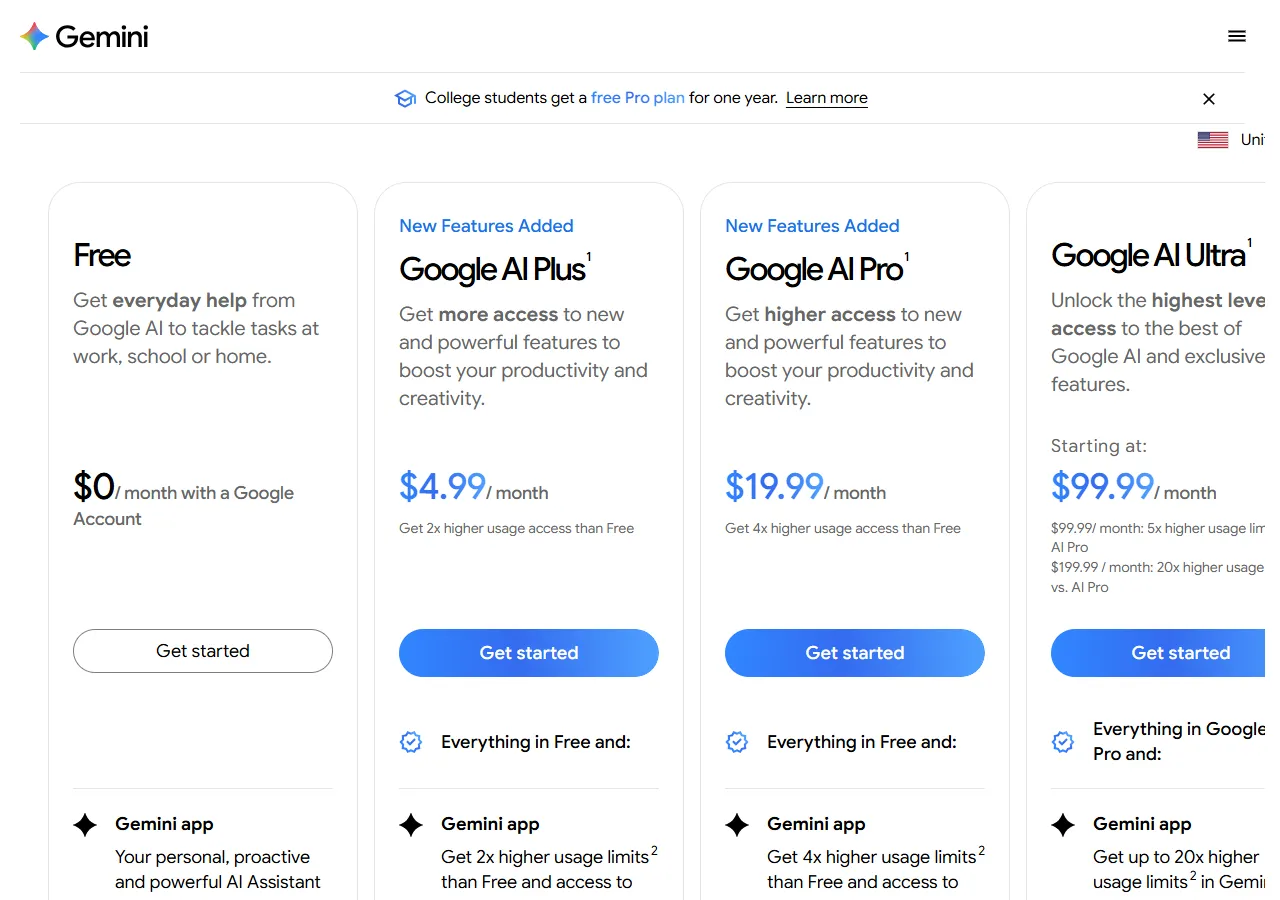
The prices are four cards on one page
The US about page prints the whole consumer line in one place. Free is $0 a month with a Google Account. Google AI Plus is $4.99, Pro is $19.99, and Ultra starts at $99.99 for 5x Pro or $199.99 for 20x Pro. Every card carries the monthly figure, and none of the cards mentions an annual rate; this review did not find one in the page's raw HTML, and a page's silence on annual billing is not the same as a no.
The name on the cards is worth reading before the price. These are Google AI plans, and Gemini access is what they carry. The profile for Gemini calls this out, and the Claude vs Gemini comparison reads the naming difference as a buying fact: one of the two entry prices is already a bundle.
The entry figure is the lowest of the three chatbots ranked on the ranking page: $4.99 against Claude's $20 and ChatGPT's $8, both US figures on their own pages. That comparison is scoped to the three tools that page ranks, and it is a statement about printed entry prices, not about what each dollar buys.
What a paid plan buys is a multiple, not a count
No card on the about page prints a message count or a numeric allowance. Instead, the pricing mechanism is a multiplier: Plus gives 2x the usage of Free, Pro gives 4x, and Ultra gives 5x or 20x the usage of Pro. The help article that explains the system puts the same table in words: without a plan you get standard limits, AI Plus gives 2x higher than standard, AI Pro 4x, and AI Ultra 5x or 20x higher than AI Pro depending on the subscription.
The limits themselves are compute-based. The help article states that usage factors in the complexity of your prompt, the features you use, and the length of your chat, that limits refresh every five hours until you reach a weekly limit, and that the changes took effect for users over 18 on May 17, 2026, and for users under 18 on July 24, 2026. Paid users have higher limits than users without a subscription, and premium features like media generation and Deep Research consume more.
What the page does not print is the size of the standard limit that everything multiplies from. A buyer cannot translate 2x Free into a monthly budget without knowing what Free is. AI credits extend limits during a month, and the article says they can be purchased, but the price per credit is not on the pages this review read. These two absences are the reason the fit score below is not higher: the pricing mechanism is legible, and the unit it multiplies is not.
The training answer is a setting, and it is written down
The Gemini Apps Privacy Hub, last updated September 24, 2026, answers the training question in plain language, and the answer has two branches.
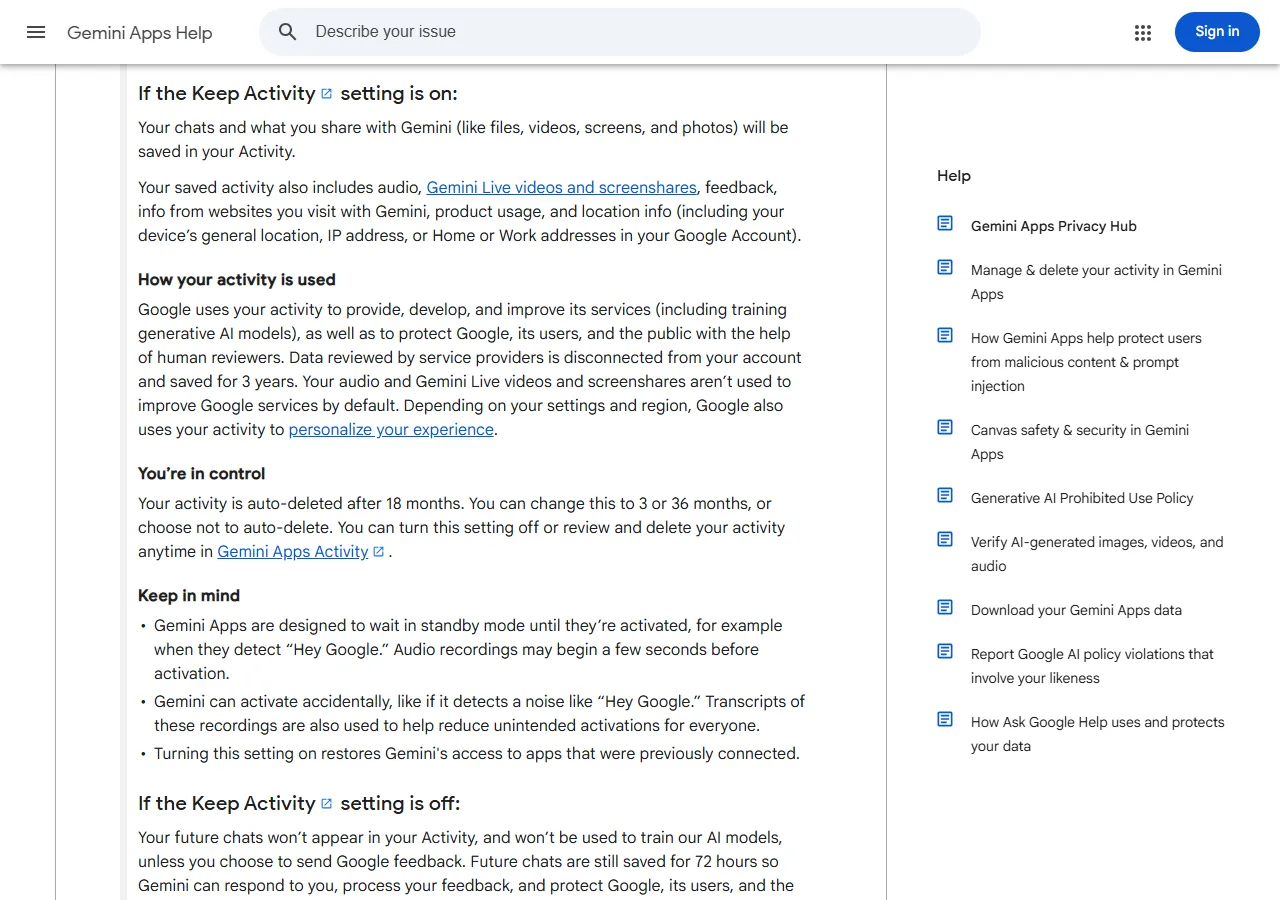
With Keep Activity on, your chats and everything you share with Gemini are saved in your Activity, and Google uses that activity to provide, develop and improve its services, including training generative AI models, with the help of human reviewers. The document names the human role precisely: a subset of chats are reviewed by human reviewers, including Google's trained service providers, to improve Google services, and reviewed chats are retained for up to three years.
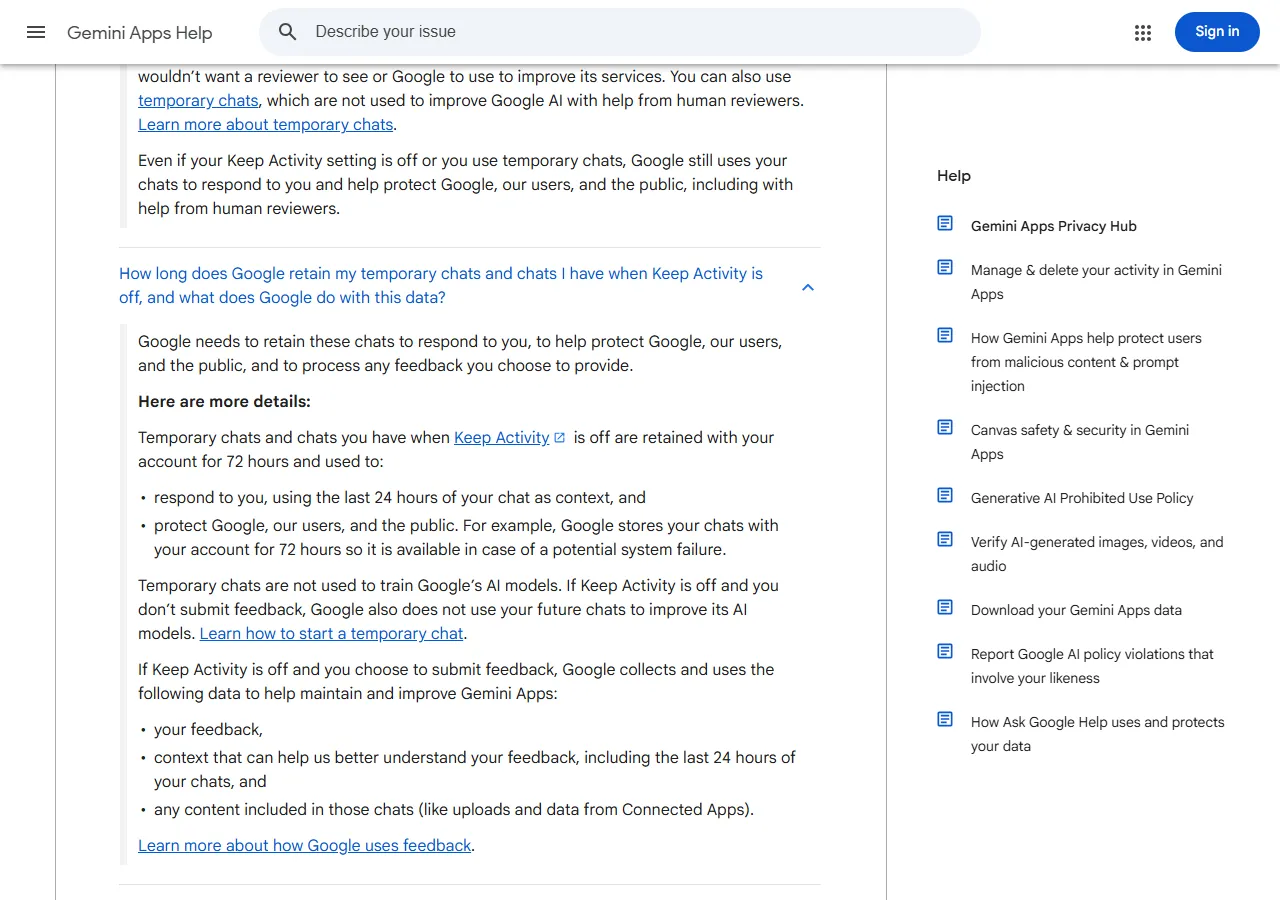
With Keep Activity off, the statement is the mirror: future chats are not used to improve Google's AI models, unless you submit feedback. Temporary chats are not used to train Google's models at all. There is a third line that matters: even with the setting off, chats are still retained for 72 hours to respond to you and to help protect Google, its users and the public, including with help from human reviewers. Turning the setting off does not remove every use of the chat, and the document says so in the same answer.
Retention: 18 months is the default, three years survives deletion
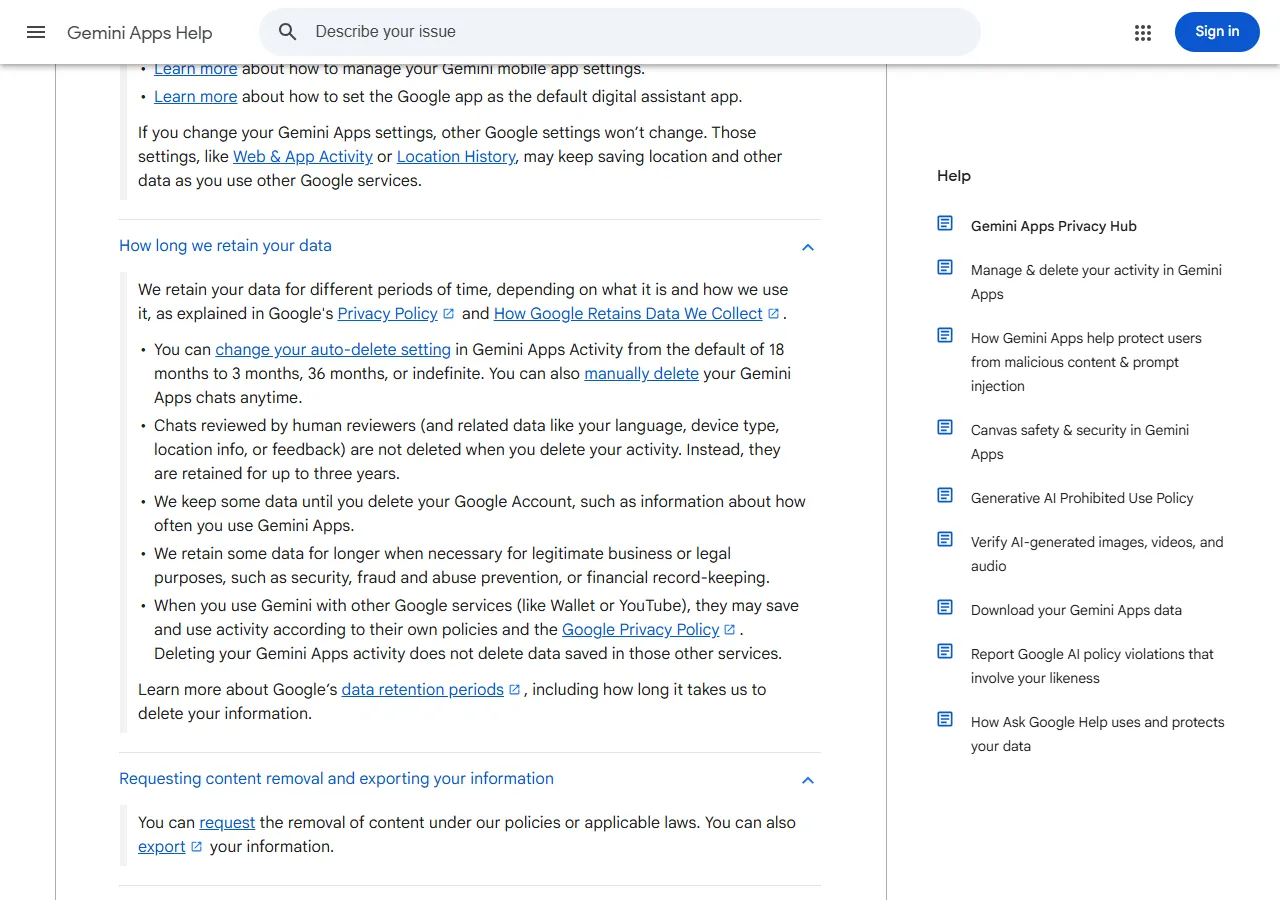
Activity is auto-deleted after 18 months by default, and you can change that to 3 or 36 months, or choose no auto-delete. You can also delete your chats manually at any time. The sharp edge is the reviewed-chat clause: chats reviewed by human reviewers, and related data like your language, device type and location, are not deleted when you delete your activity, and are retained for up to three years, disconnected from your account.
That is the portability story of this product in two lines. You can delete and you can export, and the deletion is not complete for the subset that entered human review. The review scores portability down for exactly that reason: the export statement exists, and the delete statement carries an exception.
The Workspace boundary is a different product with a different answer
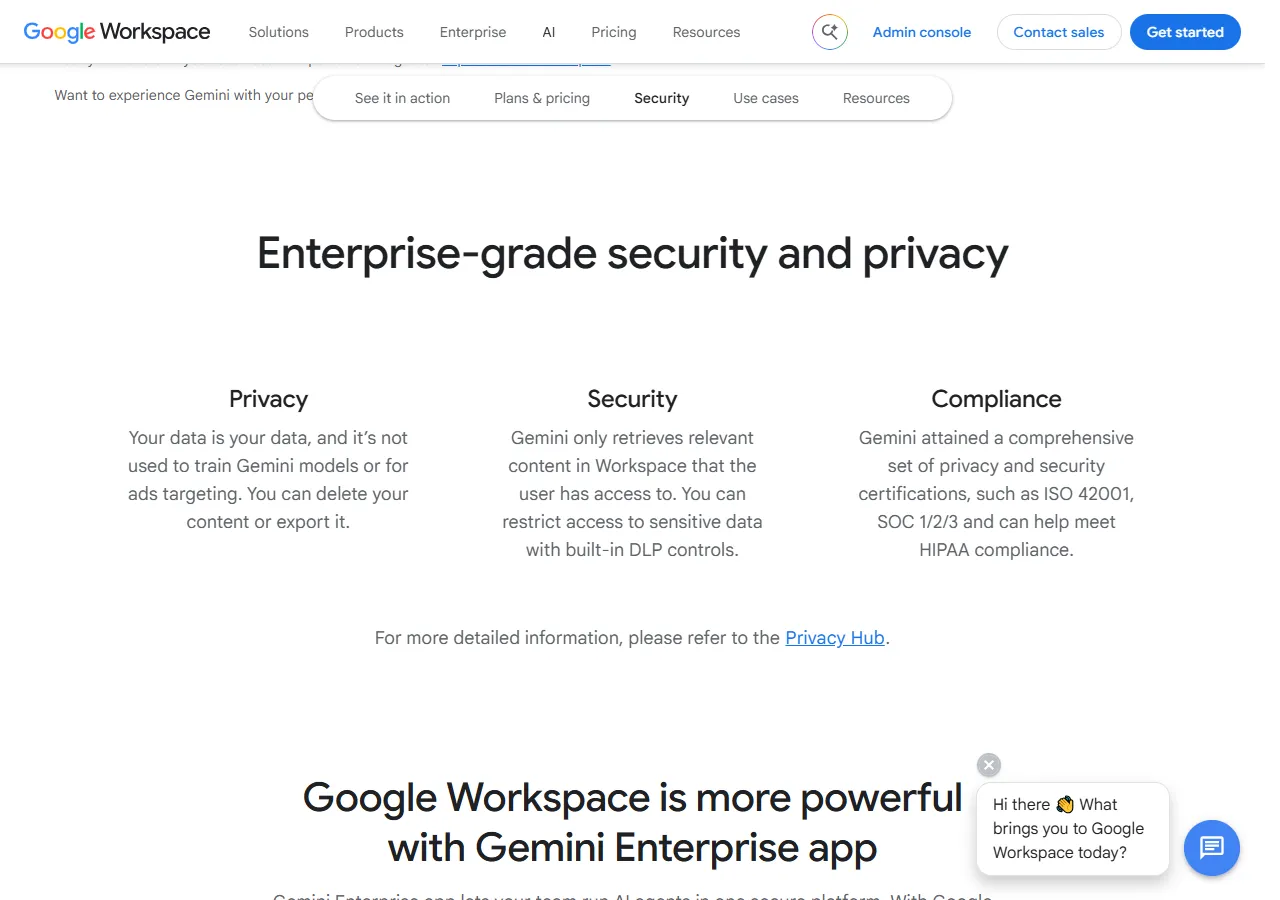
For Workspace organizational data, Google publishes a different boundary, on its own business page: an organization's data in Workspace is its data, and is not used to train or improve Gemini models or for ads targeting, and Gemini only retrieves relevant content the user has access to. The Privacy Hub itself points work or school accounts to the generative AI in Workspace Privacy Hub, with different data handling terms.
This split is the reason the verdict for Gemini is not a single sentence about privacy. For a personal account, the training answer is Keep Activity on or off, and it is written in one document with a date. For organization data in Workspace, Google publishes a no-training boundary on its own business page. A buyer who will use both should read both documents, because the two are not the same claim.
What the score rests on
The five components and their weights are published on our methodology page, so here is what this review put under each of them.
Fit for the stated job, 30 percent. Gemini is a broad general assistant: everyday chat, image generation, video generation, Deep Research, Live, Canvas, Gems and Notebook all sit behind one subscription. It loses ground because the paid tiers price in usage multiples rather than in a count, so a buyer cannot map 2x Free onto their own pattern without knowing what Free's limit is.
Cost to get started, 25 percent. The entry price is legible and dated: $4.99 for Google AI Plus and $0 for Free, both on the US page, and the lowest printed paid-entry price of the three assistants ranked on this site's chatbot page. Held back by the two unprinted figures: the size of the standard limit, and the price of AI credits.
What the vendor commits to, 20 percent. A dated privacy document that answers the training question in two explicit branches, a dated help article with effective dates for the usage changes, a configured retention default, and a Workspace boundary that is stated separately and is materially stricter for organizations.
Portability, 15 percent. Export is stated on both the Privacy Hub and the Workspace page, and deletion is possible from Activity at any time. Docked because deletion does not remove chats that entered human review, and because no conversation-level export format is documented on the pages read.
Documentation quality, 10 percent. The Privacy Hub is dated, comprehensive, and answers the exact questions a buyer asks, including the reviewer question and the retention question. The help article on limits is dated with effective dates. Docked because the one number a budget needs, the size of the standard limit, is not printed anywhere we read.
Weighted at the published weights, that comes to 7.8.
What we could not settle
There is no output-quality score here. We do not run these models against each other on the same prompts and score the answers, and we have not found an independent benchmark we would be willing to rank on, so nothing here compares Gemini's answers with ChatGPT's or Claude's. There is also no figure for the size of the Free allowance, the price of AI credits, or any annual rate, because none of the three is printed on the pages this review read. Each absence is stated as an absence, not as a no.
The Gemini tool profile carries the same figures with the same dates, the AI chatbot ranking reads the three entry prices side by side, the Claude vs Gemini comparison reads the naming difference head to head, and AI chatbots is the category hub. The ChatGPT review and the Claude review read the other two entry prices in this category.