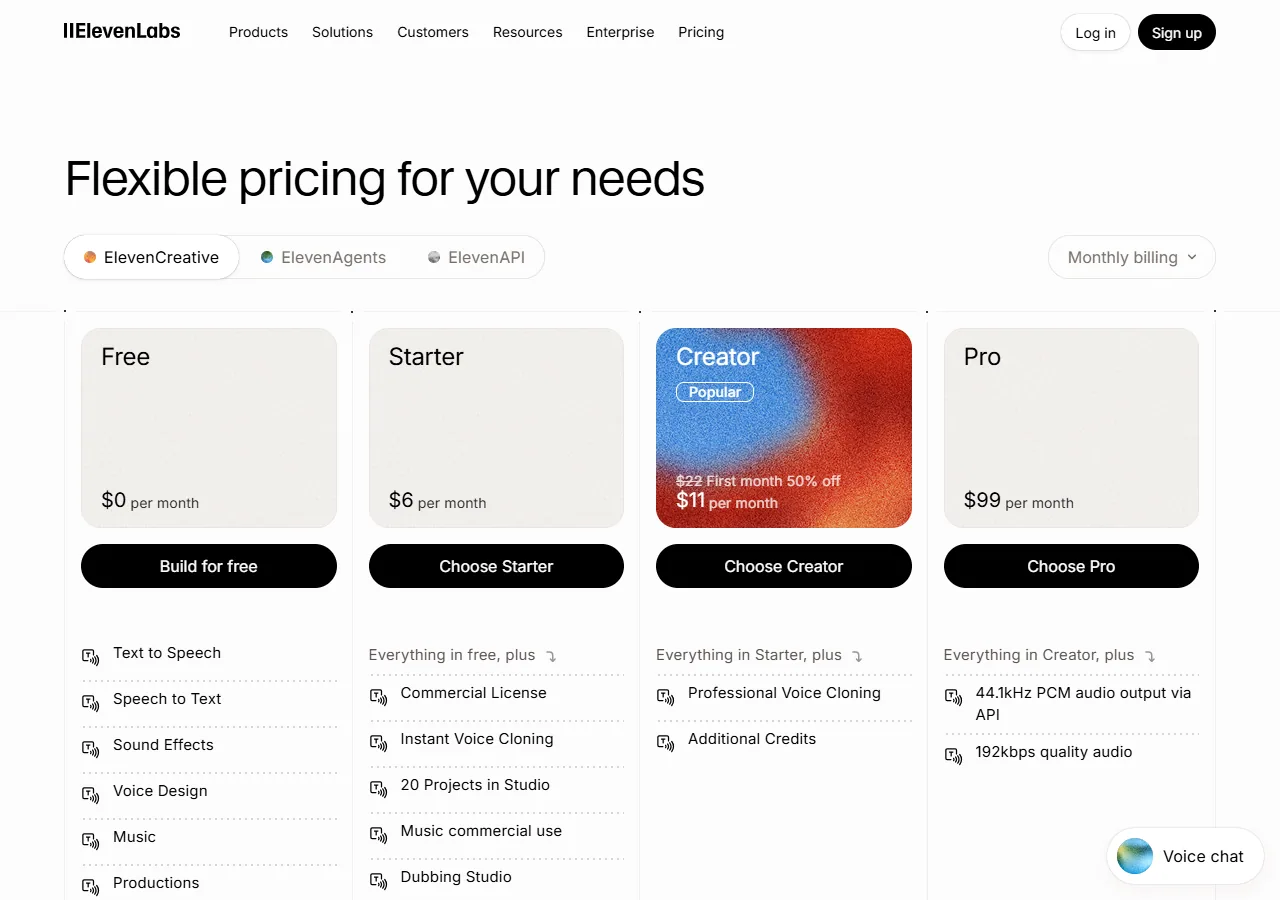
Pricing cards: Free at $0, Starter at $6 with Commercial License, Creator at $11 first month, Pro at $99ElevenLabs pricing page · Captured 25 thg 9 2026
Teams who need synthetic speech over material they already have, and who expect to be paying for it rather than evaluating on the free plan.
Không hợp với
Anyone planning to ship a commercial deliverable from the free tier. The Prohibited Use Policy rules that out in writing, whatever the credit balance says.
A vendor that prints the price and the allowance in one sentence, and a free tier its own policy bars you from using for work.
Hợp nhất với
Teams who need synthetic speech over material they already have, and who expect to be paying for it rather than evaluating on the free plan.
Không hợp với
Anyone planning to ship a commercial deliverable from the free tier. The Prohibited Use Policy rules that out in writing, whatever the credit balance says.
Chúng tôi có thể nhận hoa hồng nếu bạn đăng ký qua liên kết này. Điều đó không bao giờ làm đổi một điểm số hay một thứ hạng. Đọc công bố.
The pricing page answers what six dollars buys in one sentence, so the figure and the allowance never have to be reconstructed from a feature table
The limits that decide whether you may use the output are published in writing, dated, and in a document you can read before you spend anything
A public REST API with a runnable example printed on the API reference page, where the words contact sales, talk to sales and request a demo appear zero times
Điểm cần cân nhắc
The free tier cannot be used for a commercial purpose, so the allowance you can plan a deliverable around starts at the paid step
The rule that decides that is in the Terms of Use but not on the pricing page, so a buyer reading the pricing page learns the allowance and not the boundary
The Terms of Use we read never uses the word clone, so a buyer searching the obvious document for the voice rules finds nothing there
01Nhà cung cấp công bố những gì
Đọc từ chính các trang của nhà cung cấp vào những ngày liệt kê ở cuối trang này. Chỗ nào không tìm thấy con số nào được công bố, dòng đó vắng mặt thay vì được đoán ra.
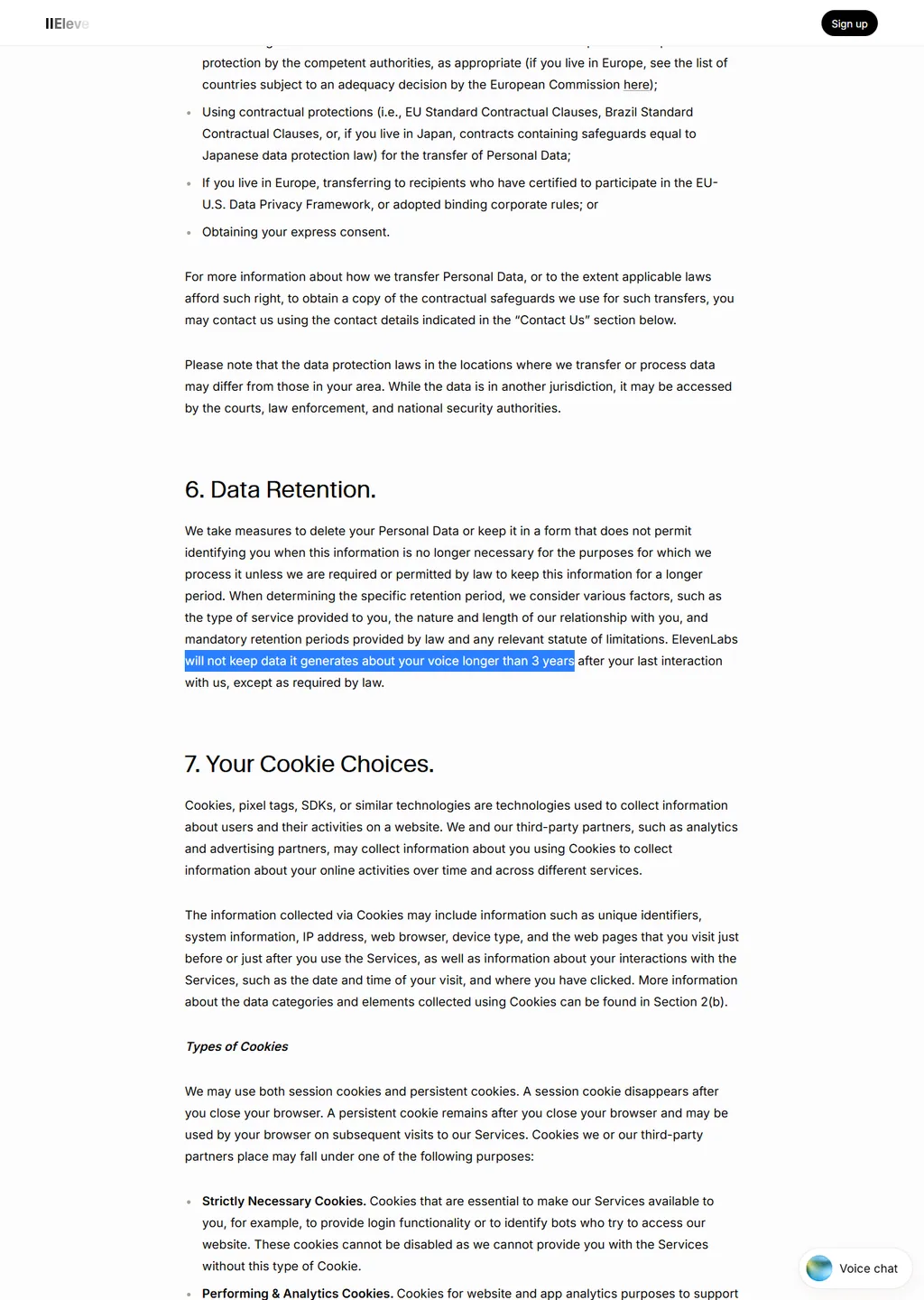
ElevenLabs will not keep data it generates about your voice longer than 3 years after your last interaction with us, except as required by law10
Training opt-out
You may opt out of our use of your Personal Data for training at any time, in the Data use menu11
Zero retention mode
Zero retention may only be used by enterprise customers12
Free user non-commercial boundary
A free user may only use the Services for non-commercial purposes; a paid user may use them for commercial purposes, both subject to the Prohibited Use Policy13
Rights to Input and Output
As between you and ElevenLabs, you retain all rights in and to your Input and your Output14
License to User Voice Models
To the extent you own or acquire any intellectual property rights in or to any User Voice Models, you grant ElevenLabs a perpetual, irrevocable, nonexclusive, royalty-free, worldwide, sub-licensable license15
Bài viết bên dưới được đăng bằng tiếng Anh. Mọi con số trong đó là con số do chính nhà cung cấp công bố, kèm ngày chúng tôi đọc được.
ElevenLabs sells synthetic speech, and its pricing page does something most pricing pages do not: it prints the price and the allowance in the same sentence. The rule that decides whether you may use the result is somewhere else.
Most pricing pages give you a figure in one place and an allowance in another, and leave the arithmetic to you. ElevenLabs answers both at once, in a question near the foot of its pricing page: the free plan is $0/mo, 10,000 credits, and the first paid step is $6/mo, Starter, carrying 30,000 credits. The same answer adds that Starter includes a Commercial License, Instant Voice Cloning and Music commercial use on top of everything in the free plan.
That is worth more than it sounds. A price for generated audio means very little without the allowance attached to it, because the same dollar buys different amounts of work depending on what the vendor counts. Reading an AI pricing page is mostly about reconstructing that relationship from two places on one screen. Here there is nothing to reconstruct.
What a credit converts into is the next question, and the same page answers it per tier rather than globally: the minutes of speech a credit yields move with the audio quality you ask for. So the step from one figure to the other is three times the credits for six dollars, and that is a ratio of credits rather than of finished minutes. Our profile of ElevenLabs sets the same figures beside the rest of what the vendor publishes.
The same FAQ answers what happens to credits you do not spend. On a paid plan, unused credits roll over for up to two months, to at most three times your monthly quota, while you stay subscribed. Downgrade or cancel, and the policy is one sentence: unused credits are forfeited at the end of the cycle. Rollover does not apply to the free plan at all. For a buyer, that converts the credit balance from a number that resets monthly into a number that survives a quiet month and not a cancellation, which changes how much allowance a paused subscription is really keeping.
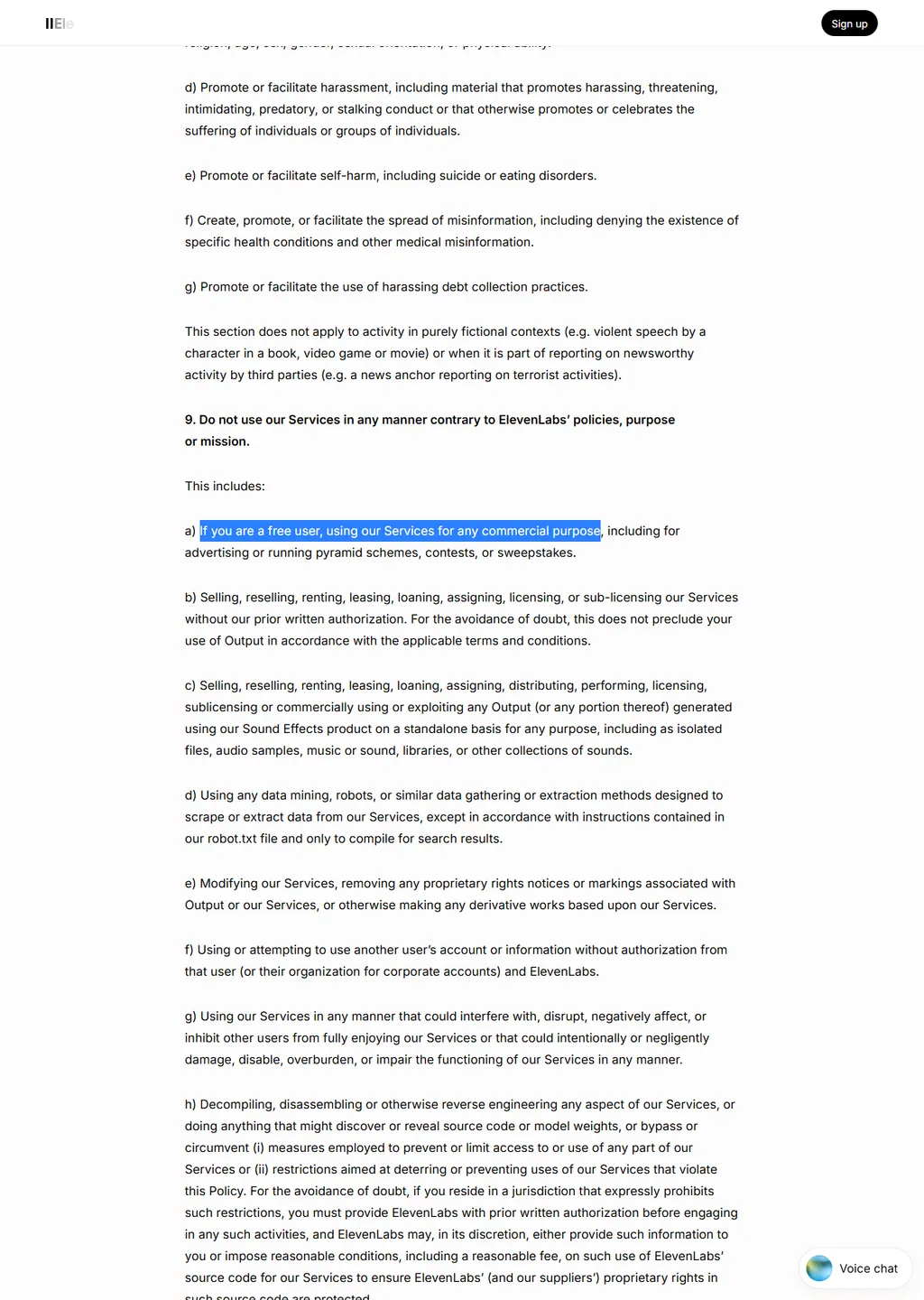
The free plan's 10,000 credits are not a smaller version of the paid one. The boundary is in the Terms of Use before it is anywhere else: section 1(c) says a free user may use the Services for non-commercial purposes only, a paid user may use them for commercial purposes, and both stay subject to the Prohibited Use Policy. The same boundary is repeated in the Prohibited Use Policy, dated in its own text, and section 9 spells out what it excludes in a list that opens: "If you are a free user, using our Services for any commercial purpose, including for advertising or running pyramid schemes, contests, or sweepstakes."
Evidence · ElevenLabs Prohibited Use Policy, section 9 · Prohibited Use Policy section 9: a free user may not use the Services for any commercial purpose · Captured 25 thg 9 2026
Read that against what a free tier is normally for. Our own note on free tiers argues that the allowance is a budget to spend on the version you would actually ship, and to put that in front of whoever signs it off. That note was written about the video products in our ranking, and this is the case it does not cover: here the vendor's policy bars a free user from shipping the result at all.
So the free plan answers a narrower question than its credit balance suggests. It can tell you whether the voices sound right, whether pronunciation holds on your own script, and whether the API behaves. It cannot produce the deliverable, because the terms you accepted on the way in say it may not be used for one.
None of that is hidden. It appears twice, in section 1(c) of the Terms of Use and in section 9 of the Prohibited Use Policy, and it is readable before you spend anything. It is simply not written where you would go looking for it first: the pricing page prints the allowance and not the boundary.
If you want to know whether you may replicate a colleague's voice, the document to open is not the one called Terms of Use. We read the whole of that document on the day this page was last updated, and the word clone appears in it zero times. So does the word consent.
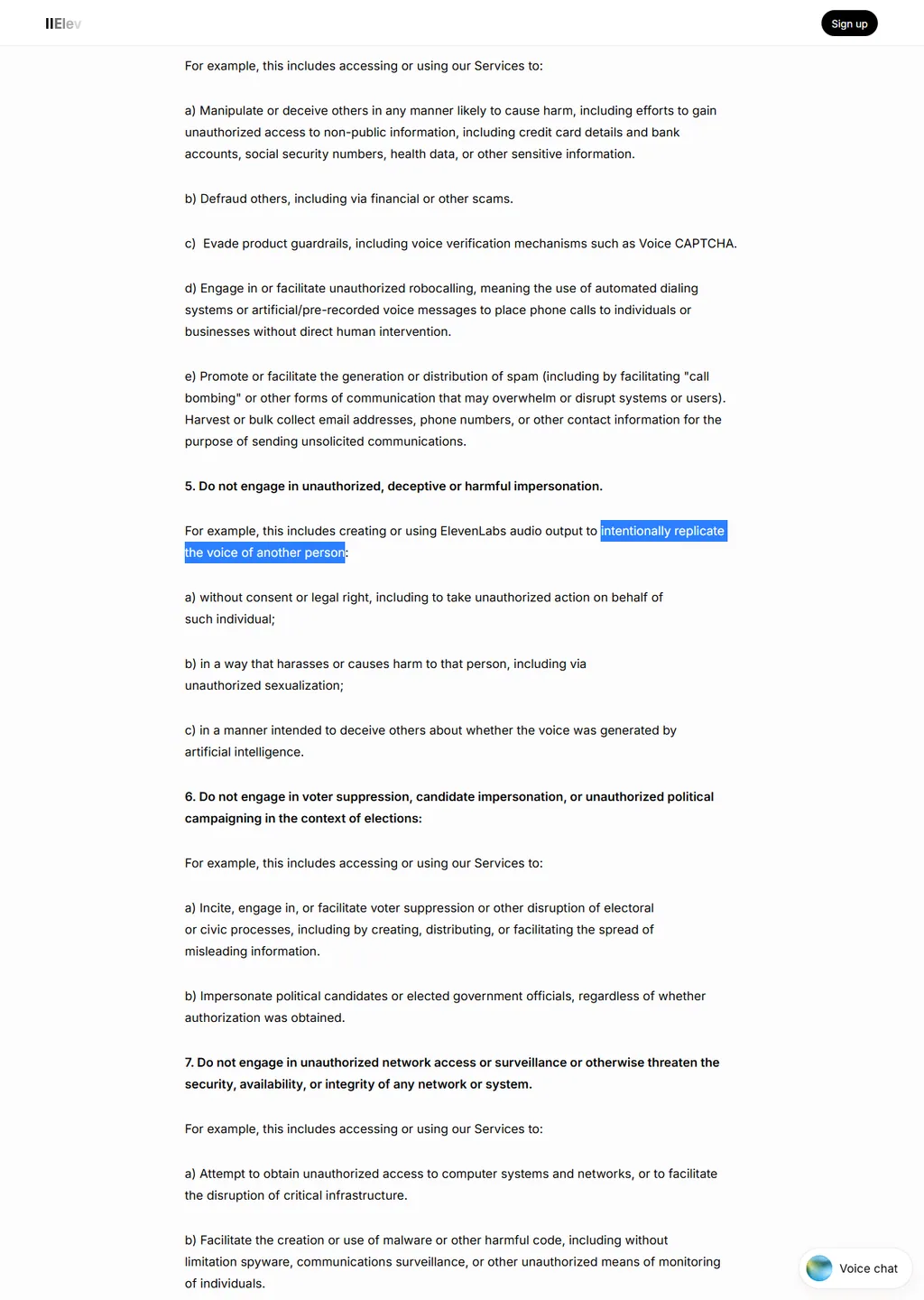
The rule exists, and it is clear. It is in the Prohibited Use Policy, and it is worded as replication rather than cloning: creating or using output "to intentionally replicate the voice of another person: a) without consent or legal right, including to take unauthorized action on behalf of such individual".
Evidence · ElevenLabs Prohibited Use Policy, section 5 · Prohibited Use Policy sections 5 and 6: replicating a voice requires consent or legal right · Captured 25 thg 9 2026
That is a statement about two documents we opened, not a claim about the company. ElevenLabs plainly does use the word cloning, because Voice Cloning is the name of a product in its own navigation. What can be said is narrower and more useful than a verdict on the vendor: a buyer who searches the Terms of Use for the voice rules finds nothing there, because the rules live in another document and under another word.
The Terms of Use do settle the ownership question in the other direction, and they keep it separate from the license question. Section 4(c) states that as between you and ElevenLabs, you retain all rights in and to your Input and your Output. Section 4(d) then grants ElevenLabs a license to use your Content to provide and improve the Services and to develop new services and products. Those two sit side by side: ownership stays with you, and the license is a permission you grant, not a transfer of what you own.
For a voice in particular, section 4(e) adds a third step. To the extent you own or acquire any intellectual property rights in or to a User Voice Model, you grant ElevenLabs a license to that model that is perpetual, irrevocable, nonexclusive, royalty-free, worldwide and sub-licensable through multiple tiers. The qualifier that opens the sentence matters: the license is measured by what you own, not the other way around. It is the counterpart to the consent clause, and it means the ownership sentence and the license coexist rather than cancel each other.
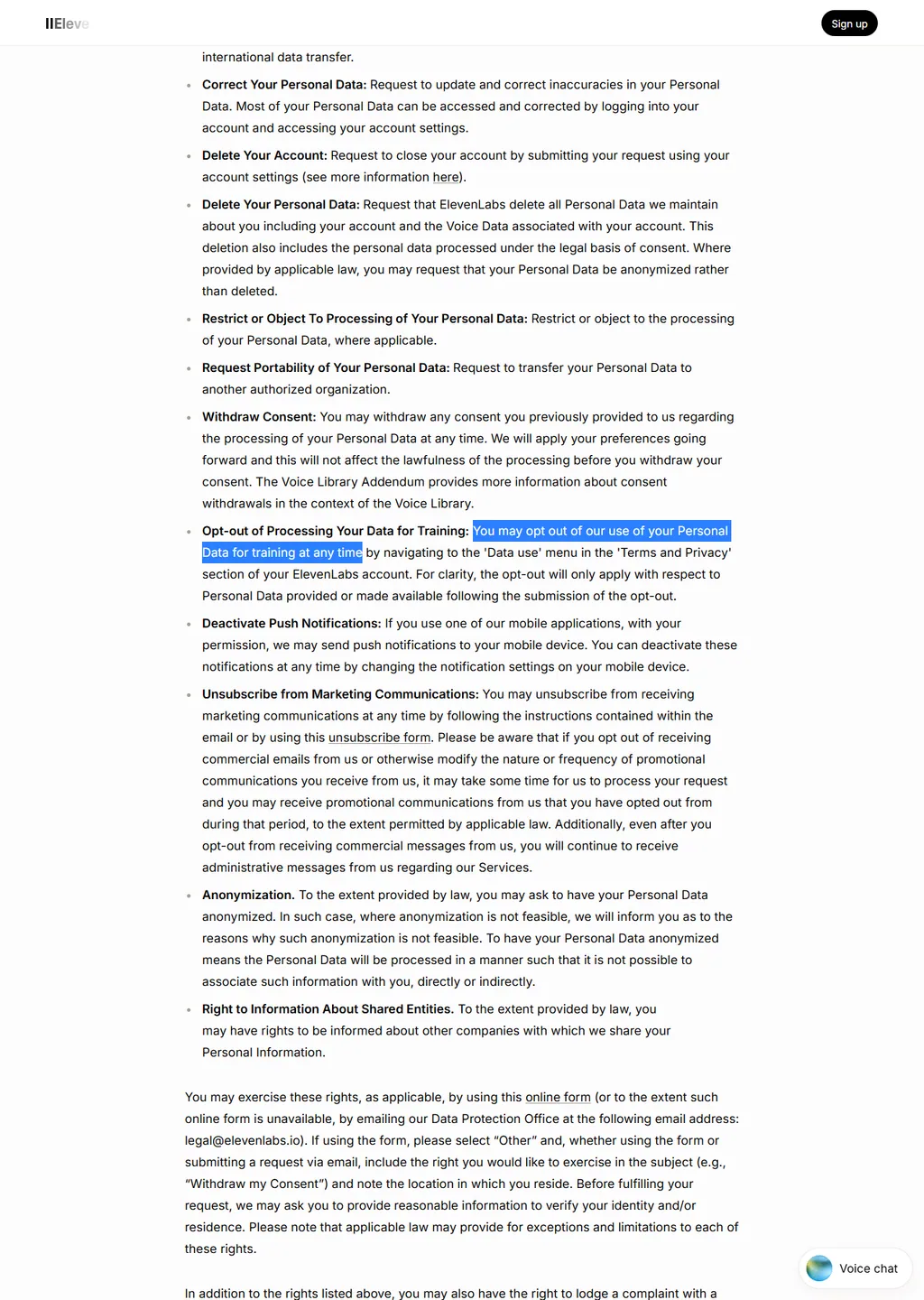
ElevenLabs says it may process Personal Data for research, development and training of its AI models, and it says it in the privacy policy rather than in the Terms. Section 3 lists that as a purpose with a legitimate interest basis, on data that is disassociated (or fully removed) from identifiers before it is used for training. Section 2 separately says that Voice Data specifically is used to help the models learn about patterns and connections in speech and audio content and to improve the Services. The opt-out is documented in section 8: you may opt out of the use of your Personal Data for training at any time by navigating to the Data use menu in the Terms and Privacy section of your account, and the opt-out applies to data you provide or make available after you submit it.
Evidence · ElevenLabs Privacy Policy, section 8 · Privacy Policy section 8: training opt-out in the Data use menu, and the deletion request · Captured 25 thg 9 2026
Retention has one number that matters for anyone whose work is a voice. Section 6 of the same policy says ElevenLabs will not keep data it generates about your voice longer than 3 years after your last interaction with us, except as required by law. The same section gives you the deletion route: you may request that ElevenLabs delete all Personal Data it maintains about you, including your account and the Voice Data associated with it.
Evidence · ElevenLabs Privacy Policy, section 6 · Privacy Policy sections 6 and 7: voice data is not kept longer than 3 years after the last interaction · Captured 25 thg 9 2026
The zero retention mode on the API is real, but it is smaller than the phrase sounds. Setting enable_logging to false switches a request to zero retention mode, which means history features, including request stitching, are unavailable for it. The same reference page adds the qualifier that decides whether it helps you: zero retention mode may only be used by enterprise customers. So the guarantee exists, and it is priced behind the highest tier rather than available to every API caller.
Our methodology publishes the five components and their weights, so here is what each one had under it on this page rather than a number with nothing behind it.
Fit for the stated job, 30 percent. ElevenLabs publishes speech synthesis, voice cloning, dubbing and speech to text, which is the whole of what this category is about rather than one corner of it.
Cost to get started, 25 percent. Both figures arrive from the vendor in one sentence, so there is no gap between price and allowance for a reader to close. Against that, the free tier cannot be spent on commercial work, so what it costs to get started on a real job is the paid step and not zero.
What the vendor commits to, 20 percent. A Prohibited Use Policy that dates itself, an explicit consent requirement for replicating a voice, an explicit restriction on free accounts, a published training opt-out, a three-year voice retention cap, and a zero retention mode on the API that is scoped to enterprise customers. Held back by where the voice rule sits rather than by what it says.
Portability, 15 percent. A public REST API, POST /v1/text-to-speech/:voice_id, with a runnable example printed on the reference page and an output format chosen in the request.
Documentation quality, 10 percent. That same reference page answers a real question with a command you can paste, and the words contact sales, talk to sales and request a demo appear on it zero times.
Weighted, that comes to 8.2, which is the same total our Synthesia review reached by a different route. We have left it there rather than nudging either page: Synthesia earns its total on a free tier denominated in the unit a client understands, and ElevenLabs earns the same total on clarity and documentation while giving ground on what its free tier permits. Two products can be equally good buys for opposite reasons.
The reference page shows one output format in its printed example and we have not published a list of the rest, because counting a file extension in a page's prose is not the same as reading a documented list of supported formats.
And there is no quality score here, on voices or on pronunciation, because we did not measure it. We have not found a published benchmark of synthetic speech we would be willing to rank on, and inventing one to fill the row would be worth less than the empty space.
Not according to the vendor. The Prohibited Use Policy lists using the service for any commercial purpose as prohibited for free users, so the free allowance is for deciding whether to buy rather than for producing something you will ship.
In the Prohibited Use Policy, section 5, worded as replicating the voice of another person without consent or legal right. The Terms of Use does not use the word clone at all, so searching that document for cloning rules finds nothing.
Because we did not measure it. We compare what vendors publish and cite benchmarks other people ran, and we have not found a published benchmark of synthetic speech quality we would be willing to rank on.
04Sổ nguồn: mọi phát biểu trên trang này kèm tài liệu và ngày đối chiếu
Những con số này lấy từ đâu
Mọi con số ở trên là con số do chính nhà cung cấp công bố. Mỗi dòng nêu tên tài liệu đã đọc và ngày một người mở tài liệu đó.
Sổ nguồn: mọi phát biểu trên trang này kèm tài liệu và ngày đối chiếu
A free user may only use the Services for non-commercial purposes; a paid user may use them for commercial purposes, both subject to the Prohibited Use Policy
To the extent you own or acquire any intellectual property rights in or to any User Voice Models, you grant ElevenLabs a perpetual, irrevocable, nonexclusive, royalty-free, worldwide, sub-licensable license