Bài viết bên dưới được đăng bằng tiếng Anh. Mọi con số trong đó là con số do chính nhà cung cấp công bố, kèm ngày chúng tôi đọc được.
Cursor prices the entry in plain dollars and the overage in plain API rates. What it does not price is the amount of usage a seat includes, and that gap is the part of the cost a buyer cannot predict from the page.
The seat is priced, the usage is pooled
The entry plan is Pro at $20 a month, and the plan table in the docs names two more individual tiers, Pro+ at $60 and Ultra at $200. The same table is careful to say that Pro, Pro+ and Ultra include usage rather than to say how much. That is not a small omission: it is the difference between a price and a budget.
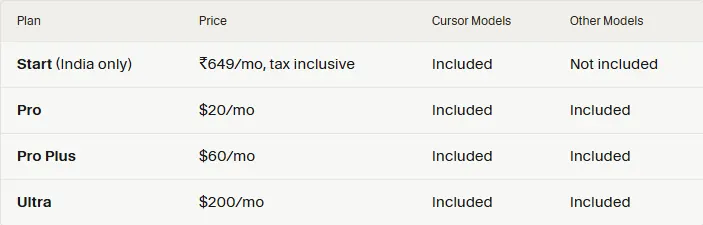
That table is where the two pools come from. Pro, Pro+ and Ultra carry two usage pools that reset monthly. Cursor's own models, named in the docs as Grok and Composer, draw from one pool. Third-party models draw from the other at the model's listed API price. On the paid plans the table marks both columns Included, and it does not print a number for either. So what a paid seat actually buys is access to those pools with an included allowance that is described, not enumerated, plus the option to keep going. The Hobby plan is the limited-access tier below all of that, and a separate India-only Start plan covers only the Cursor Models pool.
Every figure the page prints is a rate
When included usage runs out, the pricing FAQ and the usage docs agree that additional requests on individual plans are billed at the model API rate with no markup. (On Teams and Enterprise plans the docs add a Cursor Token Rate of $0.25 per million tokens to third-party model requests on top of the API price.) On individual plans this on-demand mode has to be switched on deliberately in settings, and there is a spend limit you can set, with the docs noting that enforcement is not instant.
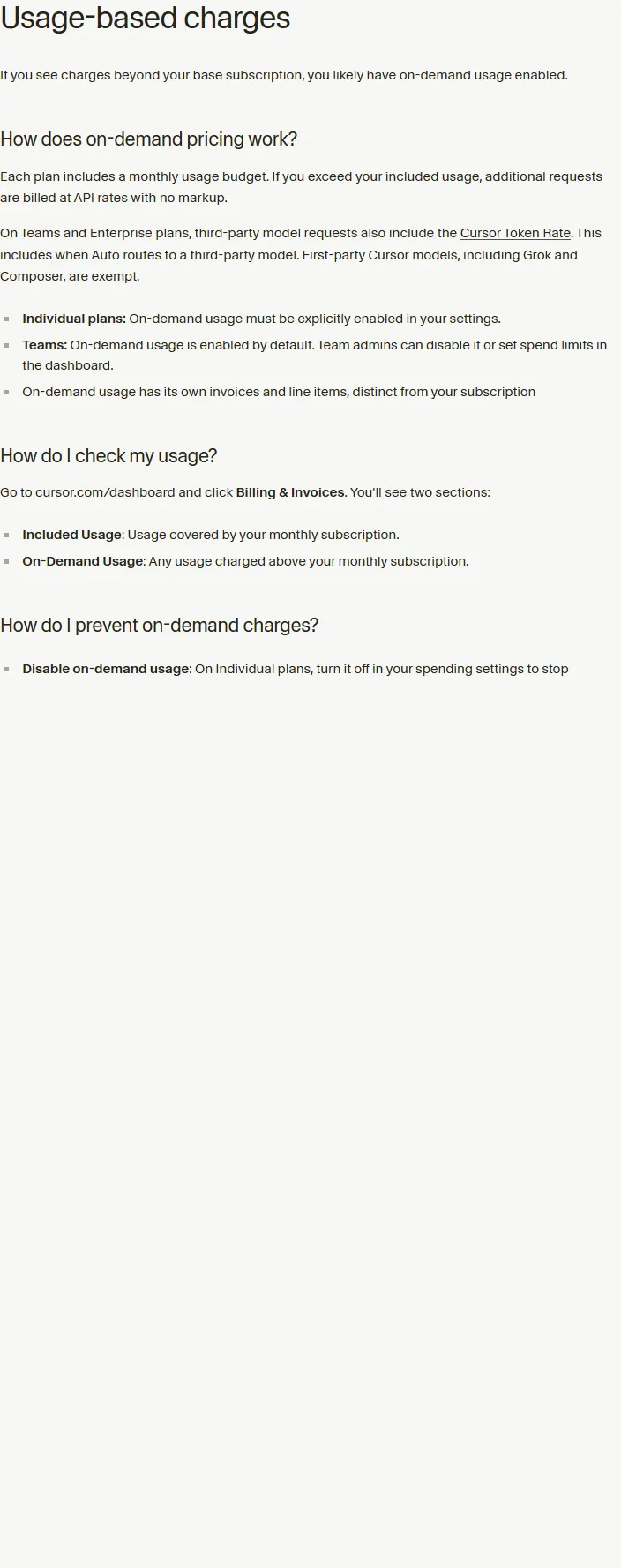
The second figure worth reading is the one that is absent. Nowhere on the pricing page or the models and pricing docs is the included allowance stated as a dollar figure. The conversation a buyer needs, "how much does a normal month actually cost", is answered instead by the vendor's own usage guidance, which puts daily agent users in the 60 to 100 dollars a month range of total usage and power users above 200.
The free tier is described, not counted
The Hobby plan is genuinely free and needs no credit card. It grants access to the core features with limited usage, which is the whole sentence. The word limited is not followed by a number on the pricing page, and the usage docs describe free access in terms of the same three features rather than an allowance.
That is a factual statement about the page, not a criticism of the plan. It means a reader cannot answer from the vendor's own material whether the free tier is enough for a week of real work. If the answer is important to you, the only way to get it is to run the plan and watch the spending dashboard.
Privacy is a mode, and the difference is written down
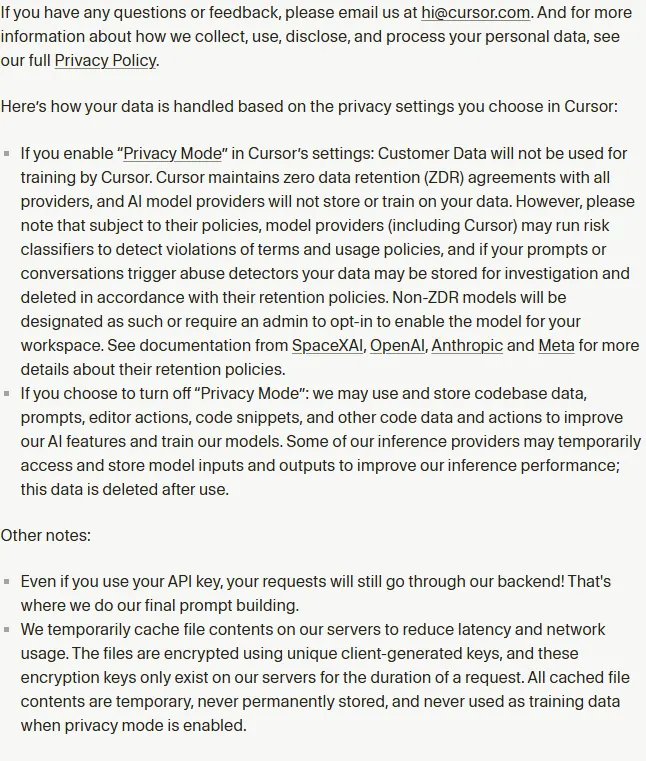
Anysphere publishes the data arrangement in one dated document with two states. With Privacy Mode on, customer data is not used for training by Cursor, and Anysphere says it maintains zero data retention agreements with all providers, with model providers not storing or training on your data. The same sentence carries qualifications: model providers may still run risk classifiers, and data that triggers an abuse detector may be stored for investigation under the provider's retention policy, and non-ZDR models are designated as such or require an admin opt-in. With it off, the same document states that codebase data, prompts, editor actions and snippets may be used to improve AI features and train models.
None of that is hidden, and none of it is permanent by default. Privacy Mode is a setting, available to any user, and the guarantee is attached to the mode rather than to the product, with the exceptions above stated in the same paragraph as the promise.
The exit is heavier than an extension's
Two facts shape how hard it is to leave. First, requests made with your own API key still pass through Anysphere's backend for final prompt building, even though on individual plans your provider bills you directly and those requests do not draw from the plan's usage pools. Second, adopting Cursor is adopting an editor, not a plugin on the one you already use, so a decision to leave is a decision to migrate your editing workflow as well.
Taken together they mean the portability of your prompts is not the same as the portability of your subscriptions. The AI-native editor choice is closer to a platform change than to an uninstall.
What the score rests on
The five components and their weights are published on our methodology page. Here is what this review put under each of them rather than a number with nothing behind it.
Fit for the stated job, 30 percent. Cursor is an editor that is also a coding agent, which is the whole of what this category is about rather than a corner of it.
Cost to get started, 25 percent. A real free plan with no credit card, an entry price of 20 dollars that is printed plainly, and an overage rate stated in writing. Held back by the missing included-usage figure, which moves the cost question to after you subscribe.
What the vendor commits to, 20 percent. The Privacy Mode guarantee, the zero data retention commitment, and a spending control with a published behavior keep this component strong.
Portability, 15 percent. Own-API-key requests still route through the vendor, the product demands an editor change, and leaving is therefore a migration rather than an uninstall.
Documentation quality, 10 percent. The pricing, usage and overage help pages answer the follow-up questions a buyer asks, dated and with the edge cases named.
Weighted at those weights the total comes to 8.0.
What we could not settle
There is no score here for output quality, because we did not measure it and we have not found an independent benchmark of coding-agent output we would be willing to rank on. There is also no figure for the amount of included usage, in either pool, because the models and pricing docs and the help pages we read describe both pools as included and print no allowance for either, and publishing a number to fill the row would be worth less than the empty space.
A note on the two pools, since the distinction is easy to miss. The docs mark both Cursor Models and Other Models as Included on the paid plans. What the pages do not do is separate the two with different allowances: neither pool carries a published amount in the documents we read. The vendor's own guidance on total spend, 60 to 100 dollars a month for daily agent users and above 200 for power users, is the closest thing to a budget figure anywhere in them.
If you are comparing editors, the Cursor tool profile carries the same figures and the comparison with GitHub Copilot is where the free tiers are read side by side. AI coding is the category hub for both.