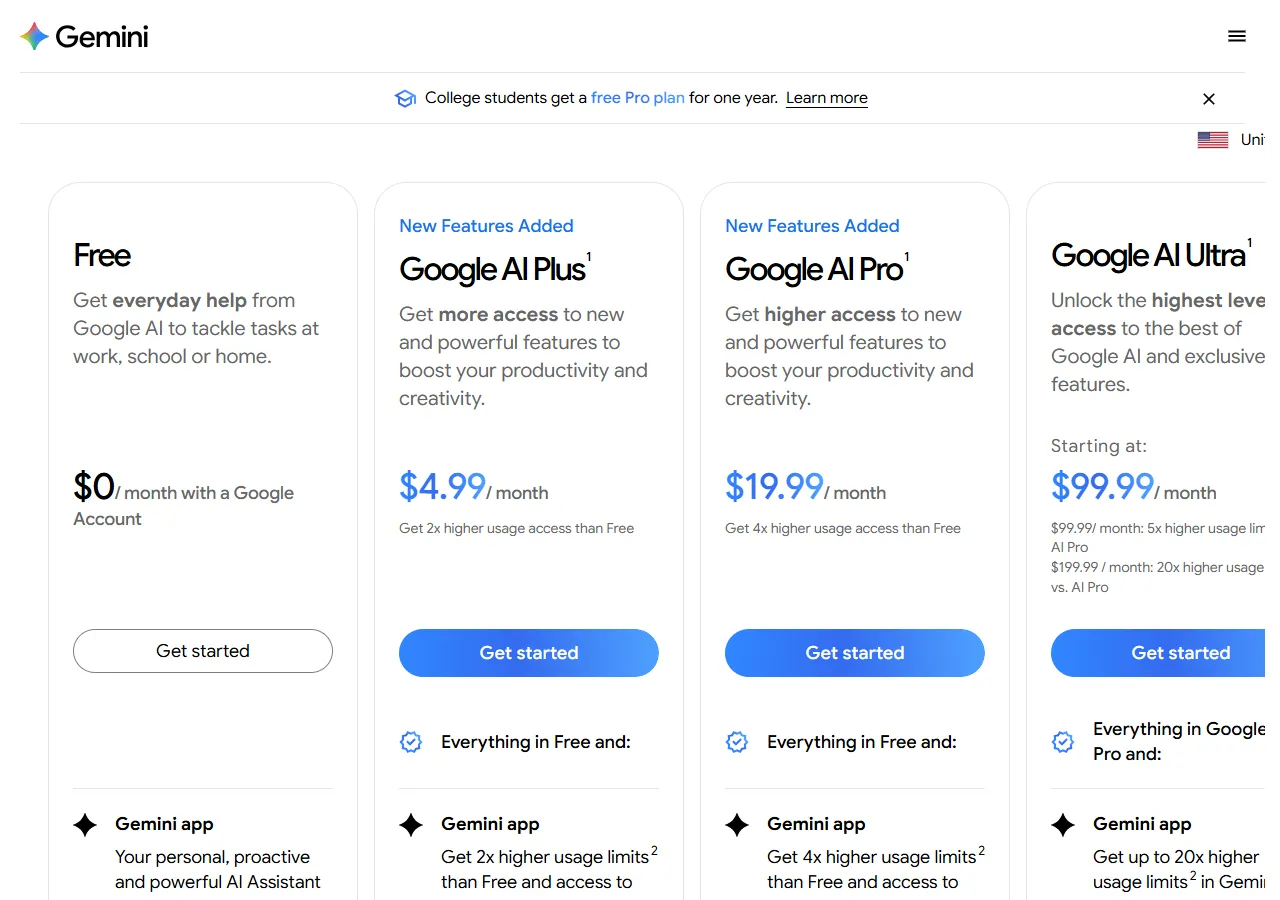
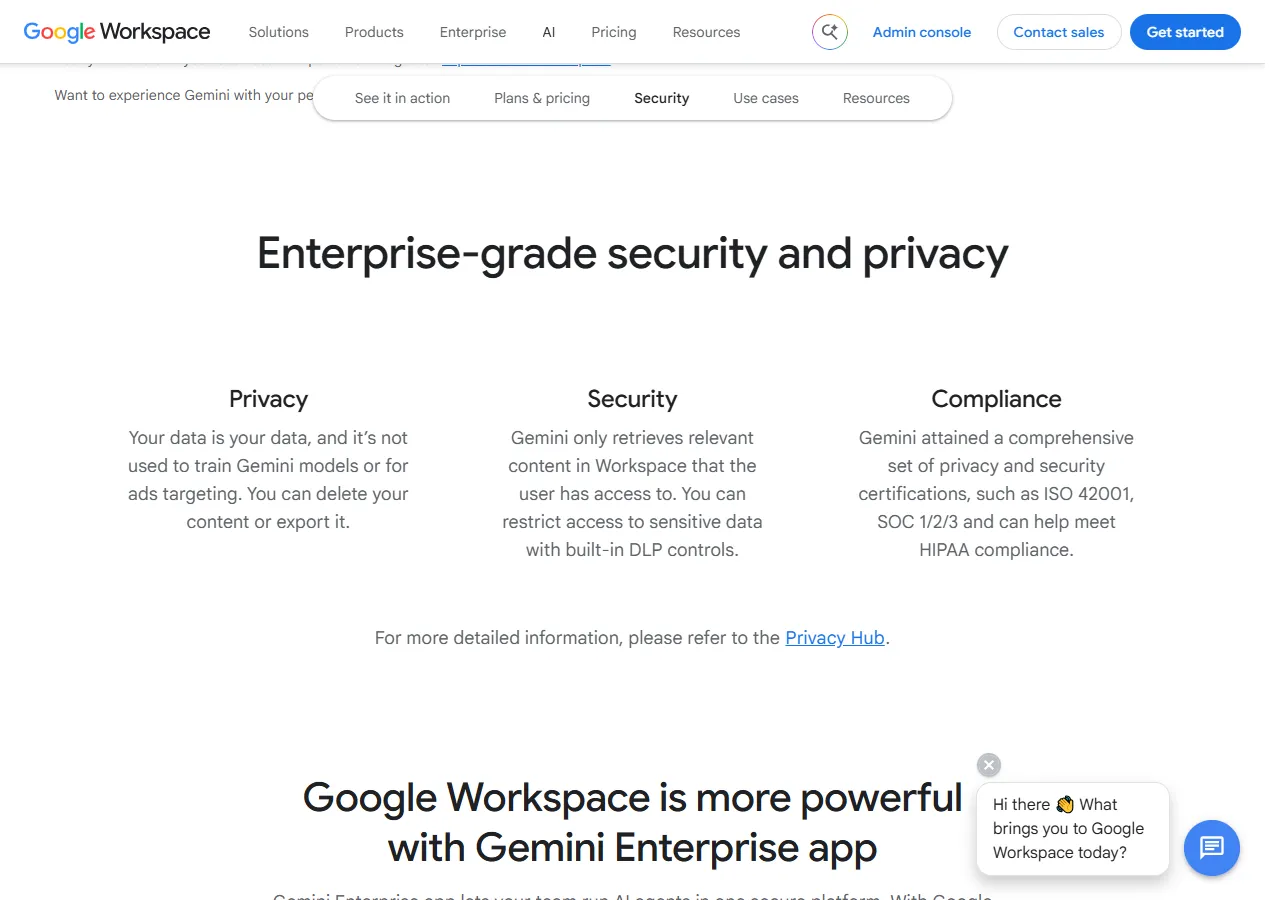
Google AI plan cards: Free at $0, Plus at $4.99 per month, Pro at $19.99 per month; Ultra begins at the right edgeGemini about page, the plan cards · Captured Sep 27, 2026
Someone buying one assistant who wants the lowest printed paid-entry price of the three ranked here, is comfortable planning a budget in usage multiples rather than message counts, and wants one document that states what happens to chats in plain language.
Not for
Anyone who budgets from a message count, because Google prints none; or who needs a single answer that holds for both a personal account and a Workspace account, because the two have different training statements.
A general assistant whose entry price is the lowest of the three we rank on this site, and whose privacy answer is a setting: Keep Activity on means chats can train Google's models, with a subset reviewed by humans, and the Workspace boundary is a separate, stricter claim.
Best for
Someone buying one assistant who wants the lowest printed paid-entry price of the three ranked here, is comfortable planning a budget in usage multiples rather than message counts, and wants one document that states what happens to chats in plain language.
Not for
Anyone who budgets from a message count, because Google prints none; or who needs a single answer that holds for both a personal account and a Workspace account, because the two have different training statements.
We may earn a commission if you subscribe through this link. It never changes a score or a ranking. Read the disclosure.
The entry price is a real, dated figure on a live page: Google AI Plus at $4.99 per month on the US page, with Free at $0, and two higher tiers printed on the same cards
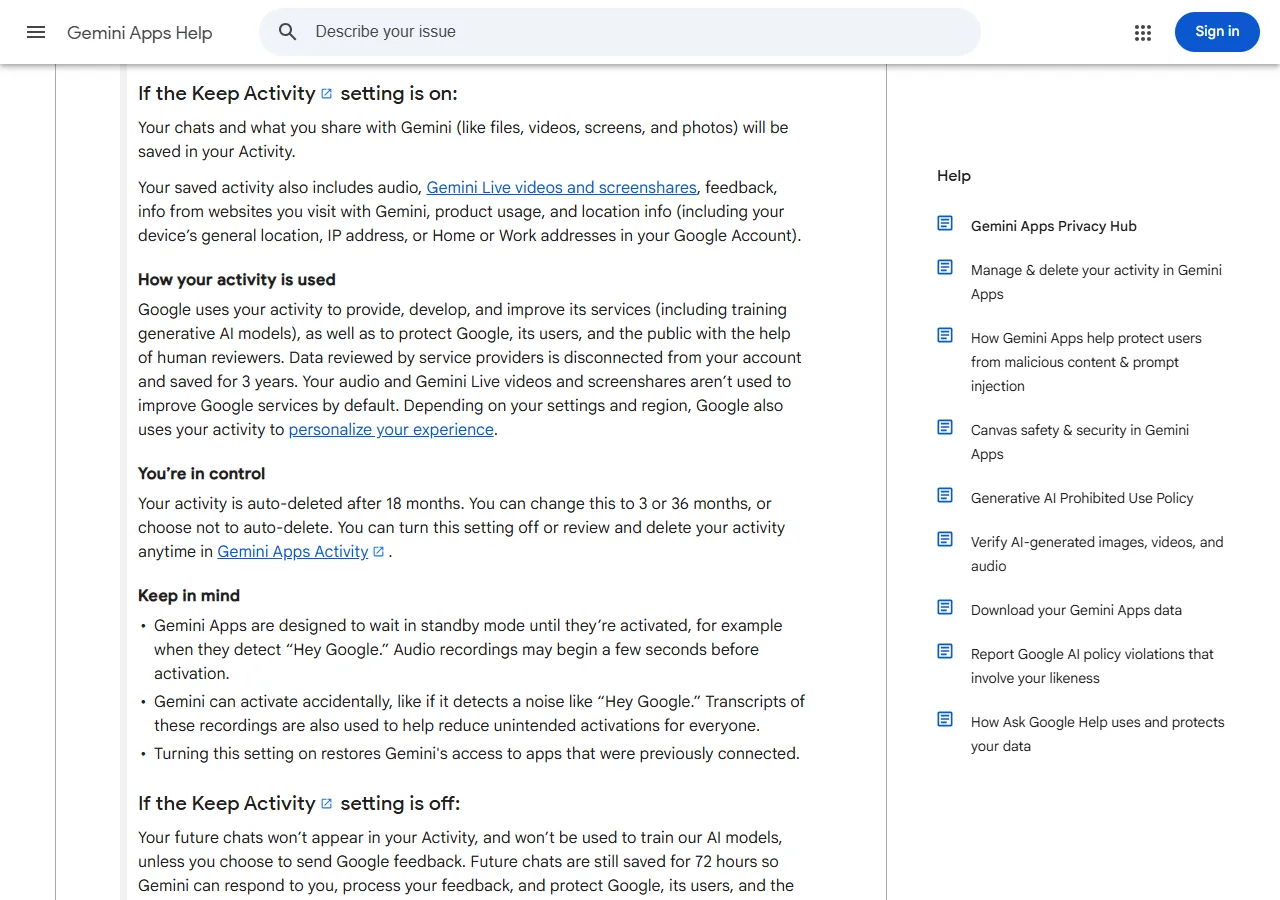
The privacy document is dated and answers the training question in a sentence: with Keep Activity on, Google may use chats to train generative AI models, with a subset reviewed by human reviewers; with it off, future chats are not used to improve AI models unless you submit feedback
The Workspace boundary is published and materially different: organization data in Workspace is not used to train or improve Gemini models or for ads targeting
Auto-delete defaults to 18 months and is configurable to 3 or 36 months, or off, which is a written retention commitment most vendors do not print
What to weigh
No plan prints a message count, a session count, or any numeric allowance, so the size of the weekly limit cannot be known before you hit it
Usage is a relative scale: Plus is 2x Free, Pro is 4x Free, Ultra is 5x or 20x Pro, and what Free's own limit is stays unpublished
The plan names are Google AI Plus, Pro and Ultra, not Gemini plans, so the buyer maps a brand name onto a page that names it differently
AI credits extend limits at a price the pages we read do not print
01What the vendor publishes
Read from the vendor's own pages on the dates listed at the bottom of this page. Where a figure is not published anywhere we could find, the row is absent rather than guessed.
Free is standard limits; Plus 2x, Pro 4x, Ultra 5x or 20x Pro, per the plan table in the help article5
Compute-based usage limits, refresh cadence
Limits refresh every 5 hours until a weekly limit; complexity, features used and chat length factor in; AI credits can extend them6
Keep Activity ON behavior
Chats are saved in Activity; Google may use the activity to provide, develop and improve services, including training generative AI models, with human reviewers7
Keep Activity OFF behavior
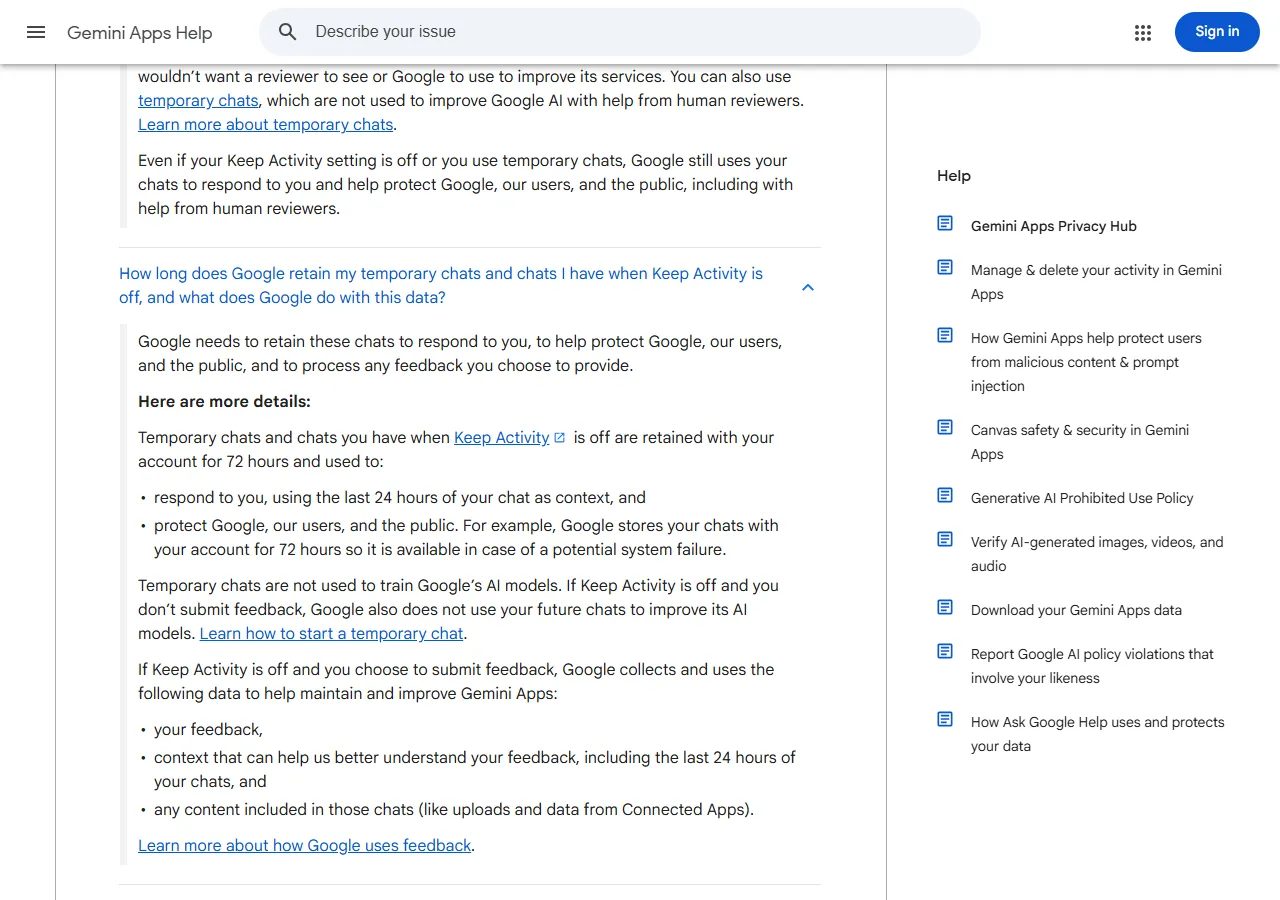
Future chats are not used to improve AI models unless you submit feedback; chats when the setting is off are retained 72 hours for response and safety8
Temporary chats never used to train
Temporary chats are not used to train Google's AI models9
Human review scope
A subset of chats are reviewed by human reviewers, including Google's trained service providers, to improve Google services10
Default auto-delete retention
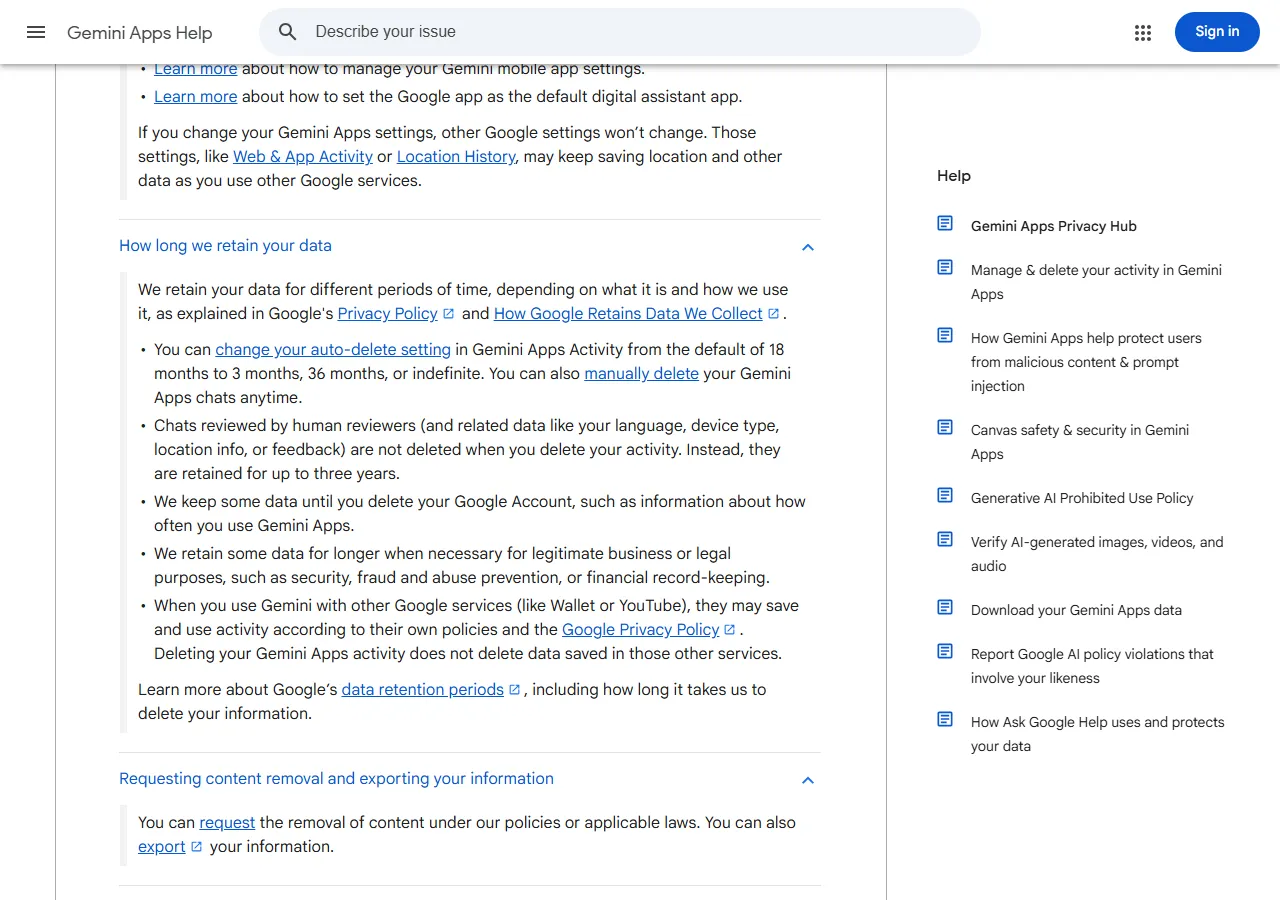
Activity auto-deletes after 18 months by default; configurable to 3 or 36 months, or no auto-delete11
Reviewed-chat retention
Chats reviewed by human reviewers and related data are not deleted when you delete your activity; retained up to three years12
Workspace training boundary
Organization data in Workspace is not used to train or improve Gemini models or for ads targeting13
Workspace delete/export
You can delete your content or export it; the Hub's export statement covers the consumer side14
Gemini is Google's consumer assistant, sold as Google AI plans, and the cheapest paid entry among the three assistants this site ranks on its chatbot page. The price is the easy part to verify. The question that decides the purchase is what happens to the chats, and Google's answer depends on a setting and on which product you are using.
The US about page prints the whole consumer line in one place. Free is $0 a month with a Google Account. Google AI Plus is $4.99, Pro is $19.99, and Ultra starts at $99.99 for 5x Pro or $199.99 for 20x Pro. Every card carries the monthly figure, and none of the cards mentions an annual rate; this review did not find one in the page's raw HTML, and a page's silence on annual billing is not the same as a no.
The name on the cards is worth reading before the price. These are Google AI plans, and Gemini access is what they carry. The profile for Gemini calls this out, and the Claude vs Gemini comparison reads the naming difference as a buying fact: one of the two entry prices is already a bundle.
The entry figure is the lowest of the three chatbots ranked on the ranking page: $4.99 against Claude's $20 and ChatGPT's $8, both US figures on their own pages. That comparison is scoped to the three tools that page ranks, and it is a statement about printed entry prices, not about what each dollar buys.
No card on the about page prints a message count or a numeric allowance. Instead, the pricing mechanism is a multiplier: Plus gives 2x the usage of Free, Pro gives 4x, and Ultra gives 5x or 20x the usage of Pro. The help article that explains the system puts the same table in words: without a plan you get standard limits, AI Plus gives 2x higher than standard, AI Pro 4x, and AI Ultra 5x or 20x higher than AI Pro depending on the subscription.
The limits themselves are compute-based. The help article states that usage factors in the complexity of your prompt, the features you use, and the length of your chat, that limits refresh every five hours until you reach a weekly limit, and that the changes took effect for users over 18 on May 17, 2026, and for users under 18 on July 24, 2026. Paid users have higher limits than users without a subscription, and premium features like media generation and Deep Research consume more.
What the page does not print is the size of the standard limit that everything multiplies from. A buyer cannot translate 2x Free into a monthly budget without knowing what Free is. AI credits extend limits during a month, and the article says they can be purchased, but the price per credit is not on the pages this review read. These two absences are the reason the fit score below is not higher: the pricing mechanism is legible, and the unit it multiplies is not.
With Keep Activity on, your chats and everything you share with Gemini are saved in your Activity, and Google uses that activity to provide, develop and improve its services, including training generative AI models, with the help of human reviewers. The document names the human role precisely: a subset of chats are reviewed by human reviewers, including Google's trained service providers, to improve Google services, and reviewed chats are retained for up to three years.
With Keep Activity off, the statement is the mirror: future chats are not used to improve Google's AI models, unless you submit feedback. Temporary chats are not used to train Google's models at all. There is a third line that matters: even with the setting off, chats are still retained for 72 hours to respond to you and to help protect Google, its users and the public, including with help from human reviewers. Turning the setting off does not remove every use of the chat, and the document says so in the same answer.
Evidence · Gemini Apps Privacy Hub, How long we retain your data · Retention: activity auto-deletes after 18 months by default; reviewed chats are kept up to three years and survive activity deletion · Captured Sep 27, 2026
Activity is auto-deleted after 18 months by default, and you can change that to 3 or 36 months, or choose no auto-delete. You can also delete your chats manually at any time. The sharp edge is the reviewed-chat clause: chats reviewed by human reviewers, and related data like your language, device type and location, are not deleted when you delete your activity, and are retained for up to three years, disconnected from your account.
That is the portability story of this product in two lines. You can delete and you can export, and the deletion is not complete for the subset that entered human review. The review scores portability down for exactly that reason: the export statement exists, and the delete statement carries an exception.
For Workspace organizational data, Google publishes a different boundary, on its own business page: an organization's data in Workspace is its data, and is not used to train or improve Gemini models or for ads targeting, and Gemini only retrieves relevant content the user has access to. The Privacy Hub itself points work or school accounts to the generative AI in Workspace Privacy Hub, with different data handling terms.
This split is the reason the verdict for Gemini is not a single sentence about privacy. For a personal account, the training answer is Keep Activity on or off, and it is written in one document with a date. For organization data in Workspace, Google publishes a no-training boundary on its own business page. A buyer who will use both should read both documents, because the two are not the same claim.
The five components and their weights are published on our methodology page, so here is what this review put under each of them.
Fit for the stated job, 30 percent. Gemini is a broad general assistant: everyday chat, image generation, video generation, Deep Research, Live, Canvas, Gems and Notebook all sit behind one subscription. It loses ground because the paid tiers price in usage multiples rather than in a count, so a buyer cannot map 2x Free onto their own pattern without knowing what Free's limit is.
Cost to get started, 25 percent. The entry price is legible and dated: $4.99 for Google AI Plus and $0 for Free, both on the US page, and the lowest printed paid-entry price of the three assistants ranked on this site's chatbot page. Held back by the two unprinted figures: the size of the standard limit, and the price of AI credits.
What the vendor commits to, 20 percent. A dated privacy document that answers the training question in two explicit branches, a dated help article with effective dates for the usage changes, a configured retention default, and a Workspace boundary that is stated separately and is materially stricter for organizations.
Portability, 15 percent. Export is stated on both the Privacy Hub and the Workspace page, and deletion is possible from Activity at any time. Docked because deletion does not remove chats that entered human review, and because no conversation-level export format is documented on the pages read.
Documentation quality, 10 percent. The Privacy Hub is dated, comprehensive, and answers the exact questions a buyer asks, including the reviewer question and the retention question. The help article on limits is dated with effective dates. Docked because the one number a budget needs, the size of the standard limit, is not printed anywhere we read.
Weighted at the published weights, that comes to 7.8.
There is no output-quality score here. We do not run these models against each other on the same prompts and score the answers, and we have not found an independent benchmark we would be willing to rank on, so nothing here compares Gemini's answers with ChatGPT's or Claude's. There is also no figure for the size of the Free allowance, the price of AI credits, or any annual rate, because none of the three is printed on the pages this review read. Each absence is stated as an absence, not as a no.
Google does not publish a count. The usage system is compute-based and relative: limits factor in prompt complexity, features and chat length, refresh every five hours until a weekly limit, and Free is the baseline that paid tiers multiply from. The size of the baseline is not printed on the pages we read.
If Keep Activity is on, chats are saved in Activity and may be used to train generative AI models, with human reviewers on a subset. If Keep Activity is off, future chats are not used to improve AI models unless you submit feedback, and temporary chats are never used to train.
Deleting your activity removes your chats and lets you change the auto-delete period from the 18-month default to 3 or 36 months, or off. Chats that were reviewed by human reviewers, and related data, are retained for up to three years, disconnected from your account, and are not deleted when you delete your activity.
Yes. Google states that an organization's data in Workspace is not used to train or improve Gemini models or for ads targeting. That is a separate, published claim from the consumer one, and the Privacy Hub points work and school accounts to the generative AI in Workspace Privacy Hub.
Because we did not measure it. We compare what vendors publish and cite independent benchmarks where they exist, and we did not run these models against each other on the same prompts, so this review ranks the purchase decision, not the answers.
04Source ledger: every claim on this page with its document and the date it was checked
Where these numbers came from
Every figure above is the vendor's own published number. Each row names the document it was read from and the day a human opened it.
Source ledger: every claim on this page with its document and the date it was checked
Chats are saved in Activity; Google may use the activity to provide, develop and improve services, including training generative AI models, with human reviewers