L'article ci-dessous est publié en anglais. Chaque chiffre qu'il contient est le chiffre publié par l'éditeur lui-même, avec la date à laquelle nous l'avons lu.
HeyGen turns a script into a video of an avatar presenter, and it translates that video across languages with lip sync. The price is answerable now, and so is the question that matters more: what rights you keep when you upload a face, a voice, or business material into a tool whose whole product is built on your likeness.
What the plans cost, and what the free tier actually permits
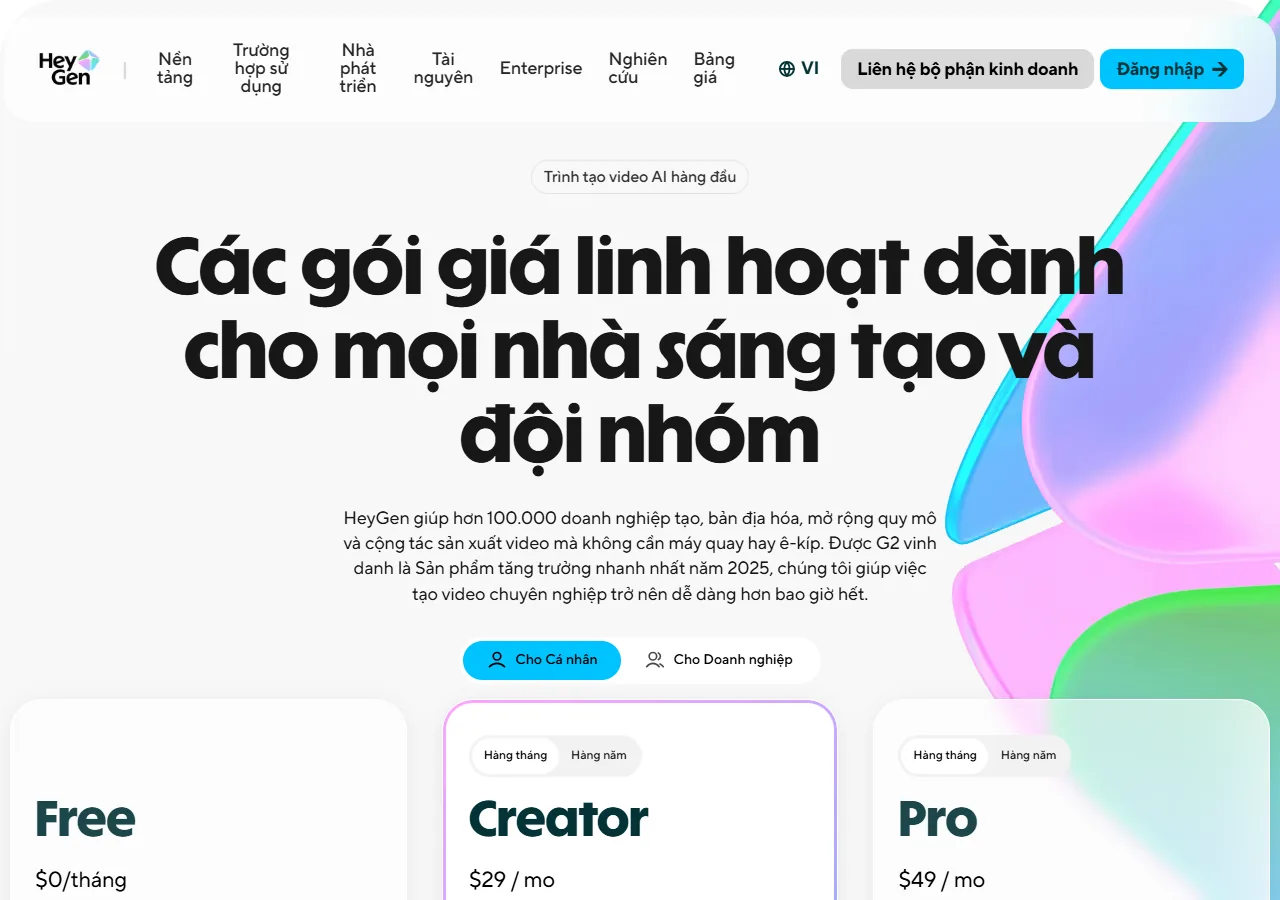
HeyGen publishes five tiers on its pricing page, and the figures are shown in USD in the page's own data, which is what lets this review publish a price where an earlier profile deliberately would not. Free is $0 for three videos a month, each up to one minute. Creator is $29 per month, or $24 per month if you pay annually, with 600 credits. Pro is $49 per month with 1,000 credits, Business is $149 per month per user with 1,500 credits and $20 per seat beyond the included seats, and Enterprise is Contact Sales.
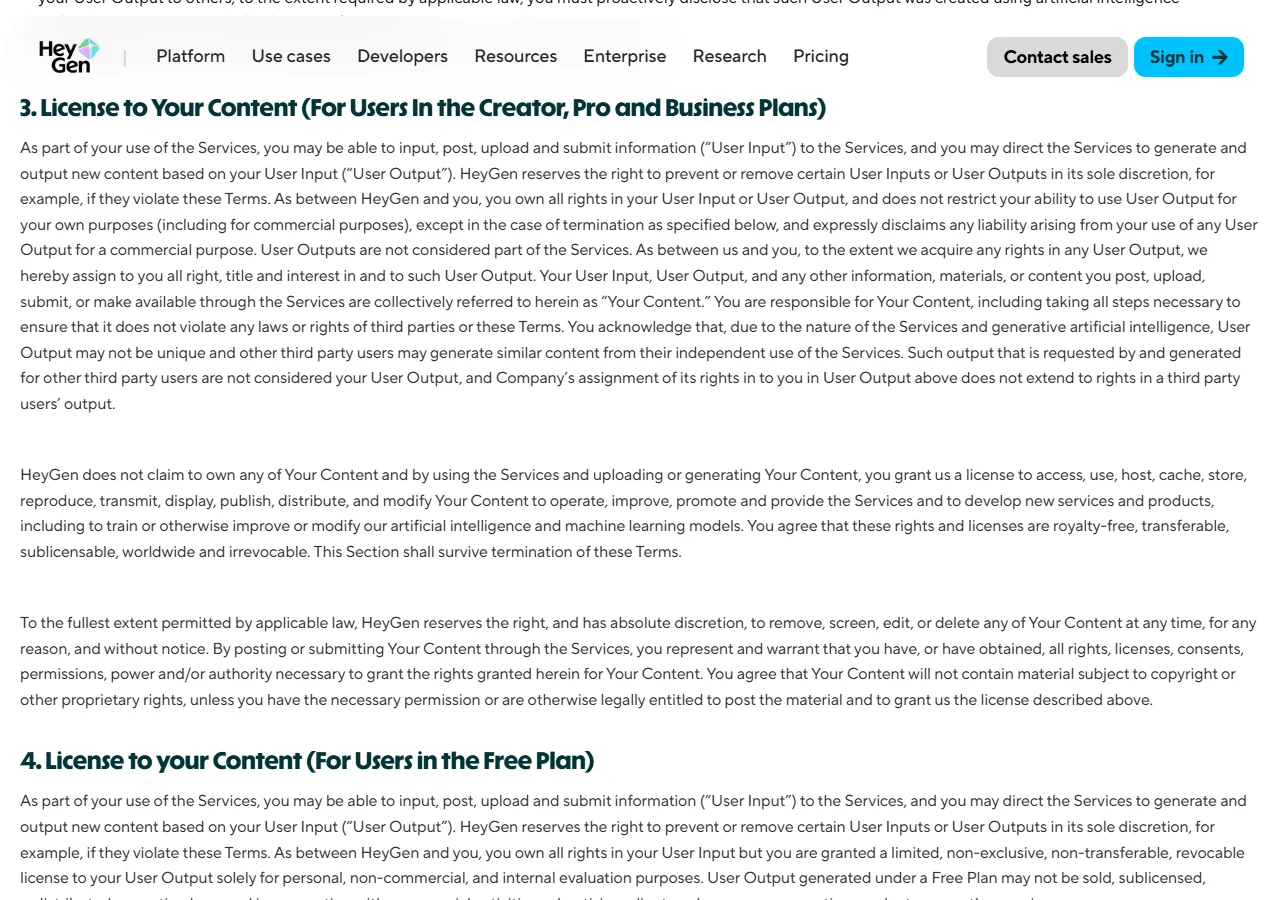
The free tier has two ceilings, and both are in writing. The first is a time ceiling: one minute per clip, three clips a month. The second is a license ceiling that matters more if you wanted to ship anything you make on it. Terms section 4 licenses free-plan output solely for personal, non-commercial, and internal evaluation purposes, and it is explicit about what that excludes: free output may not be sold, sublicensed, redistributed, monetized, or used in commercial activities, advertising, client work, or a revenue-generating product. Free output also carries a watermark, and removal is a paid-plan feature. So the free tier is for judging whether the tool fits, not for producing anything you deliver.
You own your output, and HeyGen holds a broad license over it
The most important thing HeyGen publishes is one sentence with two halves, and the review exists because buyers usually hear only one of them. In section 3 of the terms: as between HeyGen and you, you own all rights in your User Input or User Output, and HeyGen does not restrict your ability to use your output for your own purposes, including commercial ones.
The other half of the same section grants HeyGen a license to your content that is royalty-free, transferable, sublicensable, worldwide and irrevocable, and it survives termination of the terms. That license lets HeyGen access, use, host, cache, store, reproduce, transmit, display, publish, distribute and modify your content to operate, improve, promote and provide the services, and to develop new services and products, including to train or otherwise improve or modify its artificial intelligence and machine learning models.
Those two statements are both true and they are not contradictory. You own the content, and you grant HeyGen a license over it. The practical reading for a team deciding whether to upload a face, a voice or internal material: the ownership sentence is real, and so is the training clause. Neither cancels the other.
Training, and the opt-out that is documented but not default
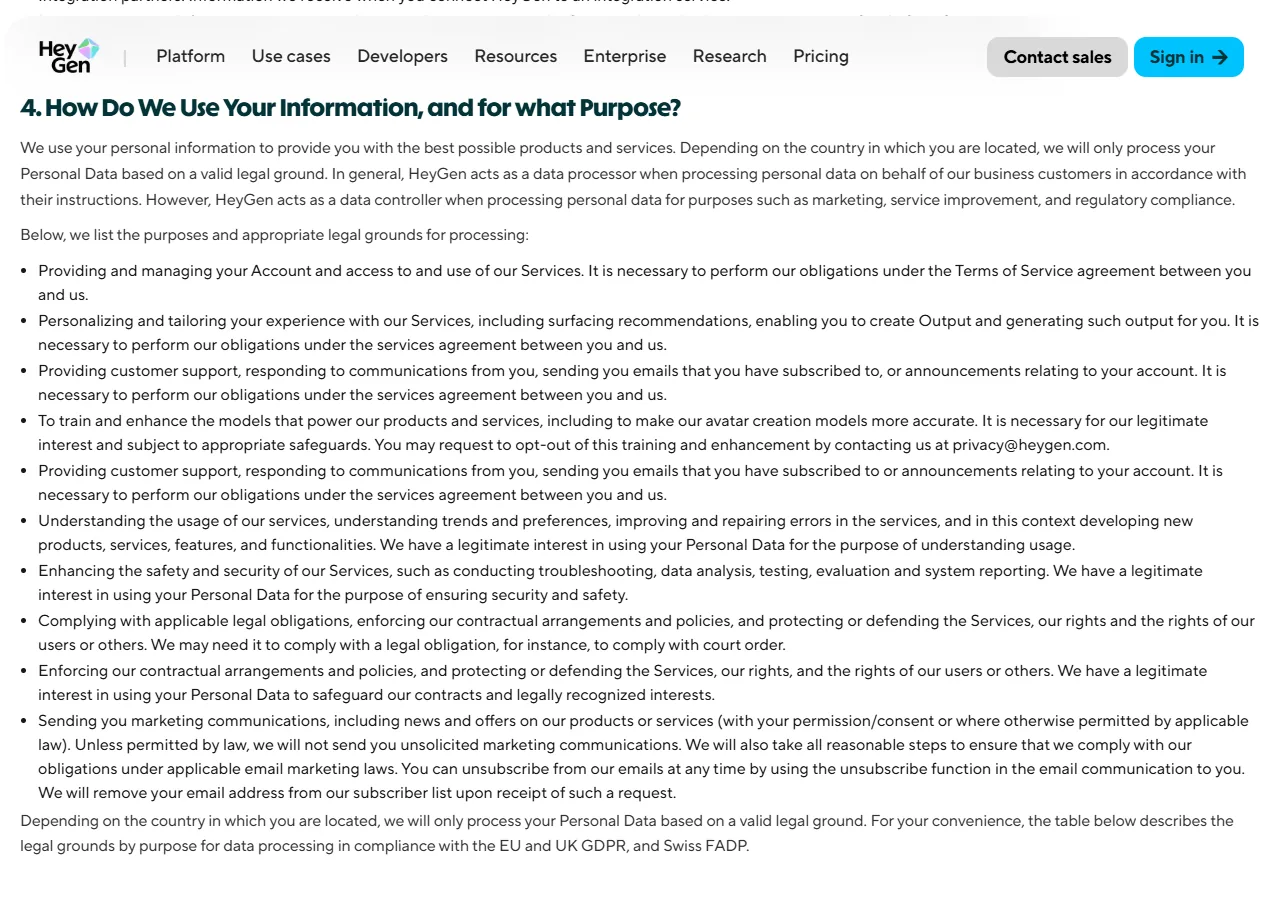
HeyGen's privacy policy, dated 11 August 2026, states that HeyGen may use the input you provide to improve its services, for example to train and enhance the models that power its Services. That sentence is not scoped to paid plans in the way the section 3 license is, so there is no basis in the published terms for claiming free users are exempt from training. The policy lists the input kinds it covers: text, voice, scripts, images and videos.
The same policy documents an opt-out. You may request to opt out of this training and enhancement by contacting HeyGen, and the policy names the contact address. It does not state a default posture for the opt-out beyond the fact that a request is possible, so the honest reading matches the published language: training is a listed use of input, and you can ask to opt out.
If you create an avatar, the privacy policy adds a biometric layer. It says processing may include face imagery, that HeyGen relies on your explicit consent as the lawful basis for processing face data in relation to avatar creation, and that you may withdraw consent at any time, with the consequence that you may be prevented from using avatar creation. That is a real feature consequence of withdrawing consent, and it is the reason the review says the consent is revocable and the consequence is named.
Retention, deletion, and how you actually leave
Deletion has two published numbers, and both belong in the buying decision. After you request deletion of your data or your account, HeyGen says it strives to take steps to delete that information within 72 hours, unless required or permitted to retain it under applicable law. And the privacy policy says that after deletion or account deletion, personal data is kept in backups for the purpose of disaster recovery for 60 days, then automatically and permanently erased.
Two caveats stop the deletion story from reading cleaner than it is. On termination, Terms section 5 says HeyGen may, but is not obligated to, delete your content, so the post-termination guarantee is discretionary rather than absolute. And there is no export or download-data workflow documented in the legal and pricing pages, so leaving with your videos and your history is a deletion request under a policy rather than a download button.
There is a separate deletion rule that applies only to the free plan. Terms section 23 says that if you are under the Free Plan and do not access or use the Services for a continuous period of six (6) months, HeyGen may, upon reasonable notice, delete your account. Deletion is discretionary, notice is required, and the clause is scoped to the Free Plan, so it cannot be generalized to paid accounts.
Where the web subscription stops and the API begins
The API is a separate product line from the web subscription, and the review keeps the two billing surfaces apart. HeyGen describes the API with its own plan shape, a concurrency model of Pay-As-You-Go and Enterprise, with contract-based overage above included slots. The API's own endpoints return an API-side credit balance and plan tier, and the billing integration applies a budget for API credit. The web-subscription credits that this review quotes on Creator, Pro and Business are not documented as applying to API usage, so the safe statement is that the web subscription and the API are separate billing surfaces and HeyGen does not document web-app credits as shared with the API.
What the score rests on
The five components and their weights are published on our methodology page.
Fit for the stated job, 30 percent. An avatar and spokesperson video tool with translation and lip sync marketed as a headline capability, and a free tier that lets you judge whether the avatars clear your bar. Held back by the free tier's non-commercial ceiling and one-minute clip cap.
Cost to get started, 25 percent. A publishable USD entry price for the first time on this site, with the annual figure named on the page. The free tier is a genuine evaluation tier, and its watermark and non-commercial limits mean it cannot produce a deliverable, which caps the cost story.
What the vendor commits to, 20 percent. The ownership sentence is clear, and the license it sits beside is named in the same clause. The training use of input is disclosed with an opt-out and a biometric consent with a named consequence. The discretionary deletion after termination and the free-plan inactivity rule are the qualifiers.
Portability, 15 percent. No documented export or download workflow, a discretionary may-delete after termination, and a free-plan account that can be deleted after six months of inactivity. Leaving is a request under a policy, not a flow.
Documentation quality, 10 percent. The pricing, terms and privacy pages state the relevant figures and clauses in writing, dated, with the watermark, non-commercial scope and retention numbers named.
Weighted at those weights the total comes to 7.2.
What we could not settle
This review publishes no score for output quality, because that would mean generating the same script through HeyGen and judging the result, and this site does not claim to have used the tools it reviews. There is also no figure for free-plan export resolution, because the pricing page does not print one, and no statement either way on whether web-app credits can be used in the API, because HeyGen does not document that sharing. And the Pro plan's annual price is not published here because the page shows one figure on the card and a different one in its underlying data, which is not a number a reader can trust.
If you are choosing between avatar tools, the tool profile carries the same figures, and the comparison with Synthesia reads the two free tiers side by side. AI avatars is the hub for both.