Ask which AI coding tool is better and the question is shaped wrong. Anthropic's Claude Code and Cursor are not two brands of the same product. Claude Code is an agent that happens to have an editor nearby; Cursor is an editor that happens to have an agent inside it. Every figure in this guide is the vendor's own published number or a page we opened and dated, and the two pricing pages, read side by side, say more about which one fits your week than any benchmark does.
Two different products wearing the same category label
Claude Code is described by Anthropic as "an agentic coding tool that reads your codebase, edits files, runs commands, and integrates with your development tools. Available in your terminal, IDE, desktop app, and browser." The terminal is the first surface in that sentence because the terminal is the product. The editor is one of several places it can run.
Cursor describes itself as "your coding agent for building ambitious software", which is a recent reframe: for years its own homepage called it The AI Code Editor. The product is a fork of VS Code. Chat, tab completion and inline edits live in the editor you already use, and the agent features have grown out from there.
That difference decides almost everything downstream. If your day is a repo and a terminal, Claude Code is already where you are. If your day is reading unfamiliar code and editing inside a large codebase one file at a time, Cursor is already where you are. The tool that matches the surface you work on is the one you will actually use.
What each one actually does in a repo
Both tools now do agentic work: plan a change, edit several files, run the tests, and report back. The vocabulary differs and the overlap is large, so the honest comparison is about emphasis, not capability.
Where Claude Code puts the weight: composability and parallelism. Its docs document subagents that each run "in its own context window with a custom system prompt, specific tool access, and independent permissions", background agents that run several full sessions in parallel, hooks that run shell commands before or after actions, and a CLI built to be piped into: the docs' own example reads tail -200 app.log | claude -p "Slack me if you see any anomalies". The pattern is Unix. You are buying a component that fits into scripts, CI, and whatever else you already run.
Where Cursor puts the weight: the editing surface. Its docs describe an editor-native agent with planning, review, and debugging modes, plus cloud agents that run "on their own computers to build, test, and demo features end to end for you to review". Tab completion, the thing you feel a hundred times an hour while editing inside a codebase, is the feature Claude Code does not compete on at all. If refactor-by-increment is your actual workflow, this is the difference that matters.
Code review is a first-class workflow on both. Claude Code ships GitHub Actions integration and automatic PR review; Cursor's Premium tier lists "Code hosting & AI code reviews" on the pricing page. Neither claim is ours to grade: both are the vendors' own feature lists, and neither requires the other tool's absence.
The pricing pages now tell two different stories
This is where the comparison stopped being a matter of taste. Both pages were opened and read on 2026-11-03, and both are changing shape faster than most coverage keeps up with.
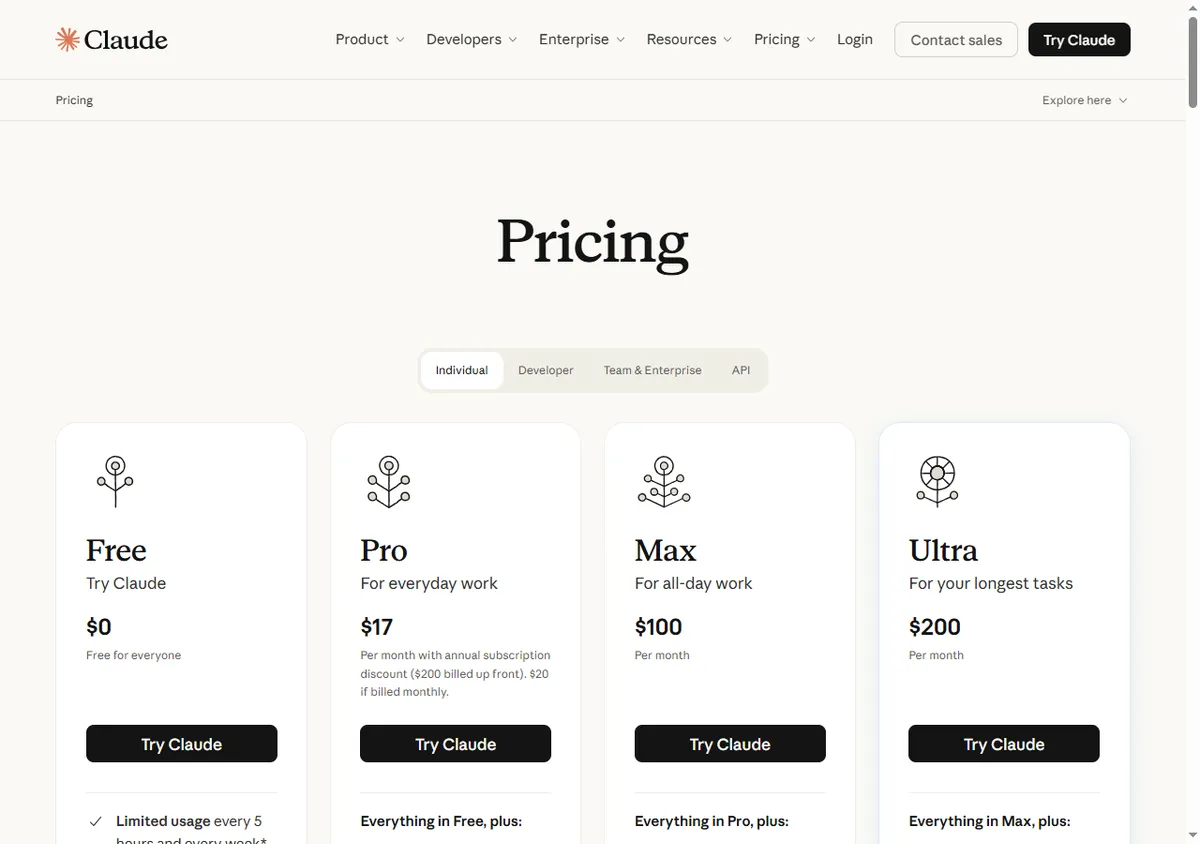
Anthropic prices Claude Code as part of a Claude subscription. The Pro plan is $17 per month with annual billing ($200 billed up front) or $20 billed monthly, and the pricing page lists Claude Code among the features Pro adds over Free. Max is $100 per month and Ultra is $200 per month, each with a larger usage allowance. There is no standalone Claude Code SKU on that page: you buy Claude, and Claude Code comes with it.

Cursor's own pricing page is the surprise, and it is the reason "everyone knows Cursor costs $20" is now a claim to check rather than a fact to repeat. The page we read on 2026-11-03 prints Free at $0, Plus at $8, Premium at $30, and Super at $100 per month, and states that subscriptions are sold through X Subscription Corp, with Grok models featured across the tiers and third-party models "at API list price" on Premium and above. If you last read Cursor's pricing when it was Free, Pro and Ultra, the page has genuinely changed under you.
Two practical readings of those two pages:
| If this is your situation | The shape that fits |
|---|---|
| You already pay for Claude and want the agent where you work | Claude Code is included on the plan you already have, as of 2026-11-03 |
| You live in an IDE and want the editor to think with you | Cursor's entry tiers start lower, $8 per month, but read the model list before you pick a tier |
| You run scheduled or scripted agent work in CI | Claude Code's CLI, hooks and scheduled tasks are the documented path |
| You review PRs inside the editor all day | Cursor lists AI code reviews as a tier feature |
Where each one is the wrong tool
A guide that never rules against either product is an advert, so here is the honest list, and it is symmetric.
Claude Code is the wrong fit if your work is mostly reading and editing unfamiliar code in place. The terminal loop, write a sentence, read a diff, is slower than tab completion when the change is smaller than a sentence. Anthropic's own docs position it around agentic work, not around autocomplete, and nobody who has used both would confuse the two experiences.
Cursor is the wrong fit if your work is orchestration rather than editing. Piping logs into an agent, running several sessions in parallel with separate permissions, scheduling overnight CI analysis: those are documented Claude Code workflows, and replicating them inside an editor means fighting the editor. And the pricing-page restructure above is its own caution: a tier that changes name and model list under you is a thing to re-check at renewal, not a fact to memorize.
How to decide, in one pass
Open your terminal history and your editor history and ask which one has more of your day. That answer, plus the pricing table above, settles it for most developers. If it is genuinely close, both vendors' free or entry tiers make trying the other one cheap, and the tool directory carries profiles for Claude and Cursor with the same sourcing rules this guide follows.
Our AI code category tracks the profiles behind both tools, and the Cursor vs GitHub Copilot comparison covers the editor-side question this guide deliberately does not: which editor-native tool to pick.