Runway's pricing card does something unusual with the entry price: it prints the monthly figure struck through, and the annual figure as the number in large type. The free tier is a different kind of unusual, because it is not a monthly allowance at all, and the help center says what it produces carries a watermark.
The card shows two prices, and the page leads with one of them
The pricing page on 2026-09-22 lists Free, Standard, Pro and Max. Standard shows a struck-through $15 beside $12, and the line under it reads "Billed annually. Save $36/year." Pro pairs $35 struck through with $28, and Max $95 with $76. The same arithmetic holds for all three, and the numbers agree with the savings printed beside them.
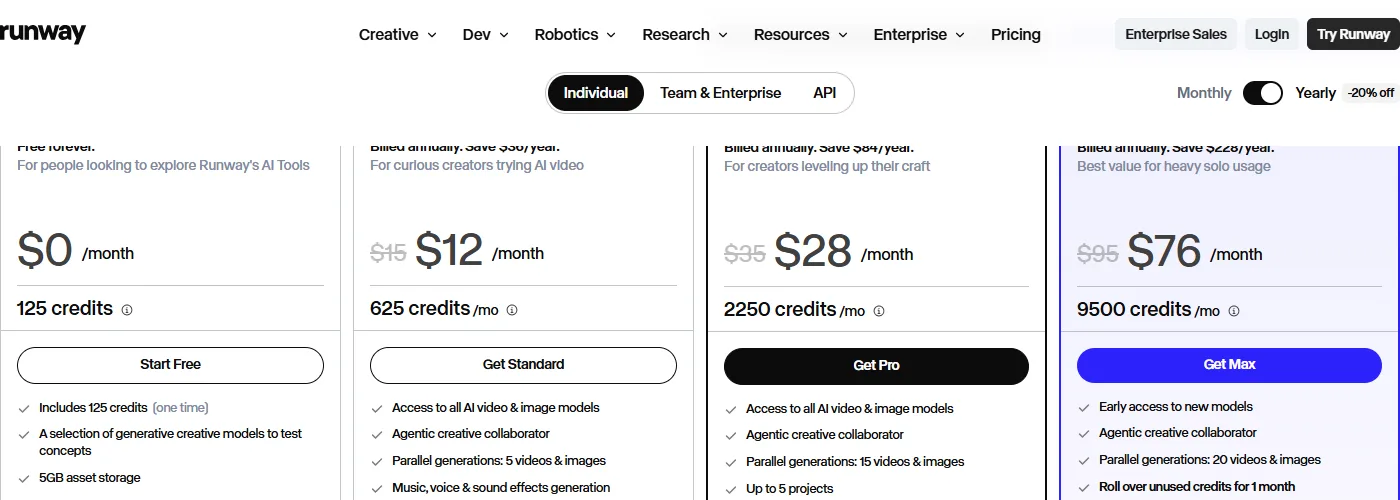
The catch is which number the page treats as home. The page title is "AI Image and Video Pricing from $12/month", the card shows $12 as the main figure and $15 struck through, and a "-20% off" badge sits on the annual toggle. Every plan's monthly rate is on the card and correct. It is simply the visually secondary figure, which is exactly how a reader skimming a shared screenshot can pick up the annual rate as the price. Our guide on choosing an AI video tool records the same caution about reading the billing toggle.
The monthly totals matter more on a subscription than the annual discount suggests: three dollars a month across twelve months is $36, which is the saving printed on the card. If you might stop after one month, $15 is the price, and the ability to cancel after a month is the whole reason the month-to-month figure exists.
The free tier is a one-time grant, and the watermark is in the help center
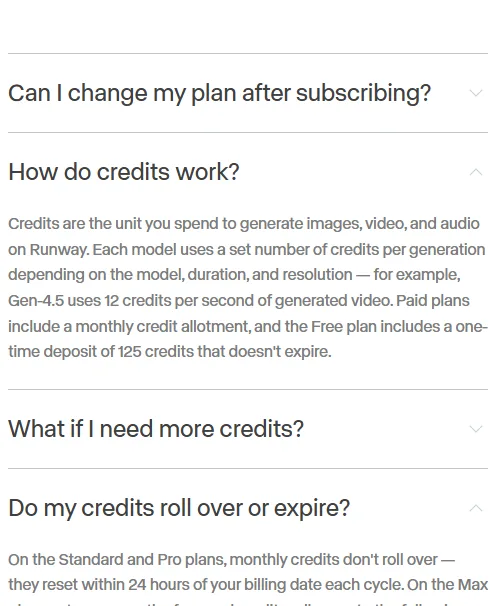
The Free card reads "$0", lists "125 credits (one time)", and the pricing FAQ spells out the rest: the free plan includes a one-time deposit of 125 credits that does not expire. Paid plans earn monthly allowances; the free plan does not refill. For a product whose credit costs are quoted per second of video, 125 credits is budget, not an allowance: the same FAQ prices Gen-4.5 at 12 credits per second, which puts the free grant at roughly ten seconds of that model.
Two consequences sit off the pricing page. The help center's subscription article says generations on the Free tier include watermarks, which you would not learn from the pricing card, and that free users cannot purchase additional credits. So the free tier is a tasting allowance: enough to judge whether the interface and a couple of models suit you, not enough to produce or buy your way past a deliverable. On the paid side, the same card lists "No watermarks" as a Standard feature, and the credits refill monthly.
What a credit buys is published, not guessed
The pricing FAQ states the unit economy in one sentence: credits are the unit you spend to generate images, video and audio, and each model uses a set number per generation depending on model, duration and resolution. Gen-4.5 at 12 credits per second is the example printed on the page. The Standard card translates its own allowance: 625 credits monthly, which the same card equates to 52 seconds of Gen-4.5, 104 seconds of Gen-4 Turbo, or 78 Gen-4 Images at 1080p.
That is the honest shape of the allowance. The unit is the vendor's, the conversion to a unit you understand comes from the vendor, and no part of the page needs you to reconstruct the maths. Credit rollover is stated the same way: Standard and Pro monthly credits reset within 24 hours of the billing date and do not carry over; Max rolls over up to one month; purchased credits never expire, and the minimum top-up is 1,000 credits. The order in which balances are spent is also published: current month's plan credits first, then rollover, then purchased.
The terms give you the output and keep the right to train on it
The document that decides what you may do with the result is the Terms of Use, last updated September 15, 2026. Section 4.4 says the company does not claim ownership of your inputs or outputs and does not restrict your commercial use of your outputs. That is the generous half, and it is stated without marketing.
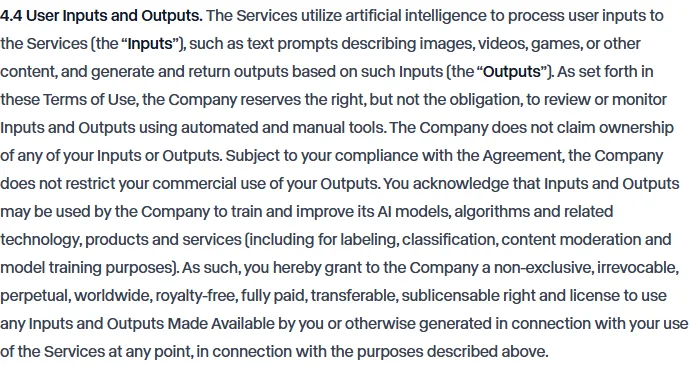
The same paragraph then names the license underneath. Inputs and outputs may be used by the company to train and improve its AI models, and the user grants a non-exclusive, irrevocable, perpetual, worldwide, royalty-free, fully paid, transferable and sublicensable right and license to use them for that purpose. That is a wider grant than the phrase "your outputs are yours" implies, and it applies to everything you generate, not to a sample. We found no consumer training opt-out in the privacy policy (which is effective as of May 11, 2026) or on the pages we read. Runway may well offer enterprise terms with a different arrangement, and this review has not read those.
We are not telling you this is unusual: synthetic media companies routinely take a training license. What matters is where it sits, and it sits beside the sentence promising open commercial use. Decide on the training license before you generate, because the license does not wait for your decision.
The lineup is mid-transition, so advice can name a dead tier
Runway began rolling out Max on June 1, 2026 and is phasing out Unlimited, its previous top individual tier. Eligible legacy Unlimited subscriptions keep their access through November 30, 2026 and then move to Max automatically at the same $95 monthly price, or can be cancelled for a refund of remaining months if annual. New subscriptions have not been able to choose Unlimited since June 1, 2026.
Two facts flow from that. First, reviews and guides written before mid-2026 may name "Unlimited" as a plan that no longer exists for new buyers. Second, the current lineup is credit-based and stated per tier, which is a newer shape than the relaxed-rate, unlimited-style plan it replaces. If a comparison or a video from earlier in the year cites Unlimited, check the date it was written.
What the score rests on
The five components and their weights are published on our methodology page, so here is what this review put under each of them.
Fit for the stated job, 30 percent. Runway is a text-to-video, image and audio suite with a timeline editor inside the same product, which covers the generation half of this category and the editing that follows it.
Cost to get started, 25 percent. A priced monthly and annual pair on every card, with the conversion from credits to seconds published. Held back hard by the free tier: one-time credits, no purchases on free, and watermarks documented away from the pricing page.
What the vendor commits to, 20 percent. Open commercial use of outputs, published credit economics, and a dated terms document. Held back by the irrevocable perpetual training license with no consumer opt-out we could find, and by a lineup transition that makes third-party advice date-sensitive.
Portability, 15 percent. Paid plans export from 4K upscaling up to ProRes and image sequences on the higher tiers, purchased credits never expire, and help articles state cancellation behavior plainly. Assets and projects stay after a cancel, subject to the free plan's project cap.
Documentation quality, 10 percent. The pricing FAQ, the credits article and the subscription guide answer the follow-up questions in writing, dated, with numbers attached. The watermark claim is documented; its placement is the defect.
Weighted at the published weights, that comes to 7.6, which places Runway below the Synthesia review in cost of trying it while standing apart on the width of what you can make.
What we could not settle
There is no score for output quality here. We do not generate footage and score it, and we have not found an independent benchmark of text-to-video quality we would be willing to rank on. There is also no figure for the exact per-credit price of a top-up, because the pricing page publishes only the 1,000 credit minimum. And the pricing page's own data disagrees with its printed cards on storage for Standard and Pro, so this review names no storage figure rather than pick a side inside the vendor's own page.
The Runway tool profile carries the same figures with the same dates, the AI video generators ranking reads the free allowances side by side, AI video is the category hub, choosing an AI video tool is where the three ways of charging are set against each other, and Runway vs Pika is where the two credit systems are compared directly.