Pika's pricing page now tells you something its older pages did not: the free plan lists zero credits per month, and the Starter plan prints an entry price of $10 a month with 900 credits. The numbers changed, and so does the buying question, because the terms make the license the deciding document.
Why the free tier changed the buying decision
The current pricing page lists Free at $0 with 0 credits per month and the note "packs only". There is no monthly allowance to evaluate the product on, and a top-up is a one off purchase that does not start a subscription. So the first generation is the first payment, which is a different posture from the one time 125 credits Runway grants or the ten minutes a month Synthesia publishes.
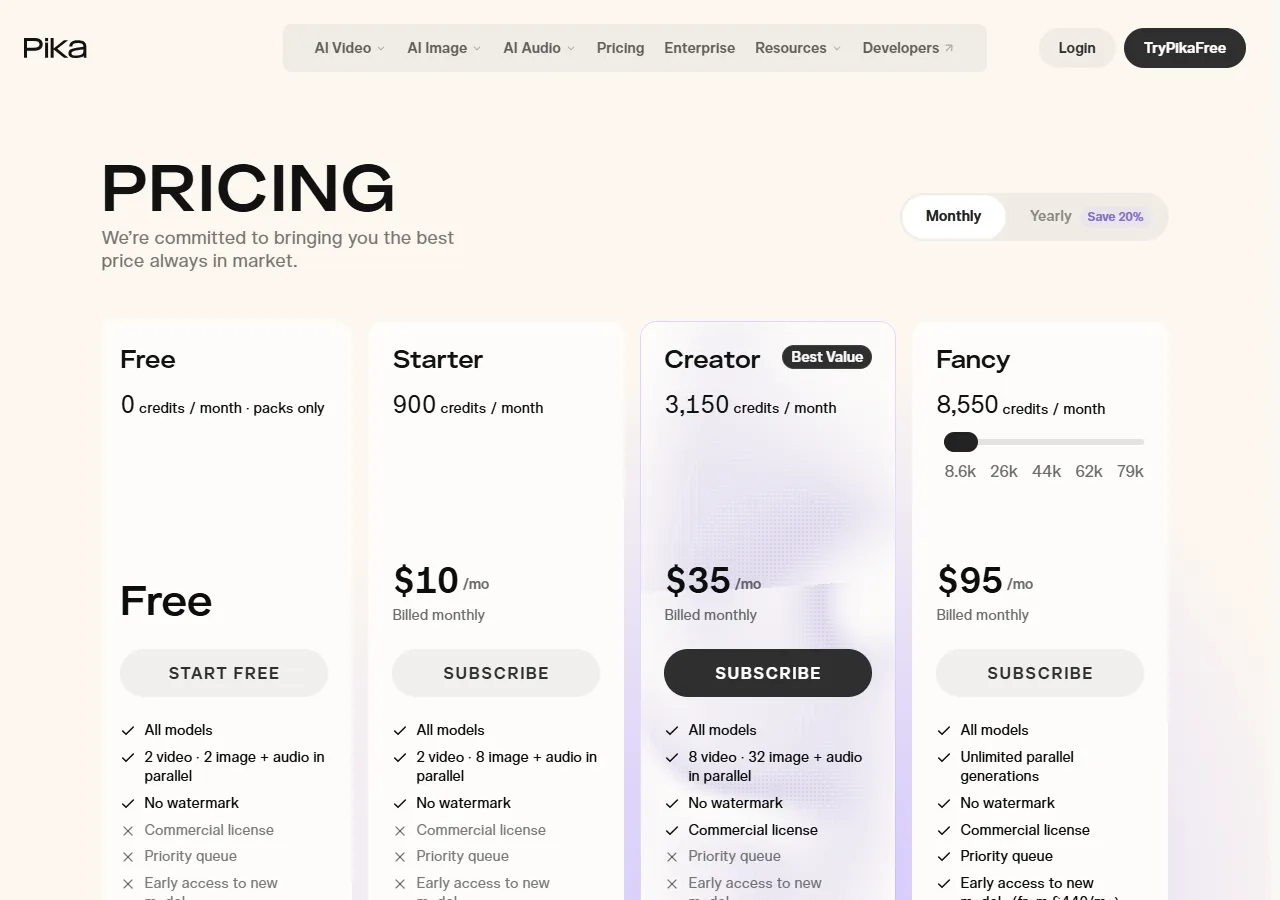
The Pika profile records the same reading with the same dates, and the AI video generators ranking is where this free grant sits against the field: it is the only entry that prints zero credits with paid packs only.
The entry price is $10, and the commercial boundary is the next number
The Starter card prints $10 a month on monthly billing, with $8 a month billed annually on the same card. The same table lists 900 credits per month for Starter and marks the commercial license as not included. The plan where the table marks the commercial license as included is Creator at $35 a month, and the support page states the same boundary: the starter plans do not grant commercial rights, and Creator and Fancy do.
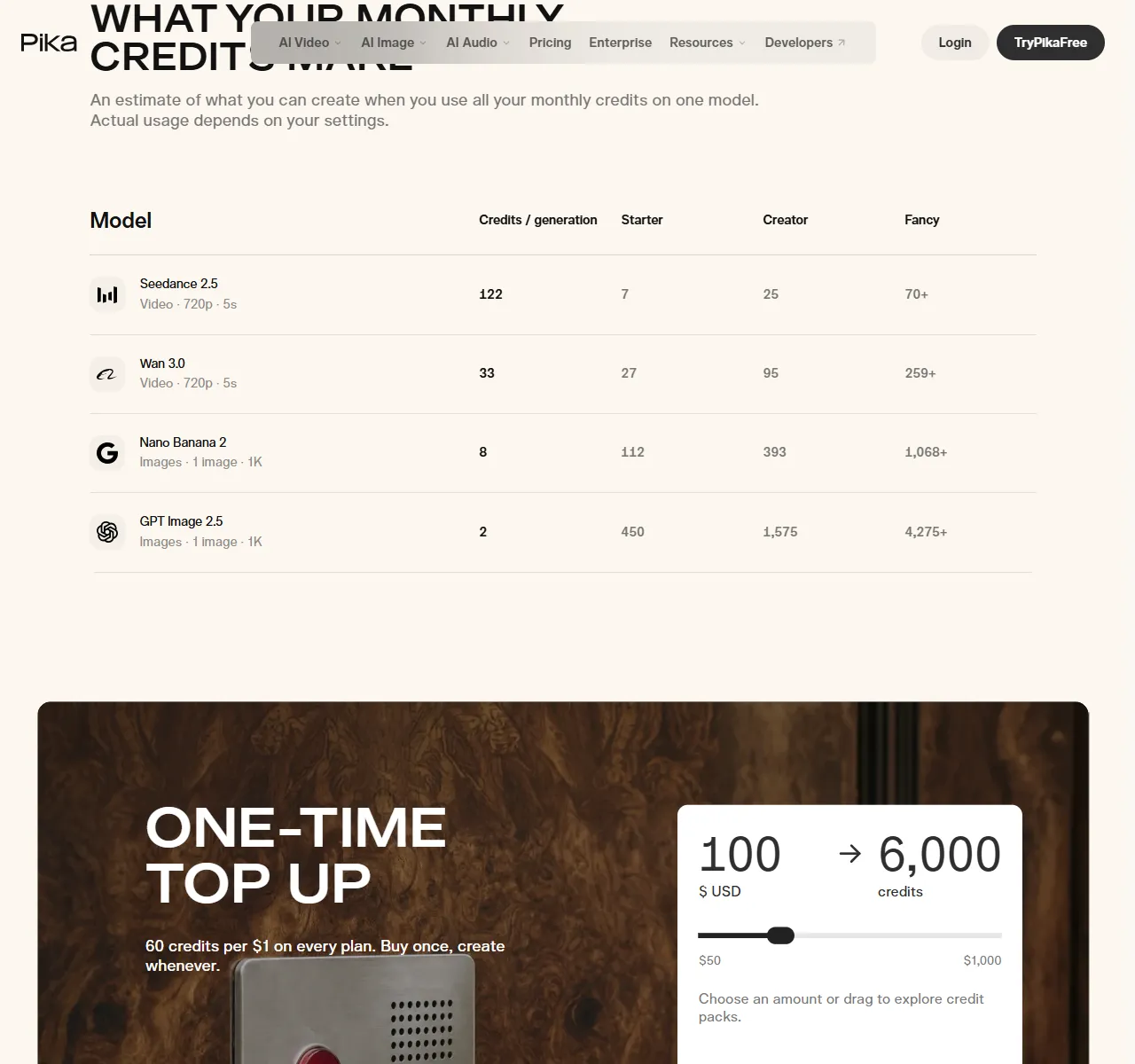
The credit economy itself is published in one table: Seedance 2.5 Video costs 122 credits for a 5 second 720p clip, and the same table prints the vendor estimate column, which reads 7 clips per month for a Starter account when all of it is spent on that one model at that one setting. The estimate is the vendor's arithmetic, and the review repeats the row rather than converting between units.
What the terms give you, and what they take
The Terms of Service, last modified August 4, 2026, separate ownership from the licenses. The ownership clause states that Pika does not claim ownership of your User Content, and that you retain all rights in your Inputs and the Outputs generated through the Service.
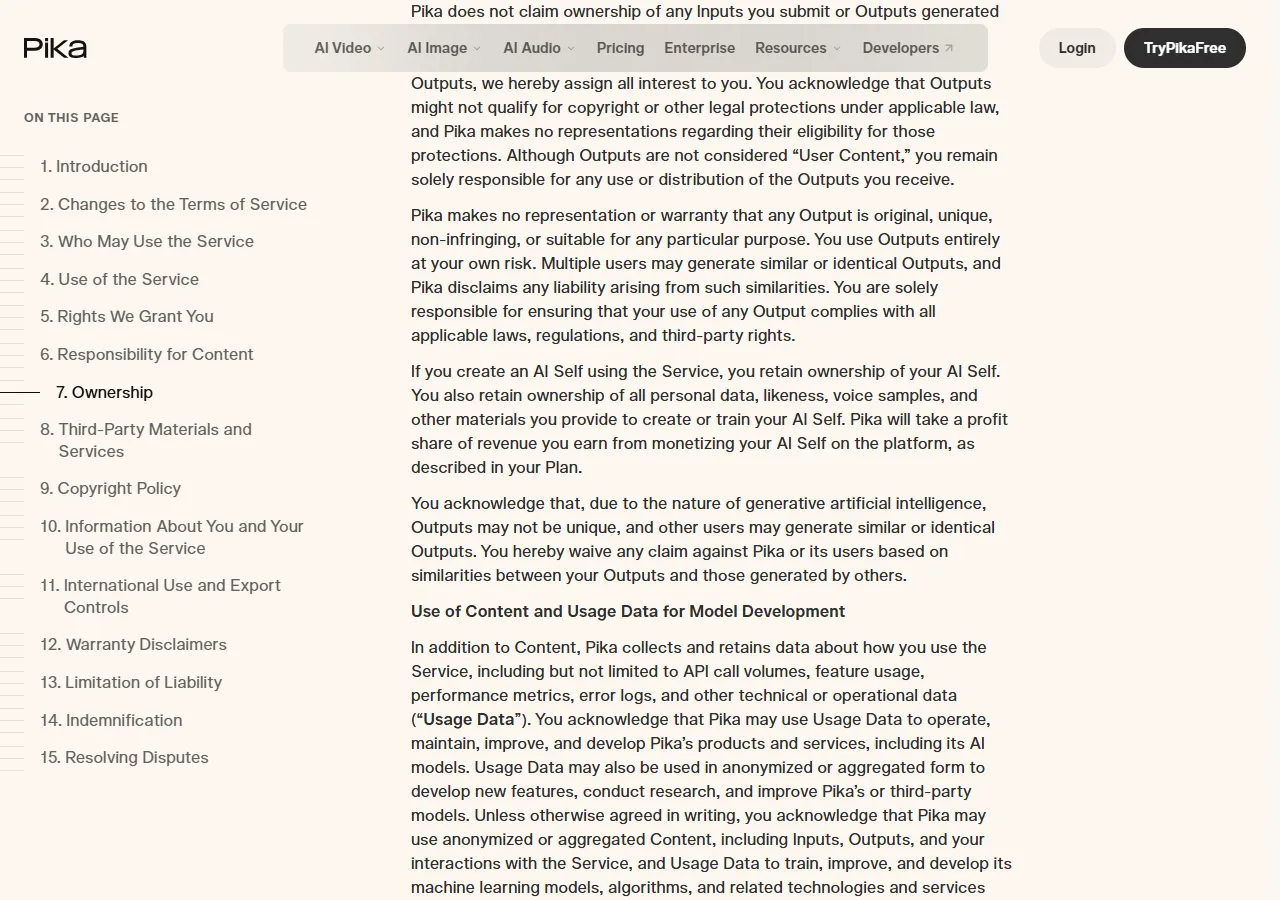
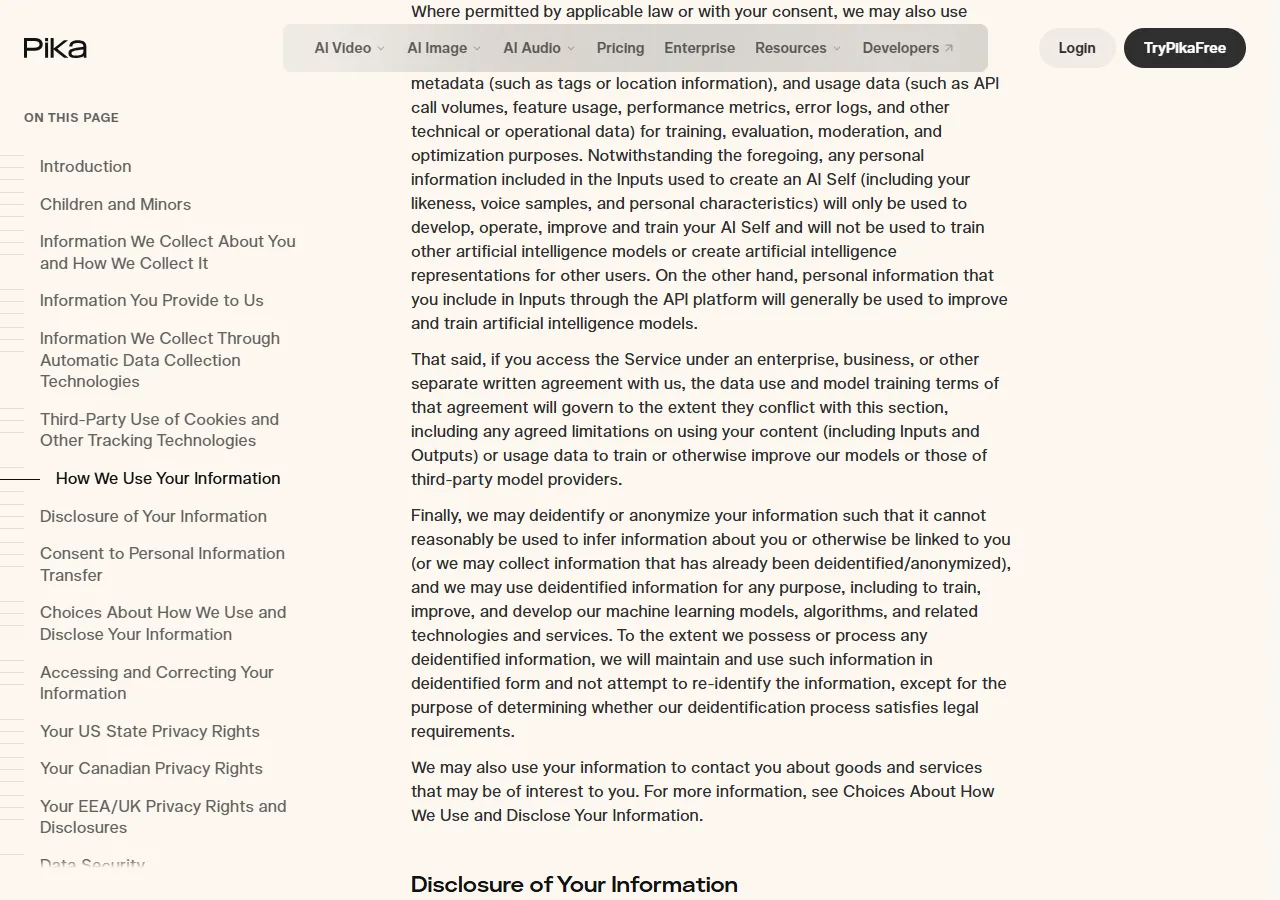
Two license clauses then follow in different parts of the document. For User Content you publish or share, you grant Pika a worldwide, nonexclusive, royalty free, transferable, sublicensable license to use, reproduce, modify, adapt, publish, translate, create derivative works from, distribute, perform and display it as necessary to operate, improve and promote the Service. And for model development, the terms allow Pika to use anonymized or aggregated Content, including Inputs and Outputs, and Usage Data to train, improve and develop its machine learning models, with a nonexclusive, perpetual, irrevocable, worldwide, royalty free, fully paid, transferable and sublicensable license to use, reproduce, analyze and modify that Content where rights in it are needed. The perpetual license is the one to read before you generate. The privacy policy repeats the training use in its own words: where permitted by applicable law or with your consent, Pika may also use content you submit, including Inputs and Outputs, to improve its AI models.
What the documents do not document
During this review we looked for a web app training opt out and did not find one. The opt out mentions the privacy policy does carry cover behavioral tracking, targeted ads, promotional email and sales, not training. The documents reviewed do not document a web app training opt out, so this review states the absence against the documents read, and enterprise agreements can differ.
The other gap is Pika's own documentation. A legacy FAQ still hosted under pika.art/faq describes an older plan structure: a Basic free plan with 150 credits per month, weekly billing, and top ups that never expire. Each current document is scoped separately: the pricing table supplies the current plan names and purchase figures, the support page corroborates the current credit behavior, and the terms corroborate the billing cycle and credit expiration semantics. The legacy FAQ remains an outlier among the official documents checked, and it is still reachable from the pricing page's navigation.
What the score rests on
The five components and their weights are published on our methodology page, so here is what this review put under each of them.
Fit for the stated job, 30 percent. Pika is a full text to video, image and audio generation suite with a published unit economy, and the core job, prompt to clip, is exactly what the credits matrix is published against: Seedance 2.5 Video at 122 credits for a 5 second 720p clip. It loses ground because the fit is scoped to generation, with no editing suite or timeline, and the commercial use boundary splits the audience.
Cost to get started, 25 percent. The entry price is legible and published on one card, monthly and annual together, and the credit math is on the same page. Held back hard by the free tier, which grants nothing monthly, the weakest free posture in this ranking alongside Google Veo, which prints Not available on its own pricing page. Packs start at $50, and one-time top-ups are sold at 60 credits per $1 on every plan.
What the vendor commits to, 20 percent. Dated legal documents, a published credit economy, and an ownership clause that is explicit. The perpetual model development license over anonymized or aggregated Content, the missing web app training opt out, and the commercial boundary at $35 all pull the score down.
Portability, 15 percent. Outputs are owned by you and export without a watermark on paid plans, and top up credits survive across billing periods. Plan credits do not roll over, the web and API balances are separate, and no export workflow is documented in the pages we read.
Documentation quality, 10 percent. The pricing page publishes the credit economy in one table with per model costs and per plan estimates, and the legal pages are dated. The legacy FAQ reachable from the same navigation is a real documentation defect and it costs the score.
Weighted at the published weights, that comes to 6.8, which places Pika below the Runway review on the free allowance you can evaluate with, and below the Synthesia review on the width of what you can make.
What we could not settle
There is no score for output quality here. We do not generate footage and score it, and we have not found an independent benchmark of text to video quality we would be willing to rank on. There is also no figure for what a new Pika account receives without paying, because the pricing page does not state a welcome credit or trial allowance beyond the packs it sells.
The Pika tool profile carries the same figures with the same dates, the AI video generators ranking reads the free allowances side by side, AI video is the category hub, choosing an AI video tool is where the three ways of charging are set against each other, and Runway vs Pika compares the two credit systems directly. The Runway review reads the other credit based entry price in this category, and choosing between them is a terms decision as much as a price one.