GitHub Copilot prices the entry plainly and answers the privacy question twice, differently, depending on whether you are an individual or an organization. That split is the most surprising fact in this category, and it is the one a buyer should settle before the price.
The privacy answer depends on which plan you buy
The strongest published fact in this review is not about completions or credits, it is about what GitHub does with your data. It is written in one documentation section with two halves. For individual Free, Pro, Pro+ and Max plans, GitHub states that starting April 24, 2026 it may use your interactions, including inputs, outputs, code snippets and associated context, to train and improve AI models, and that you can opt out in your personal Copilot settings. For Business and Enterprise plans, the same page states that GitHub does not use customer data to train its AI models, and that the data is protected under the Data Protection Agreement.
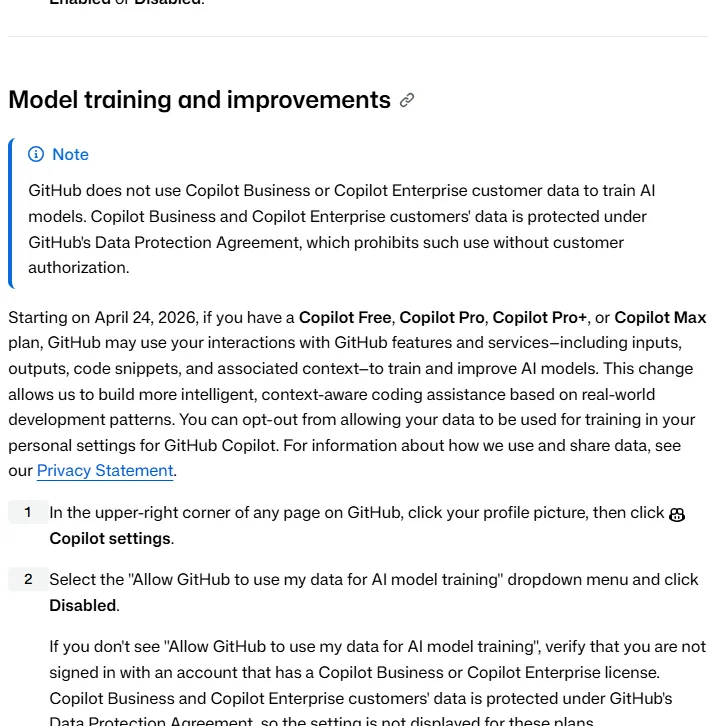
Neither half transfers to the other. The individual policy does not apply to an organization seat, and the organization policy does not protect an individual's data. The documentation does not state what the individual opt-out defaults to, so this review says may use unless you opt out, which is exactly what GitHub writes. A security review will want to know which of the two answers applies to the account under purchase.
The billing model changed more than the price did
The $10 entry price that has been associated with Copilot for years is still true: Copilot Pro is $10 a month as of the day we checked. What changed is the unit. Usage is now billed in GitHub AI Credits at 1 credit = $0.01 USD, chat and agents draw from a monthly allowance, and the old request-count mental model is gone. The current profile of this comparison still printed a 50 chat request figure alongside the completions; the billing documents and GitHub's own AI Credits FAQ have both moved to credits, so we have repaired the profile and the comparison in the same change as this review.
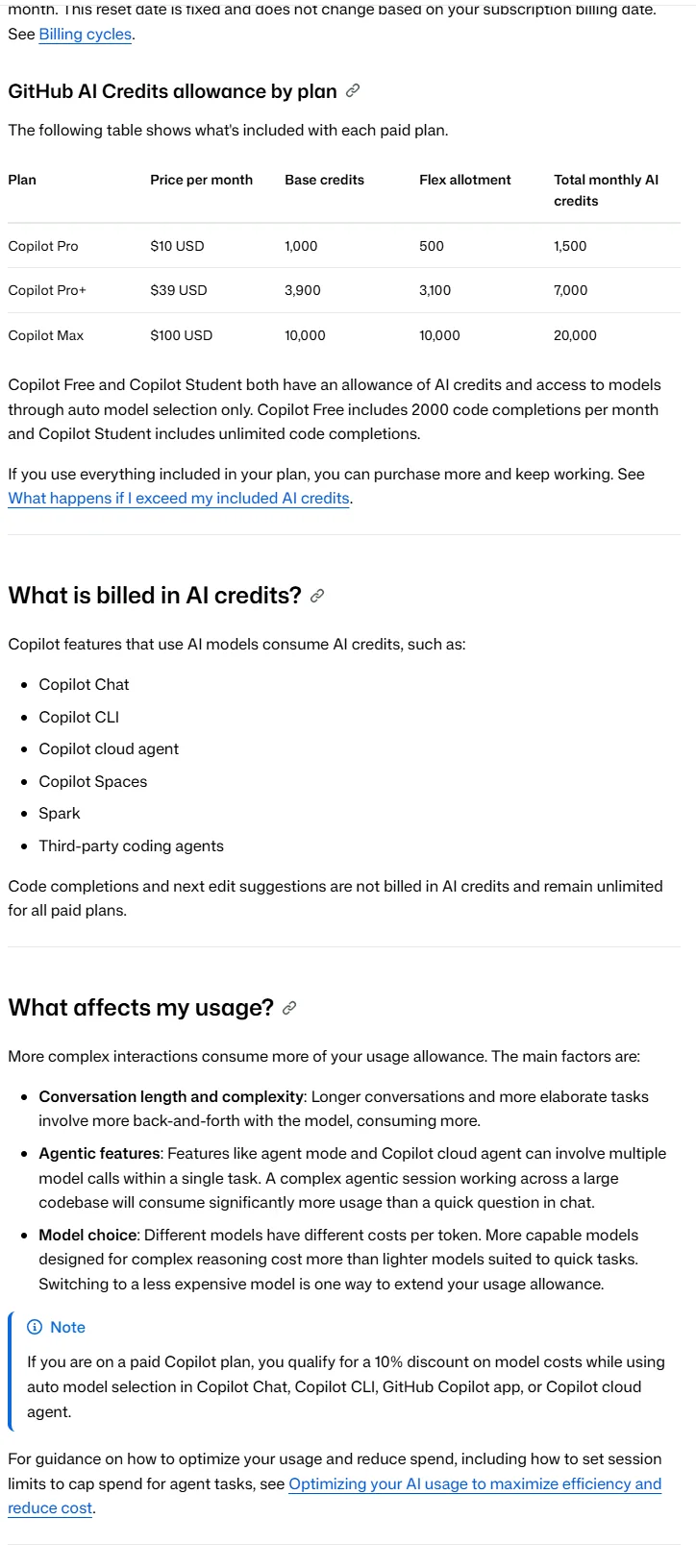
The allowance table in GitHub's docs is unusually explicit for this category. Pro includes 1,500 credits a month (1,000 base plus 500 flex), Pro+ includes 7,000 (3,900 plus 3,100), and Max includes 20,000 (10,000 plus 10,000). Copilot Free gets 2,000 completions a month plus an allowance of credits, and Copilot Student, free for verified students, gets unlimited completions. One cell carries a caveat the review is not allowed to trim: the flex allotment is a variable part of the included usage, written to adapt as model economics change. So the headline total is a floor plus a flexible top, and the predictable part of a paid month is the base number, not the total.
The free tier is the only countable one in this category
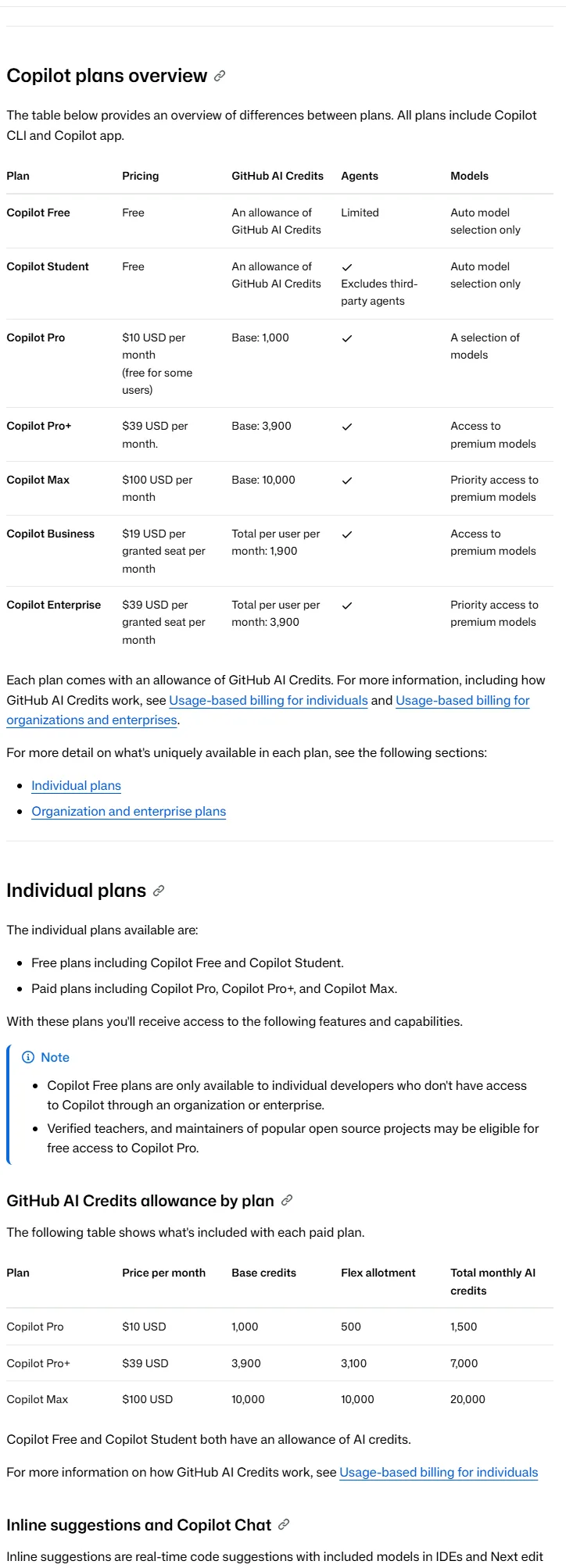
The comparison this review sits beside turns on this row. Cursor's Hobby card says Limited Agent requests with no digit beside it. GitHub prints 2000 completions per month for Copilot Free and names the allowance unit. Two other boundaries on the plans page matter for the buying decision: the cloud agent is gated at Pro, so Free is the only individual plan without it, and third-party coding agents such as Claude Code and Codex start at Pro. Copilot Student is the plan that reads oddly: it is free, it excludes third-party agents, and it has the cloud agent.
What an organization seat actually buys
Business is $19 per granted seat per month for 1,900 credits per user, Enterprise is $39 per granted seat for 3,900. The word granted matters: it is per seat an account is assigned, not per developer who happens to use the tool. Included credits pool at the billing entity level, so an enterprise of 100 Business users gets one shared pool of 190,000 credits rather than 100 individual buckets. When the pool runs out, additional usage is enabled by default on organization plans, an admin must explicitly disable the paid usage policy to stop it, and there is no automatic fallback to lower-cost models. That is the opposite default from the individual side, where additional usage has to be deliberately enabled with a dollar budget.
The exit is a downgrade, not a cutoff
Cancellation keeps your features to the end of the billing cycle and then drops you to Copilot Free rather than cutting access. That is a softer exit than an editor migration, and it is one reason an organization can pilot Copilot with less commitment risk than a tool that asks the whole team to switch. The honest caveats are on the data side: GitHub documents a general right to request deletion under its privacy statement, but there is no Copilot-specific export workflow or deletion SLA. Leaving with your prompts and your history is a request under a policy, not a download button.
What the score rests on
The five components and their weights are published on our methodology page.
Fit for the stated job, 30 percent. A coding assistant that installs into the editor and the platform a team already runs, with a free tier and no credit card. Held back only by the cloud agent being Pro-gated.
Cost to get started, 25 percent. A real free tier, an entry price of $10 below the compared editor's $20, and an overage rate published in plain terms. The variable flex allotment keeps the predictable part of a paid month below the headline.
What the vendor commits to, 20 percent. The strongest privacy document in the category: Business and Enterprise data not used for training, protected under the Data Protection Agreement, with the individual opt-out named.
Portability, 15 percent. A soft exit to the free plan, no editor migration. No Copilot-specific export or deletion flow documented.
Documentation quality, 10 percent. The billing and policy pages answer the follow-up questions in writing, dated, with the flex allowance and the reset rule named.
Weighted at those weights the total comes to 8.0.
What we could not settle
There is no score for output quality, because we did not measure it and no independent coding-agent benchmark we would rank on is in this review's sources. There is also no figure for the default of the individual training opt-out, because GitHub's documentation states that you can opt out and does not state what the setting starts as. The 50 chat request figure is not published here, because the billing documents and GitHub's own AI Credits FAQ have both moved to credits, and we do not quote a number the vendor contradicts on its own page.
If you are comparing editors, the GitHub Copilot tool profile carries the same figures, and the comparison with Cursor reads the two free tiers side by side. AI coding is the category hub.