
Google shipped two Gemini 4 models in two weeks, and they are not two sizes of the same thing. Carbon, announced October 28 and available since November 10, is built for sustained, long-horizon agent work. Hydrogen, announced November 12, is built for speed on everyday coding and agentic tasks. Every figure here was read off Google's own announcements and the Gemini API pricing page on November 13, 2026, and the two pricing pages, read side by side, answer the buying question faster than any benchmark table does.
Two models with two different jobs, by Google's own description
Google's own words draw the line. Carbon is "designed to take on much harder, long-horizon engineering problems" and is "built for sustained agentic workflows", with the announcement calling it the company's strongest model for cybersecurity. Hydrogen is "built for rapid execution across diverse agentic workflows" and "built to stand on its own as a model for everyday work". Nothing in either announcement frames them as competitors; they are the deep-reasoning slot and the fast-everyday slot of one lineup, and Google demonstrates pairing them rather than choosing between them.
That division decides most of what follows: the pricing, the access restrictions, and the benchmark tables are all shaped by which job each model is doing.
What the two models cost, and when the intro price dies
The pricing pages separate cleanly, because one of the two models is still in a promotional window.
| Gemini 4 Carbon | Gemini 4 Hydrogen | |
|---|---|---|
| API model ID | gemini-4-carbon | gemini-4-hydrogen |
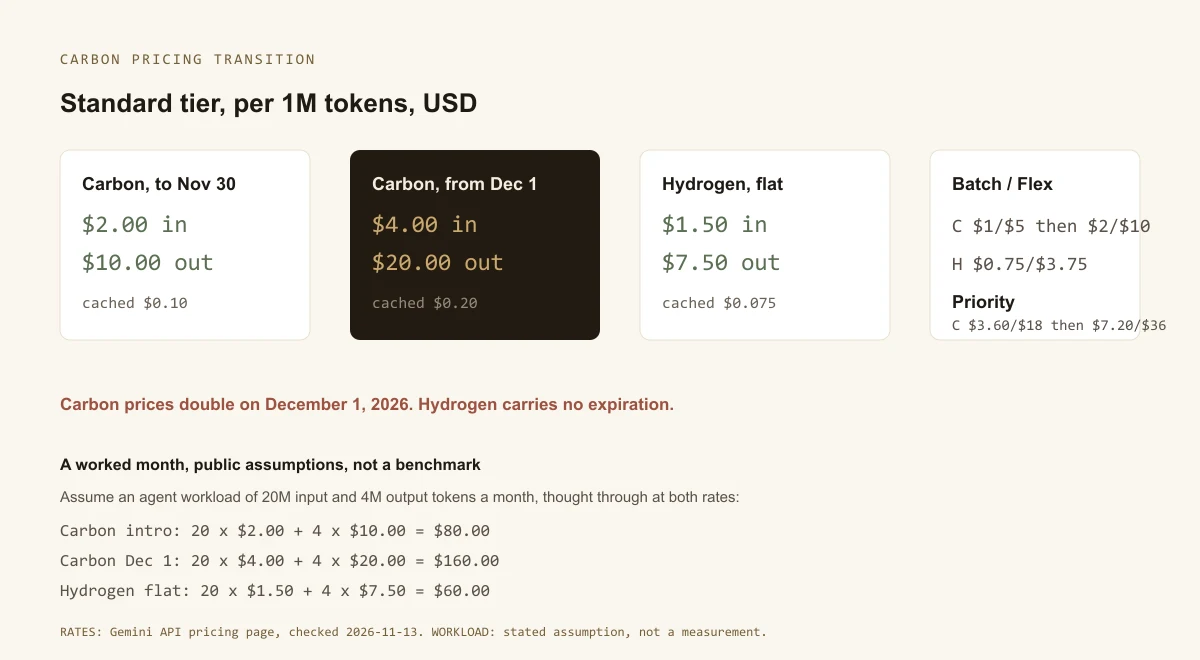
| Standard input, per 1M tokens | $2.00 through Nov 30, 2026; $4.00 from Dec 1, 2026 | $1.50, no expiration listed |
| Standard output, per 1M tokens | $10.00 through Nov 30, 2026; $20.00 from Dec 1, 2026 | $7.50, no expiration listed |
| Cached input, per 1M tokens | $0.10 (doubles Dec 1; implicit caching only) | $0.075 (implicit caching only) |
| Batch / Flex, per 1M tokens | $1.00 / $5.00 (doubles Dec 1) | $0.75 / $3.75 |
| Priority, per 1M tokens | $3.60 / $18.00 (doubles Dec 1) | $2.70 / $13.50 |
| API Free tier | Not available | Available, free of charge |
| Context | Long-decode generation up to 1M tokens (pricing page); input window not stated | Unified 1M-token input, up to 1M output |
Every Carbon cell above is time-limited except the ones marked otherwise. Google's footnote on the availability post states it directly: after the introductory period expires on November 30, 2026, $4 per 1M input and $20 per 1M output apply. From December 1, Carbon's standard output costs more than twice Hydrogen's, and that is the price at which Google intends to sell the frontier tier.
The cost comparison changes shape on December 1. At the introductory rate, Carbon is $0.50 more than Hydrogen on input and $2.50 more on output. At the standard rate it is $2.50 more on input and $12.50 more on output. Any budget built on today's Carbon pricing expires with the promotion on November 30.
Billing details worth knowing before subscribing: every token Carbon processes is counted and billed, including thinking tokens, which is stated on the pricing page, and grounding with Search carries 5,000 free requests monthly shared across Gemini 3+ models, then $14 per 1,000 with a 1,500-per-day cap.
What the benchmarks show, and what they cannot
The two models were benchmarked against different comparison sets, because they occupy different tiers, so their scores should not be read as a head-to-head ranking. Both figures below are Google's own, from the announcements and the DeepMind model pages, dated November 2026, with the independent third-party check noted where it exists.
Carbon, against frontier peers including Claude Opus 5.5 and GPT-6 Astra: Artificial Analysis Intelligence Index v5.0 rank #1 at 59. Security work is its stated specialty: SEC-bench Pro 88.2% for finding vulnerabilities, ExploitGym 54.8% where Google claims a new state of the art, CWE-bench 71.0% for turning findings into working patches. Google says external cyber benchmarks were run without guardrails. Terminal-Bench 4.0 cheating reduced to 0.0%, and a 0.0% attack success rate on the Gray Swan indirect prompt injection benchmark.
Hydrogen, against same-tier peers including Claude Sonnet 5.5 and GPT-6.1 Terra: Artificial Analysis Intelligence Index 51 at its default high setting (one point over Argon) and 54 at the new xhigh thinking level. Terminal-Bench 4.1 57% against Gemini 3.8 Flash's 18.2%, with fabricated claims cut more than fivefold. Speed is the headline: 2.5 times faster than Gemini 3.8 Flash at its high default setting, with partners reporting 2x to 2.8x speedups and 12% to 23% lower token consumption.

The independent check is incomplete. Artificial Analysis' own homepage shows Gemini 4 Carbon (High) ranked #2 across its six Capability Indexes, behind Claude Fable 5.2 (Max), but its Intelligence Index scores do not render as text on the page, so the #1-at-59 rank above is Google's claim attributed as such, neither confirmed nor contradicted by the third party. Hydrogen appears in Artificial Analysis' changelog as evaluated on November 12 with no scores published yet at the time of checking. A model's own evals page is the vendor's evidence, and this site labels it as such every time.
The thinking-level dimension is Hydrogen-only as far as either announcement states: low, medium, high (default) and the new xhigh. Carbon's announcement names no thinking tiers.
Where each one fits, and where both do
Pick Carbon when the work is deep, not wide. Root-causing a bug in a large codebase, patching low-level systems, security review where the finding has to be exploitable rather than plausible, or agent runs that span hours. The pricing confirms the positioning: it is the only one of the two sold without a free tier, and its December price makes it the expensive slot on purpose.
Pick Hydrogen when the work is the day itself. Everyday coding assistance, high-volume agent runs where latency compounds, workloads where you would otherwise accept a smaller model's quality to stay inside a budget. Its API free tier also makes it the only one of the two you can evaluate without a payment method.
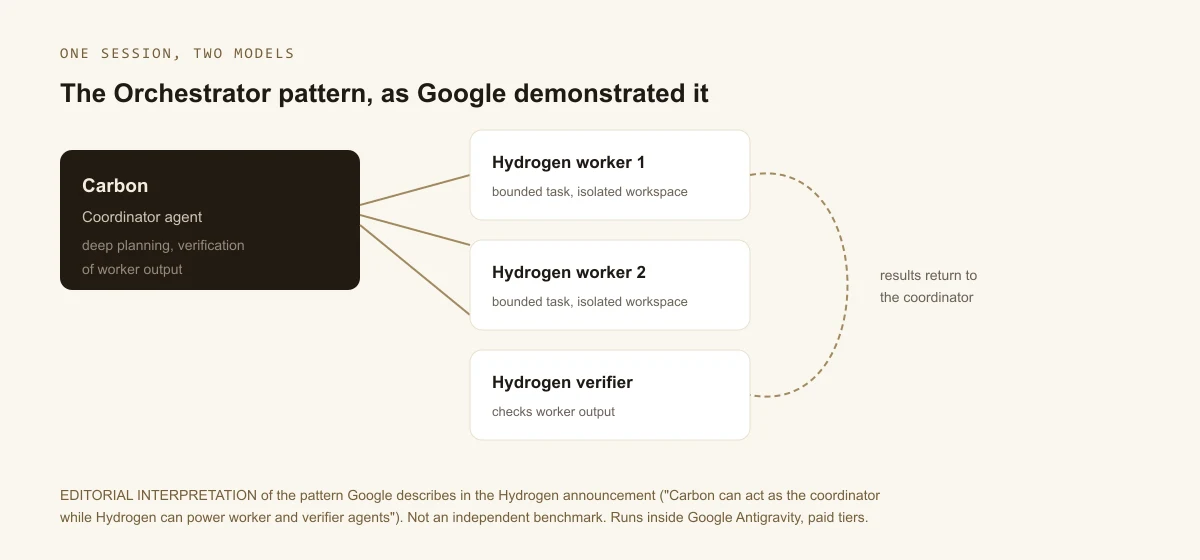
Run both, the way Google demonstrated it. The Hydrogen announcement introduces Orchestrator in Google Antigravity, which switches between models within one session, and describes the pattern in one sentence: "Carbon can act as the coordinator while Hydrogen can power worker and verifier agents." That is a real architectural statement, not marketing: a Carbon-driven coordinator delegating bounded tasks to Hydrogen workers buys frontier reasoning where the plan is made and commodity speed where the work is done. Antigravity itself requires a paid Google AI Pro or Ultra subscription, so the pairing is a subscription feature, not an API pattern.
Where to get each one
Carbon's access is the more gated. The API is limited to paying developers and enterprises, it is not on the API Free tier, consumer access requires a Google AI Ultra subscription, and cybersecurity-specific access runs through the Fairwind Program on an application basis. Hydrogen is on Google AI Studio, the Gemini API, Gemini for business, the Gemini app, and Google Search for all users globally, plus Google Antigravity for paid Google AI Pro and Ultra subscribers; free-tier users reach it through auto model selection. One data-handling difference worth reading before choosing: the pricing page states that Hydrogen free-tier content is used for product improvement, while Carbon and Argon free-tier data are not, and Hydrogen's paid tier is not either.
Google Search carries Hydrogen, which upgrades the responses Search produces. Nothing in either announcement says anything about how Google indexes, crawls, or ranks websites, and no such claim belongs in this article.
What the benchmarks have not settled
No independent latency figure in seconds exists in anything checked here; the speed claims are Google's own multiples against its own previous model. No independent benchmark of Carbon's Intelligence Index rank was readable as text at checking time. No price other than the ones in the table above is published; Google has not said what Carbon's pricing becomes after any future change beyond the December 1 doubling already footnoted. And no score on either table says anything about how either model performs on your codebase: the honest move is to run the two prompts you actually care about through AI Studio, where Hydrogen costs nothing to try, before deciding which one a workload pays for.
The one-paragraph decision rule
If the job is deep, rare, and expensive to get wrong, Carbon is the tool Google built for it, and its real price starts December 1. If the job is constant, high-volume, and speed-sensitive, Hydrogen is the tool priced flat for it, with a free tier that makes trying it a zero-cost decision. If your workload has both shapes, the Orchestrator pattern prices them as a pair: one frontier brain planning, many fast workers executing. Budget accordingly: today's Carbon price is a promotional price with an expiration date.
Our AI coding category tracks the tools these models power, our methodology explains how sourcing on this site works, and the guide to Claude Code vs Cursor covers the editor-and-agent question these models plug into.