
Google has shipped three Gemini 4 models in under three weeks, and a fourth name is now circulating that Google has never said out loud: Krypton. It exists today only as community tester reports about an internal checkpoint, summarized by CometAPI, with no listing in Google's model catalog, no announcement, and no published price. This article separates the two piles: what Google actually documents as of November 15, 2026, and what the leak reports without verification behind it.
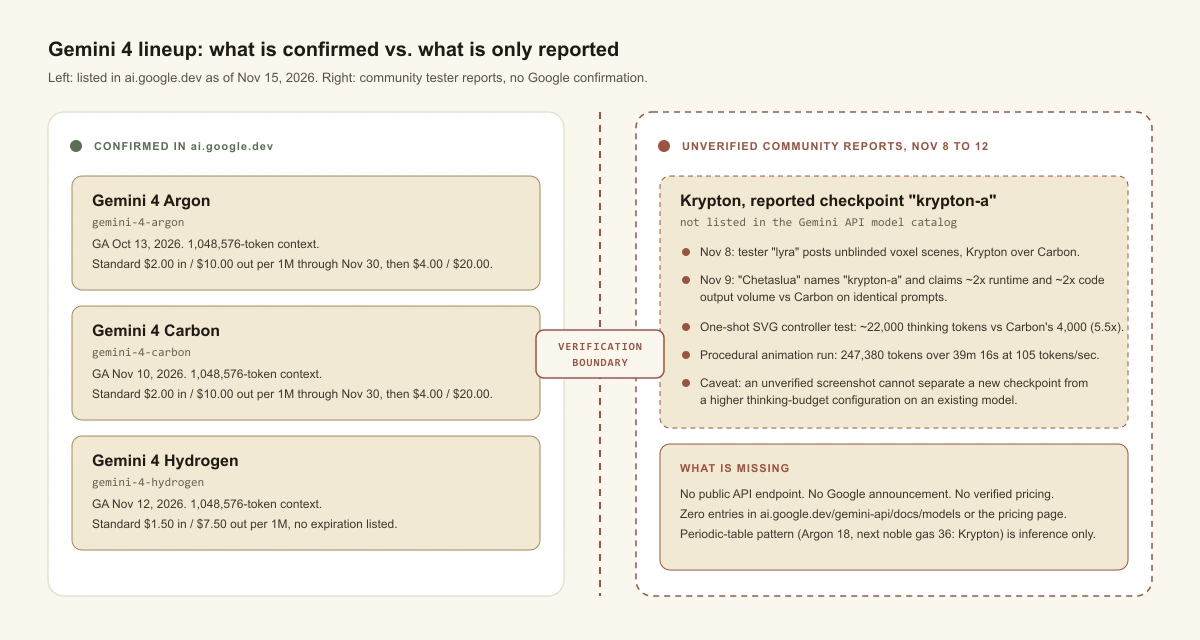
What Google actually lists, as of November 15, 2026
The Gemini API model catalog lists exactly three Gemini 4 models. Carbon (gemini-4-carbon) is the strongest reasoning model for complex software engineering, multimodal knowledge work, scientific reasoning, and cybersecurity defense, announced October 28 with broader availability November 10. Argon (gemini-4-argon) is the efficient frontier model, announced September 30 with general developer availability October 13, and Google's announcement ranks it #1 on the Vals Index at launch. Hydrogen (gemini-4-hydrogen) is the everyday coding and agentic model, announced November 12 and also rolled out to Google Search. All three carry a 1,048,576-token context window with the same 1,048,576-token long-decode output ceiling, and all three take text, image, audio, video, and PDF input.
The catalog's absence is the finding: a search for gemini-4-krypton or krypton-a returns zero entries in the model catalog and the pricing page. Whatever Krypton is, Google has not put it on a price list, and that is the strongest single fact in this article.
What the leak reports, and how it started
The reports began on November 8, 2026, when an X user posting as lyra claimed Google had an internal checkpoint called Krypton that outperformed Carbon, posting unblinded voxel-scene comparisons: a hillside castle, a harbor village with ships, a lighthouse, a windmill, a waterfall. OfficeChai summarized the claim on November 9, and CometAPI on November 12. On November 9, an X user posting as Chetaslua referred to the tested checkpoint as krypton-a, meaning the first checkpoint, and reported roughly 2x wall-clock runtime and 2x code output volume on identical prompts compared to Carbon.
The naming fits a pattern people have been reading into Google's lineup since Argon: hydrogen is atomic number 1, carbon 6, argon 18, and krypton 36, the next noble gas after argon in Group 18. That pattern is an inference from public names, not a document, and it is the kind of reading that produces confident wrong predictions as often as right ones.
The confirmed lineup rests on official releases: Carbon's launch artwork is real, Google's own, and readable below as the anchor of the documented family.
The two numbers testers keep citing, and the catch in each
Two specific claims carry the leak. The first is a one-shot PlayStation-style SVG controller test, where the reported graphic showed roughly 22,000 thinking tokens for krypton-a against about 4,000 for Carbon, a 5.5x difference in thinking-token volume. CometAPI's own caveat is the correct one: an unverified screenshot cannot distinguish a new base checkpoint from a higher thinking-budget configuration on an existing model. Thinking effort is a dial you can already turn; Google's announcements document thinking levels on its models, and more thinking tokens on one prompt is not evidence of a different model by itself.
The second is a procedural code animation run, where Chetaslua reported krypton-a generating a complete anime-style scene in pure code in 39 minutes 16 seconds at 105 tokens per second, an arithmetic product of 247,380 tokens. That total sits well inside the 1,048,576-token long-decode output limit already shipped on Carbon, Argon, and Hydrogen, so the run demonstrates nothing the confirmed models cannot be configured to attempt.
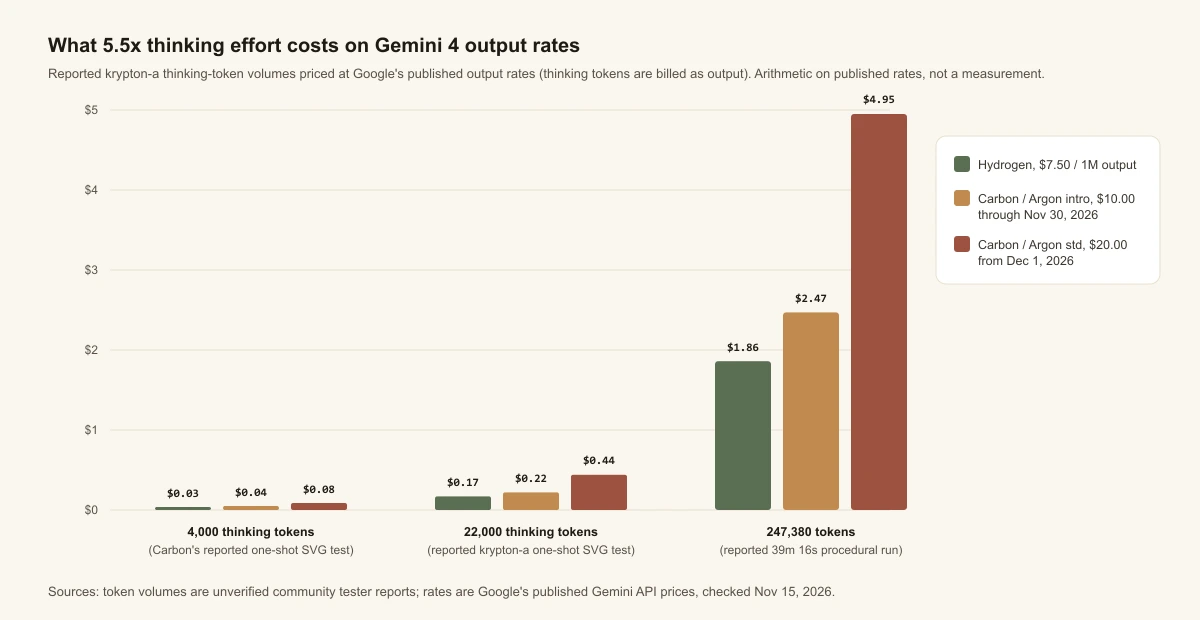
What the reported effort would cost at Google's confirmed rates
Thinking tokens are billed as output tokens on Google's pricing page. That makes the leak's two numbers directly priceable against the three confirmed models, and the arithmetic is ours, computed from Google's published rates, not a measurement: a 4,000-thinking-token turn costs about $0.04 on Carbon or Argon at the introductory rate and about $0.08 from December 1. A 22,000-thinking-token turn, the krypton-a report, costs about $0.22 introductory and about $0.44 from December 1. The 247,380-token procedural run costs about $1.86 on Hydrogen, $2.47 introductory, and $4.95 standard from December 1.
Read that column and the 5.5x thinking story lands differently: even the reported krypton-a effort costs under half a dollar per turn at Google's current rates. The leak, if it is real, describes a slower and more expensive way to work, not an unaffordable one. And a run priced at $4.95 of December-rate output is within reach of a single developer's budget, which is exactly why an unverified screenshot of a long generation cannot settle whether something new is running behind it.
For context on third-party access: CometAPI, the same source summarizing the leak, is also a proxy reseller that quotes $1.60 per 1M input tokens and $8.00 per 1M output tokens for its default group on Carbon and Argon, 20% below Google's introductory rates, and a $2.16 illustrative workload. A proxy's own pricing page is that company's price list, not Google's, and Google's pricing page is the only list that governs the API you would actually call.
What to do with an unconfirmed model name
If you build on Gemini today, the confirmed lineup already answers the practical questions, and our comparison of Carbon vs Hydrogen prices both against each other. If you are choosing an editor and agent to point these models at, our Claude Code and Cursor reviews and our Claude Code vs Cursor guide cover the layer the model names sit under. Krypton has no endpoint to call, no price to budget, and no date to plan around, so nothing in a build should depend on it yet.
The claims worth re-reading as this story matures: the model catalog's entry list, the pricing page's promotional deadline on November 30, 2026, and whether any Google announcement puts krypton on the record. Every figure here is either a Google published number with the date we checked it or a community report labeled as one, and the boundary between those two piles is the whole article.
Our methodology explains how sourcing on this site works, and Gemini Decision 1 covers the newest officially announced member of the family.