Google released Gemini 4 Neon on November 18, 2026, the fourth Gemini 4 model in seven weeks and the one positioned between Carbon and Hydrogen. It costs $3.00 per million input tokens and $15.00 per million output tokens, carries a 1M-token unified window, and on Google's own published table it wins one evaluation against its named comparators and loses another. Every figure below was read from Google's announcement, the DeepMind model card, the Gemini API pricing page, and Artificial Analysis' model page and article, on November 19, 2026.
What Neon is, in Google's own positioning
Neon is adapted from Gemini 4 Carbon, which is the sentence that explains the whole product. It is not a new architecture; it is Carbon's line with a different balance of depth and speed, slotted under Carbon for the hardest long-horizon work and above Hydrogen for everyday execution. Inputs are text, image, audio, video and PDF, the output is text, and the knowledge cutoff is March 2026.
The window has a wrinkle worth reading carefully, because it is easy to misquote. The model card describes a unified input and output window of up to 1M tokens, with up to 64K of default synchronous output and up to 1M through background long decode. That is one window shared by prompt and answer, not a 1M input window plus a separate output allowance, and a request that wants long output trades prompt space for it.
Thinking runs at four levels: low, medium, high and xhigh. Google's pricing page bills thinking tokens, which means the level you choose is a cost decision as much as a quality one, and the announcement's own framing says xhigh is for the hardest engineering, analytical and scientific workloads.
What it costs, tier by tier
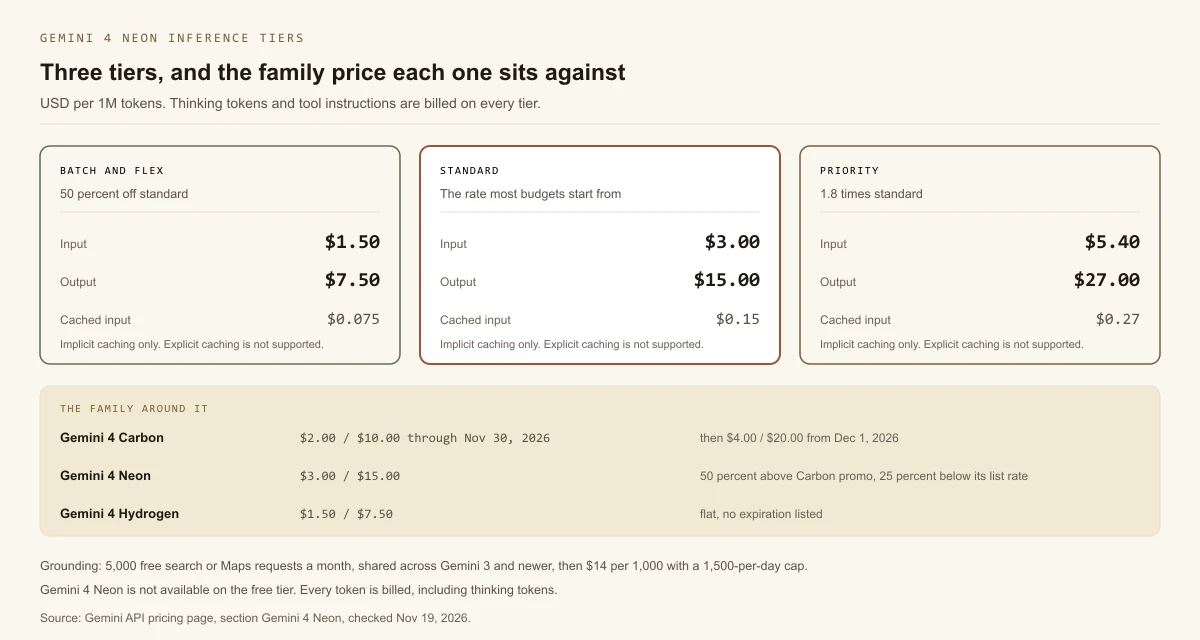
Standard is $3.00 and $15.00. Batch and Flex take 50 percent off, at $1.50 and $7.50. Priority costs 1.8 times standard, at $5.40 and $27.00. Cached input is $0.15 per million on the standard tier, a 95 percent discount, and caching is implicit only: explicit caching is not supported on this model at any tier, which rules out the manage-the-cache-yourself pattern some teams build around.
Three billing facts are easy to miss and expensive to miss. There is no free tier on the Gemini API, so evaluation costs money from the first call. Every token is billed, including thinking tokens and the internal tool system instructions and function declarations that grounding adds. And grounding with Google Search or Maps includes 5,000 free requests per month shared across Gemini 3 and newer models, then $14 per 1,000 requests, with a 1,500-per-day cap on Search grounding.
The price only makes sense next to its siblings. Carbon is $2.00 and $10.00 through November 30, 2026 and $4.00 and $20.00 from December 1. Neon's $3.00 and $15.00 sits 50 percent above Carbon's promotional rate and 25 percent below its standard rate. Hydrogen is $1.50 and $7.50 with no expiration listed.
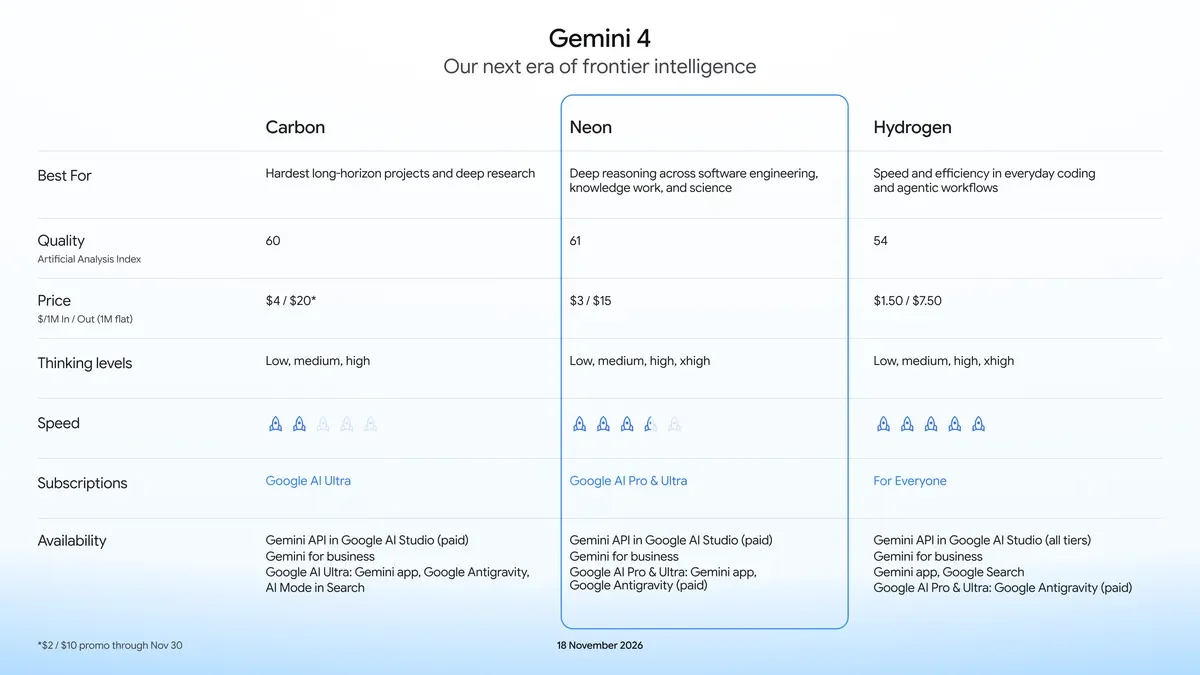
That placement is the buying decision in one line: Neon is the model you price against Carbon's December rate, not against Carbon's November rate. A team that benchmarks Neon against today's Carbon promotion and concludes Neon is expensive is comparing it to a discount that expires in twelve days.
What Google's own table shows
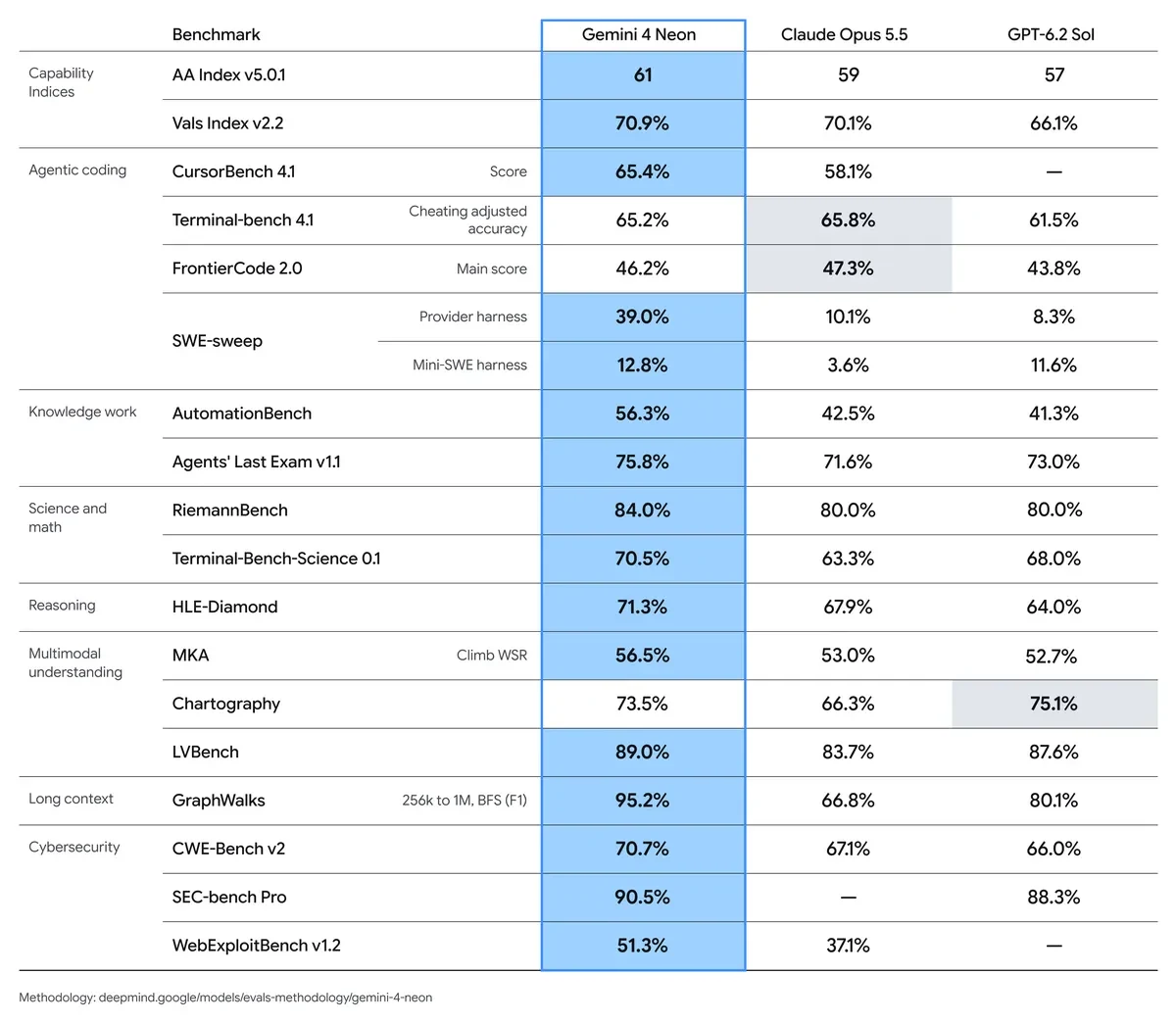
Google's model card runs nineteen evaluations against Claude Opus 5.5 and GPT-6.2 Sol, and Neon wins most of them. AutomationBench gives it 56.3 percent against 42.5 and 41.3, and Google describes that as first overall. GraphWalks, which measures retrieval across 256K to 1M tokens, gives it 95.2 percent against 66.8 and 80.1, the largest gap anywhere on the table. LVBench gives it 89.0, HLE-Diamond 71.3, RiemannBench 84.0, SEC-bench Pro 90.5 and WebExploitBench v1.2 51.3.
One row goes the other way and it is the one a page like this is tempted to drop: Chartography puts GPT-6.2 Sol at 75.1 percent against Neon's 73.5. That is a 1.6-point loss on reading dense charts, and it sits in a table Google itself published.
The coding rows are where the harness question shows up. CursorBench 4.1 gives Neon 65.4 percent against Opus 5.5's 58.1. Terminal-bench 4.1 goes the other way, 65.2 against 65.8. FrontierCode 2.0 gives Neon 46.2 at its high default against Opus 5.5's 47.3. SWE-sweep is the striking pair: 39.0 percent in Google's provider harness against Opus 5.5's 10.1, and 12.8 percent on the mini-SWE harness against 3.6. Those two harnesses disagree by a factor of three on the same model, which is the clearest evidence on the page that a score is a statement about a harness as much as about a model.
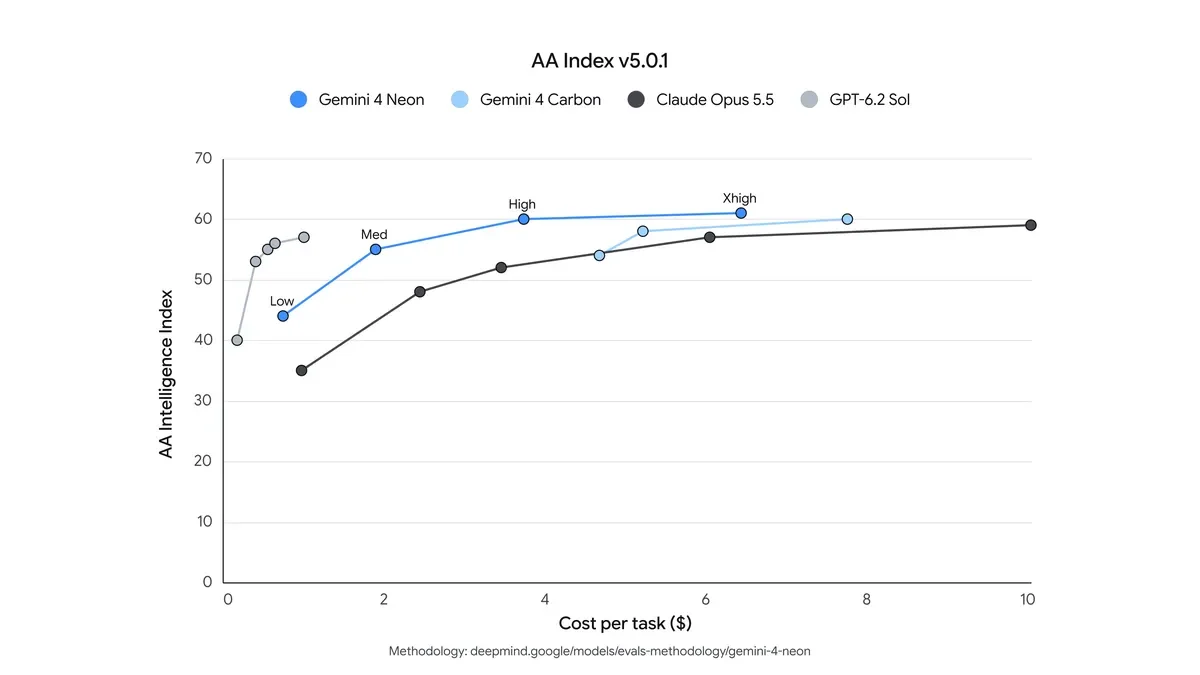
Google's own framing of the release is about cost against intelligence rather than raw score: it says Neon pairs a high index score with a 32 percent lower cost per task than Carbon at its default high level, and that at high it sits on the Pareto frontier of both the Vals index and the Agent Arena at roughly 50 to 80 percent lower cost per task than top competing frontier models.
What the independent instrument says
Artificial Analysis scores Neon at 61 on Intelligence Index v5.0.1 at Xhigh effort, which was third overall on launch day behind GPT-6.2 Astra and Claude Fable 5.2 and one point ahead of Carbon at 60. By November 19, with more effort configurations ranked, its model page shows sixth of 96.
It costs $6.44 per index task against Carbon's $7.76 at non-discounted pricing, about 17 percent lower despite generating roughly 15 percent more output tokens, and the whole of that saving comes from the 25 percent lower token price. It takes 21.5 minutes per task, roughly 21 against Carbon's 36, and runs at 110 output tokens per second against Carbon's 57. Time to first answer token is 56.51 seconds. Across the index it generated 283 million output tokens, which is verbose against a median model's 65.1 million.
The agent numbers are the most commercially relevant and the most easily misread. Neon at Xhigh in Antigravity CLI scores 59 on the Coding Agent Index at $6.86 per task. Claude Fable 5.2 at Xhigh in Claude Code scores 58, and Opus 5.5 at Max scores 58, both at more than twice Neon's cost per task. Google's announcement states its own figure as 58.6 and ranks it first overall. Both statements are true as stated and neither is a comparison of models on equal scaffolding: three models, three harnesses, and the article you read determines which one is called the leader.
Beyond the index, Artificial Analysis reports 33.4 percent for Neon at high on GDP.pdf against Carbon's 28.4, and 1700 Elo overall on AA-Briefcase with 1771 Elo on presentation quality, 45 points ahead of the previous leader.
Where it wins, and where it does not
Neon wins on long context by a margin nothing else on its table approaches: 95.2 percent on GraphWalks from 256K to 1M tokens, where the two comparators score 66.8 and 80.1. If your work is retrieving a fact from a million tokens, that row is the reason to pick it, and the price is the reason you can afford to.
It wins on business workflow evaluations, on cost per task against Carbon, and on output speed against Carbon. It wins on cyber benchmarks at surprisingly high absolute levels for a mid-tier model, with 90.5 percent on SEC-bench Pro, and Google is rolling out a cyber variant under its Fairwind Program to trusted defenders.
It does not win on chart reading, where GPT-6.2 Sol leads it by 1.6 points. It does not win on the top of the intelligence index, where Fable 5.2 is four points ahead. And it does not win on caching flexibility, because it has no explicit caching at all.
Who this is not for
Neon is not for a team that needs explicit cache control, because the model does not offer it. It is not for a team with no budget for evaluation, because there is no free tier. It is not for the single turn that must be right at any cost, because at four index points behind the leader that turn belongs on the more expensive model.
It is for daily coding loops where its cost per agent task against the frontier pair changes what you can afford to automate. It is for long-context retrieval where the 95.2 percent GraphWalks row is the whole product. And it is for the cost-capped agent fleet where the per-task price is the constraint rather than the ceiling.
Our AI coding category tracks the tools these models power, the Gemini profile carries the sourced figures for the family, and the Claude vs Gemini comparison prices the competing frontier pair. The Gemini 4 Carbon vs Hydrogen analysis covers the two models Neon was slotted between, and Claude Fable 5.2 vs Gemini 4 Neon puts this model against Anthropic's flagship on one independent instrument. The Claude Fable 5.2 analysis is the standalone read on that flagship, and the GPT-6.2 Astra vs Sol analysis is the same buying question for OpenAI's pair.