Two frontier models, released nine days apart, priced a factor of 2.67 apart per token and measured on one independent instrument. Claude Fable 5.2 scores 65 on Artificial Analysis' Intelligence Index and costs $26.54 per task; Gemini 4 Neon scores 61 and costs $6.44. Four index points separate them, and 4.1 times the cost does too. Every figure here was read from the two vendors' own documents and from Artificial Analysis, on November 19, 2026.
The headline comparison, and why it is not the whole story
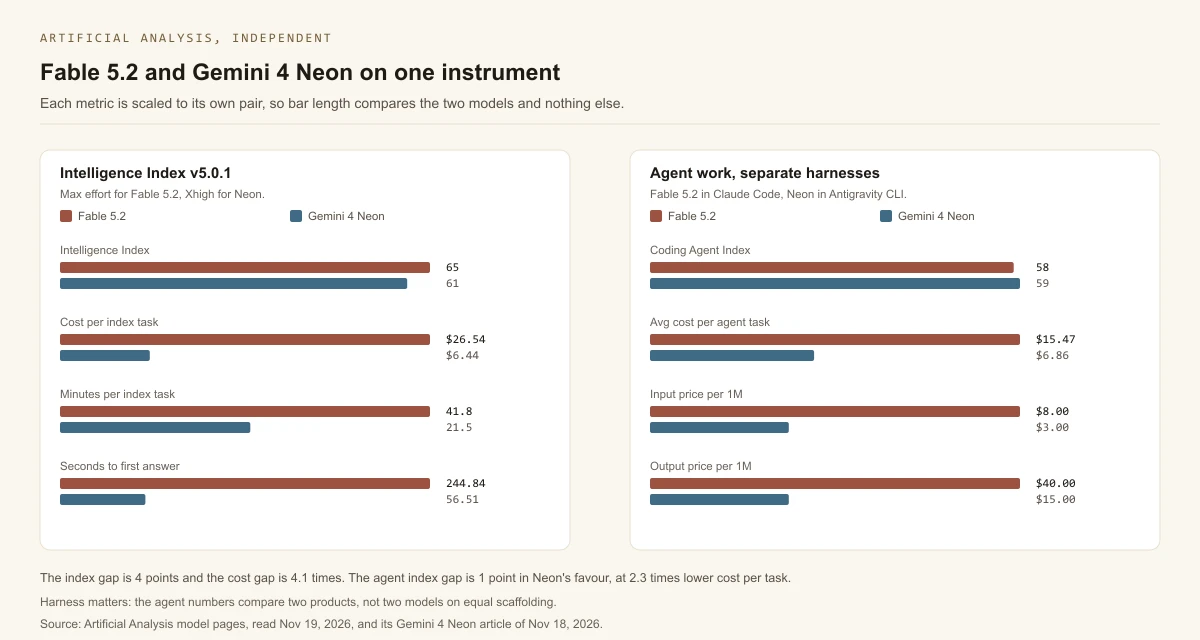
On the index, the gap is four points. On cost per task it is 4.1 times, and on time per task it is 41.8 minutes against 21.5. Time to first answer token is 244.84 seconds against 56.51, which is the number that decides whether a model can sit inside an interactive loop at all.
Those four numbers are the same instrument, the same suite, and the same published methodology, which is what makes them comparable in a way that two vendors' tables are not. What they are not is a statement about your workload: a nine-evaluation index measures the models, and the honest use of it is to run the two prompts you actually care about before moving a budget.
One more pair belongs beside them because it changes the shape of the answer. Across the index, Fable 5.2 generated 275 million output tokens and Neon generated 283 million, against a median model's 65.1 million. Both are extraordinarily verbose on this suite, so the cost gap is not a difference in verbosity; it is the token price.
The wordmark on the price is not the whole price
$8.00 and $40.00 against $3.00 and $15.00 is a ratio of 2.67 on both directions, and it is the number most comparisons stop at. It is not the number that decides a bill.
Fable 5.2's cache read is $0.20 per million, a 97.5 percent discount on its $8.00 input, and its Batch API takes 50 percent off both directions. Neon's cached input is $0.15 and its Batch and Flex tiers take 50 percent off. A workload with a stable prompt prefix and a batch-shaped schedule compresses both prices hard, and it compresses Fable's harder in absolute dollars because its starting point is higher.
Neon carries two structural limits worth naming in the same breath. There is no free tier, so every evaluation costs money from the first call, and explicit caching is not supported at any tier, so the manage-the-cache-yourself pattern is unavailable. Fable 5.2 carries a different structural limit: 30-day data retention is required, and zero data retention is not available without express authorization from Anthropic.
Where both vendors published a number for the same test
Five evaluations appear in both publishers' material with a figure for each model. They are charted together here because they are the only rows where a comparison does not require trusting one vendor's choice of comparator.
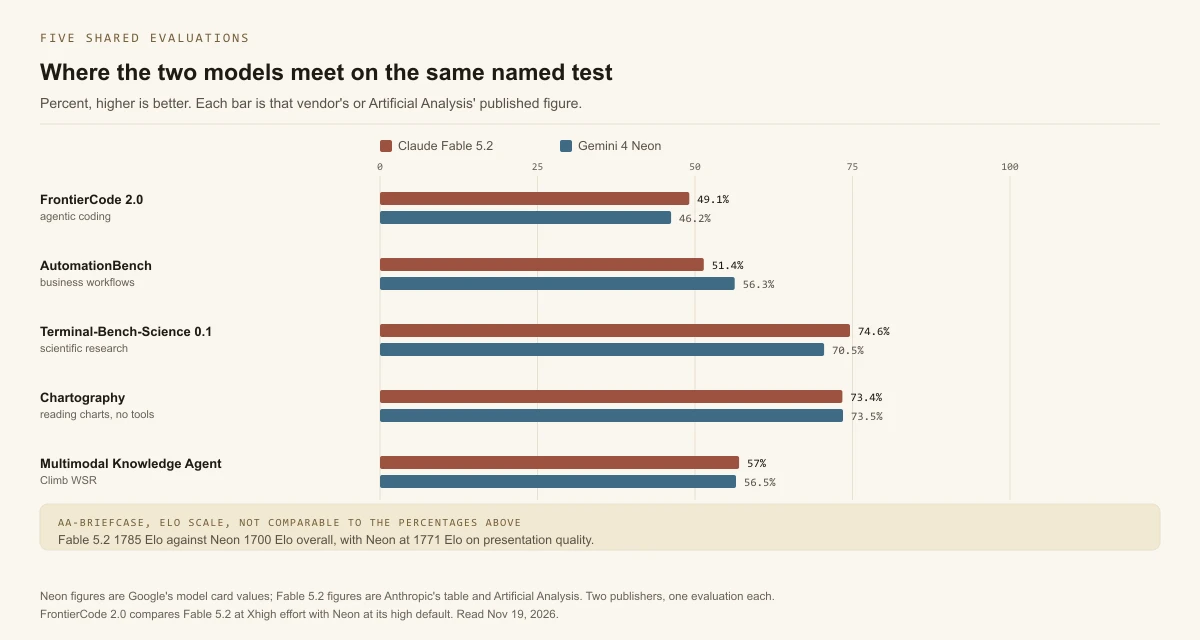
Fable 5.2 leads three of the five. FrontierCode 2.0 gives it 49.1 percent at Xhigh against Neon's 46.2 at its default high setting. Terminal-Bench-Science 0.1 gives it 74.6 against 70.5. Multimodal Knowledge Agent gives it 57 percent as reported by Artificial Analysis against Neon's 56.5.
Neon leads two. AutomationBench gives it 56.3 percent against 51.4, a 4.9-point gap that is the largest in either direction on this set. And Chartography separates them by a tenth of a point, 73.5 against 73.4, which is not a difference anybody should route work on.
The AA-Briefcase pair belongs on the page but not on that percentage scale: 1785 Elo for Fable 5.2 against 1700 for Neon overall, with Neon at 1771 on presentation quality. An Elo number and a percentage do not share a unit, and putting them on one axis is the kind of chart that looks rigorous and means nothing.
Two cautions apply to every row. First, effort levels differ between the publishers' settings, and the chart's footnote says which. Second, FrontierCode 2.0 measures whether code changes would be merged, so a model running in a stronger agent harness gets some of the credit for the harness rather than for itself.
The harness problem, which is where most comparisons go wrong
Both vendors publish an Artificial Analysis Coding Agent Index number, and the three scores are 58, 58 and 59.
Fable 5.2 at Xhigh in Claude Code scores 58 at $15.47 per task. Claude Opus 5.5 at Max scores 58 at $12.61. Gemini 4 Neon at Xhigh in Antigravity CLI scores 59 at $6.86. Google's announcement states its own figure as 58.6 and calls it first overall.
Three models, three harnesses, three prices, and a one-point spread. Any sentence that reads "Neon beats Fable 5.2 on coding agents" is true as written and misleading as understood, because the comparison is of two products rather than two models on equal scaffolding. The price column is the part that survives the caveat: $6.86 against $15.47 is a real difference measured on the same suite, and it is measured inside each vendor's own harness, which is how a customer would actually run it.
Where each one earns the difference
Fable 5.2 earns it on the turns where being right matters more than being cheap. OSWorld 2.1 gives it 89.3 percent on computer use, and the four-point index lead is concentrated in the evaluations Anthropic charts as agentic coding, science and multidisciplinary reasoning. Its own documentation recommends starting on the cheaper Opus 5.5 and escalating, which is a vendor telling you where its flagship is not worth the money.
Neon earns it on volume, on long context and on cost-shaped autonomy. GraphWalks gives it 95.2 percent from 256K to 1M tokens where the nearest comparator scores 80.1, its AutomationBench lead is 4.9 points, and $6.86 per agent task against $15.47 changes how many tasks a budget can afford to run unattended.
Who should not pick either one
If the workload is daily coding on a budget, neither of these is the right first answer: Anthropic recommends Opus 5.5 and Google positions Neon itself as the value slot inside a family that also sells Carbon and Hydrogen. The honest comparison for a volume buyer is Fable 5.2 against Opus 5.5, and Neon against Carbon's December rate rather than its November promotion.
If the workload requires zero data retention, Fable 5.2 is out until Anthropic authorizes an exception. If it requires explicit cache control, Neon is out at every tier.
Our AI coding category tracks the editors and agents both models plug into, the Claude and Gemini profiles carry the sourced figures for each family, and the Claude vs Gemini comparison prices the older frontier pair. The standalone reads are Claude Fable 5.2 and Gemini 4 Neon, the Gemini 4 Carbon vs Hydrogen analysis covers the two models Neon was slotted between, and the GPT-6.2 Astra vs Sol analysis runs the same buying question against OpenAI's pair.