Anthropic released Claude Fable 5.2 on November 9, 2026, and the most useful sentence in its own documentation is not about the model. It is the routing advice: start most coding and knowledge work on Claude Opus 5.5, then move up to Fable 5.2 when the task earns it. Every figure below was read from Anthropic's model docs, its pricing docs and its announcement, and from Artificial Analysis' independent suite, on November 19, 2026.
What Anthropic shipped, and what the cheaper sibling buys you
Fable 5.2 is the sixth-generation flagship for demanding reasoning and long-horizon agentic work, with a 1M-token context window and 128K tokens of output. It accepts text and images and returns text. Its training data and reliable knowledge cutoff both read June 2026, and Anthropic commits to keeping it available no sooner than November 9, 2027.
The sibling is the part most readers skip. Claude Mythos 5.2 is the same underlying model at the same price, and the difference is a gate rather than a capability: Fable ships to every account with cybersecurity and biology safeguards attached, while Mythos is limited to organizations verified through Anthropic's Life Sciences and Cyber Verification Programs. If your work is offensive security or protein design and you are not in one of those programs, the model you can buy is Fable, and its safeguards are the reason the scores on cyber evaluations are published twice.
The price went down, and the ladder around it matters more
Fable 5.2 bills $8 per million input tokens and $40 per million output tokens. That is 20 percent under Fable 5.1's $10 and $50, and the discount repeats on every row of the cache ladder: $10 per million for a five-minute cache write against $12.50, $16 for a one-hour write against $20, and $0.20 per million for a cache read against $0.25.
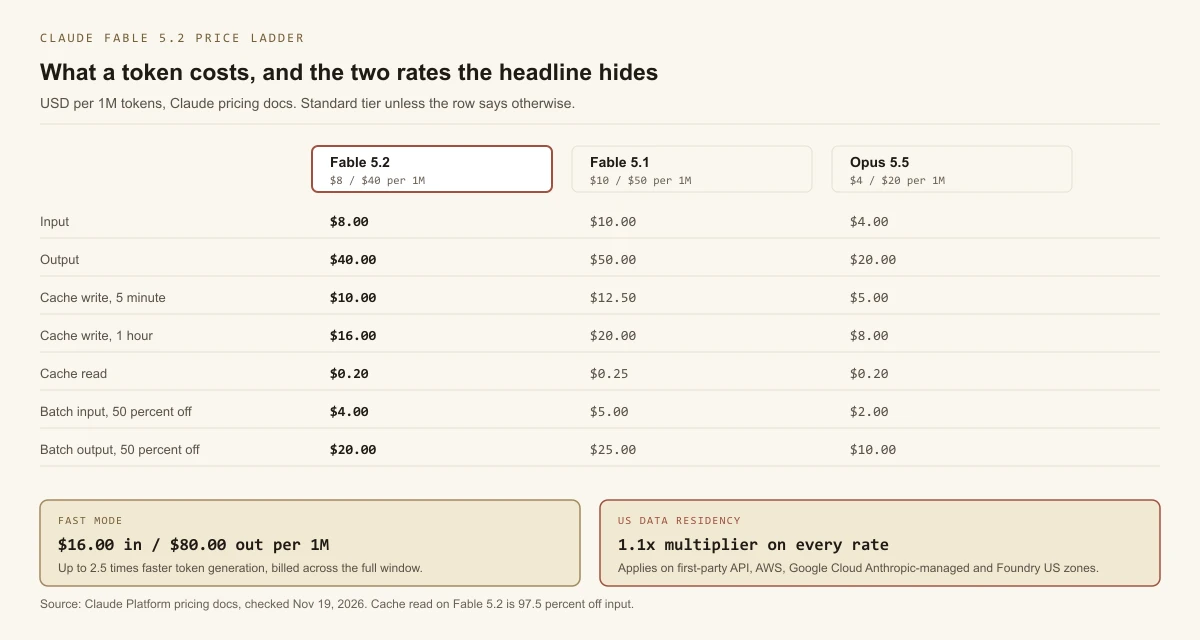
Three rows decide real bills more than the headline does. First, a cache read is 97.5 percent off the input rate, so a workload that keeps its prompt prefix stable pays $0.20 / MTok rather than $8 / MTok for every cached million tokens, and that is where the routing advice stops being a cost story and becomes an architecture story. Second, the Batch API takes 50 percent off both directions, which puts batch work at $4.00 input and $20.00 output per million, the same rates Opus 5.5 charges interactively. Third, Fast mode bills $16 input and $80 output per million for up to 2.5 times faster token generation, and it applies across the full context window rather than only below some threshold.
One more multiplier has no row of its own: sending inference to a US-only geography costs 1.1 times the listed rate on the first-party API, Claude Platform on AWS, Google Cloud's Anthropic-managed model and Microsoft Foundry's US Data Zone Standard. A budget that assumes global routing will be 10 percent light the moment a compliance requirement pins the region.
The comparison that matters commercially is against Opus 5.5, which bills $4 and $20 with a default effort of medium, and against Sonnet 5.5 at $2 and $10 and Haiku 5.5 from $0.10 and $0.50. Fable 5.2 is twice Opus 5.5 on input and twice on output. Anthropic's own benchmark prose is unusually direct about what that buys: at High effort Fable 5.2 scores about level with Opus 5.5 at Max effort for roughly half the cost per task. Read that sentence twice, because it says the cheaper model at its highest setting is the expensive model's competitor on that evaluation, and the expensive model's advantage shows up only at its own highest setting.
What Anthropic's own benchmark table shows
Anthropic published a table of eleven evaluations comparing Fable 5.2 with Fable 5.1, Opus 5.5, GPT-6 Astra and Gemini 4 Carbon. Six of them carry a comparator figure for all five models, and those are the six charted here.
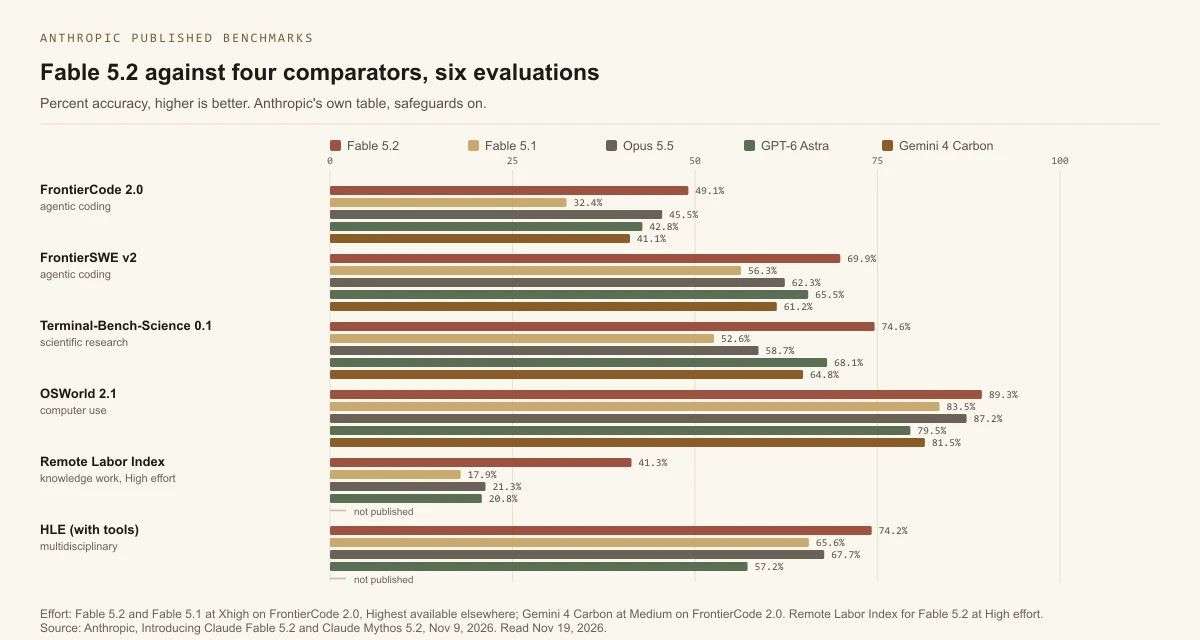
Fable 5.2 leads five of the six. FrontierCode 2.0, which measures whether a model's code changes would be merged by open-source maintainers, gives it 49.1 percent at Xhigh effort against Opus 5.5's 45.5 and Gemini 4 Carbon's 41.1 at Medium. FrontierSWE v2 gives it 69.9 percent against GPT-6 Astra's 65.5, the closest any comparator comes. Terminal-Bench-Science 0.1 gives it 74.6 percent, OSWorld 2.1 gives it 89.3, and Humanity's Last Exam with tools gives it 74.2.
The one row where it does not lead is AutomationBench, where Gemini 4 Carbon scores 53.9 percent against Fable's 51.4. That is worth stating plainly rather than burying: Google's model wins the business-workflow evaluation in Anthropic's own table, by 2.5 points, and any page that charts this table and omits that row is telling a story rather than reporting one.
Two evaluations published elsewhere in the same announcement deserve a line each. The Remote Labor Index puts Fable 5.2 at 41.3 percent at High effort against Opus 5.5's 21.3, and Humanity's Last Exam at Low effort matches Opus 5.5's top score for less than a tenth of the cost per task. Chartography, which tests reading a chart rather than generating one, puts Fable at 73.4 percent at its highest effort and 66.4 at Medium, still ahead of Opus 5.5 at Max.
The operational claims in the announcement are the ones a buyer cannot verify from a table, and they are attributed as Anthropic's own. It says a team of agents running an earlier version migrated a critical production service from Python to Rust, that over 90 percent of changes merged into Anthropic's core codebase are now written by Claude with human guidance, and that one engineer asked Fable 5.2 to design a prototype operating system from an empty folder, which it did by coordinating over 1,000 subagents across eight days. None of that is a benchmark, and this site has not reproduced any of it.
What an independent instrument says, which is harsher
Artificial Analysis runs a nine-evaluation index and prices every run, and its numbers are less flattering than the vendor's table.
Fable 5.2 scores 65 on Intelligence Index v5.0.1, first of 96 models, against a suite median of 43. It also costs $26.54 per index task, which is last of the 95 models its page ranks on cost, and takes 41.8 minutes per task, against a median of 12.1 minutes. Time to first answer token is 244.84 seconds and output speed is 109 tokens per second. Across the index it generated 275 million output tokens where the median model generates 65.1 million.
That combination is the honest shape of the model: the highest score on the suite, and the most expensive, slowest and most verbose way to get it. On the separate Coding Agent Index, run through Claude Code at Xhigh effort, it scores 58 at an average of $15.47 per task, one point behind Gemini 4 Neon's 59 on a different harness, at under half the cost per task. Which harness a number came from is not a footnote here; it is the difference between two of the numbers this article puts side by side.
The three API rules that break a working integration
None of these is a preference, and an existing Fable 5.1 integration can hit all three on the first call.
Adaptive thinking is always on and cannot be turned off. The effort parameter is the only control, and the default is high. A client that relied on disabling thinking now pays for reasoning on every request whether or not it wanted any. Forced tool use returns a 400 error when tool_choice is any or names a specific tool, so an agent that pinned a tool must let the model choose instead. And temperature, top_p and top_k must be omitted: supplying any of them returns a 400.
There is a fourth rule that is not an error but a procurement decision: Fable 5.2 requires 30-day data retention and is not available under zero data retention unless Anthropic expressly authorizes it. A team that selected a model on a zero-retention promise has to re-open that question before switching, and it is cheaper to discover that in a design review than in an audit.
Who this is not for
Fable 5.2 is not for high-volume agent loops. Twice Opus 5.5's rate on both directions, with 275 million tokens of verbosity on the index, produces a bill that a four-point index gain does not amortize across thousands of daily calls. Anthropic says so itself in the announcement, which recommends starting on Opus 5.5.
It is also not for anyone who needs zero data retention, or a temperature setting, or a pinned tool call, without an exception from Anthropic.
It is for the turn that decides the architecture, the cross-file investigation where a wrong answer costs more than the tokens, the security review where the finding has to be exploitable rather than plausible, and the long-horizon research task where 89.3 percent on computer use against 79.5 for the nearest competitor is the whole point.
Our AI coding category tracks the editors and agents these models plug into, the Claude profile carries the sourced figures for the model family itself, the Claude vs Gemini comparison prices the competing frontier pair, and the Claude Code vs Cursor guide covers the layer where model choice meets editor choice. The GPT-6.2 Astra vs Sol analysis is the same buying question for OpenAI's pair, and Claude Fable 5.2 vs Gemini 4 Neon runs this model against Google's newest on one independent instrument. If the Gemini side is the one you are pricing, Gemini 4 Neon carries its own rates and its own table.